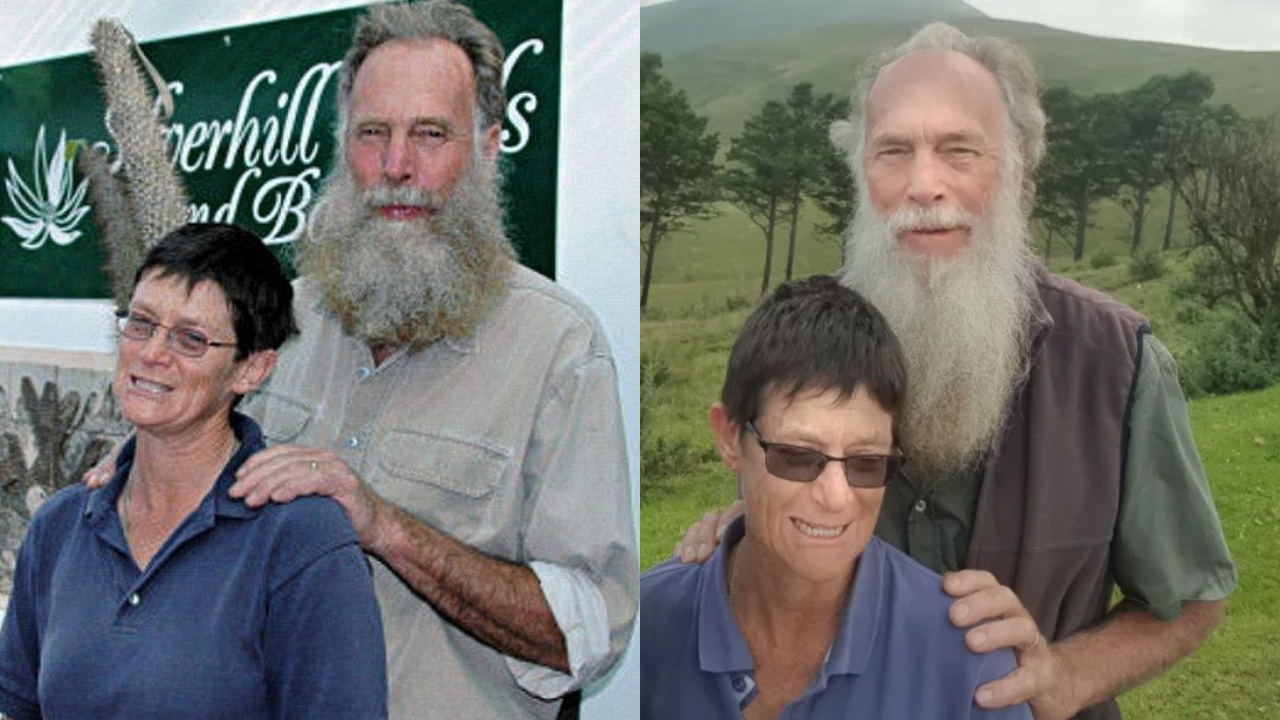
Rod Saunders knew the exact weight of a rare cycad seed in the palm of his hand. To the untrained eye, it looked like a withered brown nut, something to be cleared away from a garden path. To Rod and his wife, Rachel, it was a biological masterpiece. For over three decades, the British-South African couple traversed the wildest, most unforgiving terrains of Southern Africa, not for gold or glory, but to document and preserve the region’s vanishing flora. They lived out of a modified Toyota Land Cruiser, their days measured by the tilt of the sun and the rich scent of damp earth.
They were scientists, but more than that, they were curators of the planet’s memory.
In February 2018, their world collided with an unimaginable darkness. They had just finished filming a segment for a BBC nature documentary in the Drakensberg mountains, a place of towering green peaks and ancient echoes. They set off toward the Ngoye Forest, a rare, dense patch of indigenous woodland known for holding secrets found nowhere else on earth.
They never arrived.
Instead of a triumphant return with bags of carefully labeled seeds, their story devolved into a nightmare of greed, extremism, and profound loss. The facts of the court case that eventually concluded in South Africa outline a brutal robbery and murder by individuals linked to ISIS. But the dry legal ledgers miss the real tragedy. They miss the sheer, baffling asymmetry of the crime: two lives spent building a legacy of natural preservation, extinguished for a handful of plastic cards and a spending spree.
The Anatomy of an Ambush
Imagine spending your life learning to read the subtle language of the bush, knowing which rustle in the grass is a bird and which is a predator, only to be blindsided by human malice.
The suspects—Sayefundeen Aslam Del Vecchio, his wife Fatima Patel, and their lodger Ahmad Mussa—had established a radicalized cell in the KwaZulu-Natal region. They weren't looking for a debate on botany. They were looking for funds to finance a Jihadist dream. When they crossed paths with the elderly couple near the forest, they didn't see two brilliant minds dedicated to the African soil. They saw an opportunity.
The details that emerged during the trial at the Durban High Court are difficult to stomach. Rod and Rachel were ambushed, beaten, and stuffed into the back of their own vehicle. Their bodies, broken and lifeless, were later thrown into the Tugela River. It is a river known for its strong currents and its native inhabitants. Crocodiles.
By the time fishermen pulled the remains from the water days later, the bodies were so badly decomposed and scavenged that they were unrecognizable. For months, they remained in a local mortuary as unidentified victims, while across the country, a frantic search for the missing botanists yielded nothing but empty roads and silent cell towers.
The contrast is suffocating. On one hand, you have a couple whose entire existence was predicated on patience, growth, and the slow, beautiful cycle of nature. On the other, a sudden, violent eruption of human cruelty that views life as entirely disposable.
The Digital Ghost of a Lifetime's Work
What does a stolen life look like in the modern age? It looks like a notification on a bank app.
While Rod and Rachel’s bodies were lost in the muddy waters of the Tugela, their killers were busy turning their victims' life savings into material goods. The trio did not flee into hiding. They did not lay low. Instead, they went shopping.
Over the course of several days, the killers spent roughly £37,000 (around 740,000 South African Rand) using the Saunders' stolen credit and debit cards. They bought electronics. They bought jewelry. They bought everyday items, treating the wealth accumulated through decades of hard, honest work as an ATM for their extremist cell.
This is where the true horror of the crime shifts from physical violence to a chilling psychological reality. The killers were walking through bright, air-conditioned shopping malls, swiping cards and signing receipts, while the people who earned that money were floating in a river miles away. The disconnect is total. It reveals a complete hollowed-out lack of empathy, a mindset where another human being is merely an obstacle between a consumer and a cash register.
The police eventually tracked the killers through this digital breadcrumb trail. Bank records led to cell phone towers; cell phone towers led to text messages. When authorities raided the suspects' homestead, they found ISIS flags, radical literature, and microscopic traces of Rachel Saunders’ blood on the carpets of their own Toyota Land Cruiser. The physical evidence was undeniable, but the emotional wreckage was already done.
The Invisible Stakes of a Forgotten Forest
It is easy to look at this story as a tragic piece of true crime, a wrong-place-at-the-wrong-time narrative that could happen anywhere. But that ignores the deeper loss.
When you kill a botanist, you don't just end a life; you burn a library.
Rod and Rachel possessed a hyper-localized, experiential knowledge of the African wilderness that cannot be taught in a university lecture hall. They knew exactly which hillside harbored the last remaining population of a critically endangered gladiolus. They knew how to coax a dormant seed into life after years of drought. Their business, Silverhill Seeds, supplied nurseries, researchers, and conservationists all over the globe with indigenous seeds that kept entire plant lineages alive.
Consider the Ngoye Forest itself. It is a remnant of an ancient woodland that once covered vast swaths of the continent. It is home to the Ngoye Centipede, a creature found nowhere else on earth, and the rare Woodward’s Barbet. It is a place of fragile ecological balance. The Saunders went there to protect that balance. Their killers used it as a hunting ground.
The trial eventually brought a semblance of justice. The trio was convicted of murder, robbery, and kidnapping, receiving lengthy prison sentences that ensure they will spend decades behind bars. The judge spoke of the heinous nature of the crime, the betrayal of hospitality, and the terroristic undertones that fueled the act. The legal system did what it was designed to do. It punished the guilty.
But the courtroom cannot replant a forest. It cannot return the decades of accumulated wisdom that vanished when those two hearts stopped beating.
The Seeds That Remain
The true legacy of Rod and Rachel Saunders does not reside in the grim transcripts of a Durban courthouse, nor does it belong in the headlines that focus on the killers' spending sprees.
Their legacy lives on in the dirt.
Somewhere in a greenhouse in Europe, a rare South African cycad is stretching its green fronds toward a glass ceiling. In a garden in Australia, an indigenous African lily is blooming in defiance of the winter chill. These plants exist because two people loved the earth enough to spend their twilight years sleeping in the back of a truck, waking up early to catch the morning dew on a leaf.
The killers took their lives, their money, and their dignity. They tried to erase them in the depths of a river. But you cannot truly erase people who spent their lives scattering seeds. The ideas they planted, the species they saved, and the love they had for the natural world are far more resilient than the hatred that took them away.
The next time you walk through a garden and see a plant that looks entirely foreign, completely unique, and breathtakingly complex, look closer. Consider the hands that might have gathered its ancestors from a distant, dangerous ridge. The world is a fragile place, kept alive not by those who destroy, but by those who are willing to look at a tiny, withered seed and see the future.