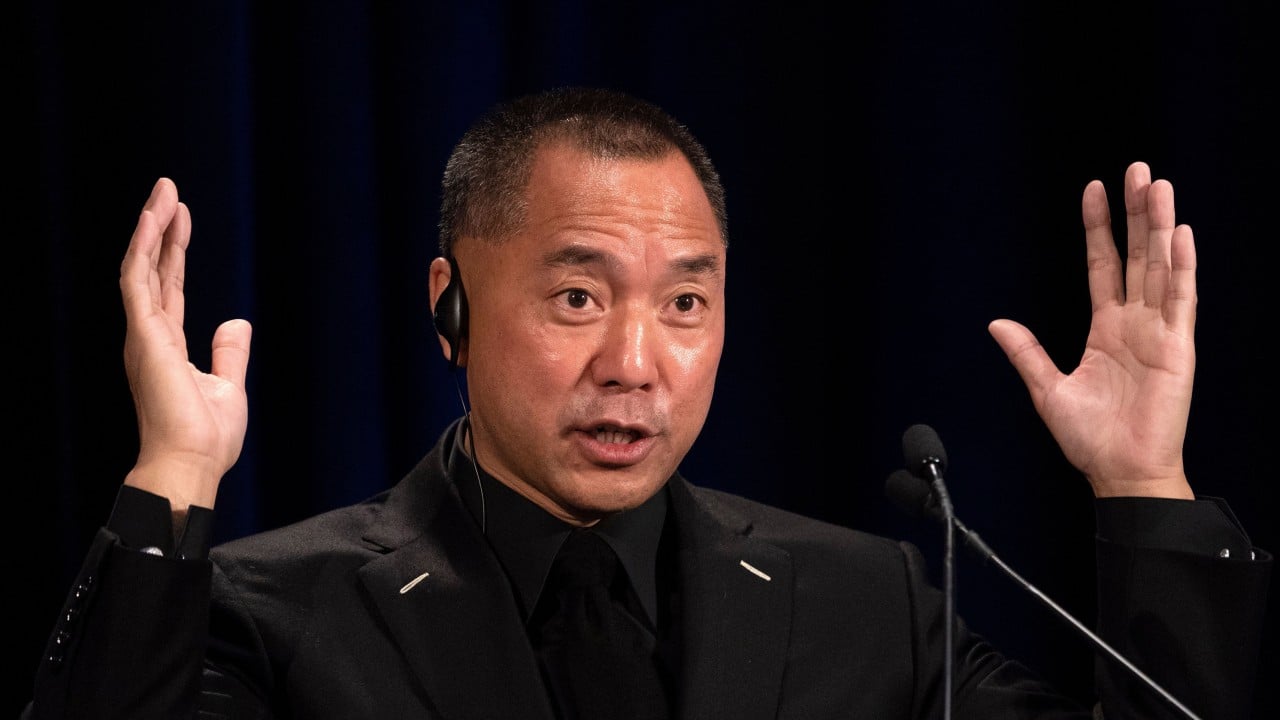
The screen glowed in the dark of a modest apartment in Queens. It was 2 a.m. For Lin, an immigrant who had spent a decade washing dishes and cutting hair in New York, the voice coming through the speaker was not just entertainment. It was adrenaline. It was hope. On the screen, a man in an impeccably tailored Brioni suit sat on the deck of a mega-yacht, the Manhattan skyline glittering behind him.
The man was Miles Guo. To his millions of online followers, he was a billionaire dissident, a heroic exile who had escaped the clutches of the Chinese Communist Party, and the only one brave enough to tear it down. He spoke with the absolute certainty of a prophet. He told them he had a plan. He told them they could get rich while changing history. For a deeper dive into similar topics, we suggest: this related article.
Lin believed him. Thousands like him did. They sent their hard-earned dollars into a web of digital entities, shell companies, and cryptocurrency schemes, thinking they were buying a piece of a new world.
Instead, they bought a billionaire a custom mattress. They bought him a $4.4 million Bugatti. They bought his son a luxury yacht. To get more background on this issue, detailed coverage can be read at Associated Press.
The illusion finally evaporated in a Manhattan federal courtroom. A judge handed down a thirty-year prison sentence to the man who had styled himself as a freedom fighter. It was the final chapter in a colossal $1 billion fraud engine that chewed through the trust of everyday people who wanted nothing more than something to believe in.
The Architecture of a Golden Cage
To understand how a man could convince ordinary working-class families to part with their life savings, you have to understand the power of a specific kind of hunger. Isolation creates vulnerability. For many in the Chinese diaspora, navigating a new country while watching their homeland from afar creates a deep, aching desire for community and resistance.
Guo knew exactly how to exploit that ache.
He did not look like a con man. He looked like success incarnate. He filled his broadcasts with grand declarations, mixing high-level geopolitical gossip with promises of immense wealth. He created his own alternative reality, complete with a self-proclaimed shadow government called the New Federal State of China.
He offered his followers an ecosystem of exclusive opportunities. There was GTV Media Group. There was the Himalaya Farm Alliance. There was a digital currency called G-Clubs. To the untrained eye, it looked like a parallel society rising to challenge an empire. To federal prosecutors, it was a textbook affinity fraud.
Consider how the mechanism worked. A follower would watch a livestream where Guo insisted that standard banks were unsafe and controlled by the regime. He presented his own platforms as financial sanctuaries. The pitch was brilliant because it weaponized fear and patriotism simultaneously. If you invested, you were a patriot. If you doubted him, you were a spy.
The psychology of the trap was absolute. People did not just invest money; they invested their identities. Once you have publicly declared your allegiance to a movement, admitting you were fooled becomes a form of psychological death. So, they kept sending money.
Where the Billions Went
While his followers were cutting back on groceries to buy digital tokens, the money was moving through a labyrinth of international bank accounts. It did not go toward funding a revolution. It went toward an obsession with hyper-luxury that borders on the surreal.
The numbers are difficult to comprehend until you break them down into the sheer physical objects they purchased.
Federal investigators tracked millions flowing directly into a life of staggering decadence. There was a $26 million mansion in New Jersey, a sprawling estate meant to serve as an island of ultimate privacy. There were the two $36,000 mattresses, custom-made for a comfort that regular citizens will never know. There were high-end rugs, exotic sports cars, and a $100,000 television set.
The most striking symbol of this betrayal was the yacht. Named the Lady May, it was a 150-foot vessel where Guo frequently filmed his videos, urging his followers to sacrifice for the cause while the sea breeze ruffled his hair. The yacht itself became a character in the drama, a floating stage where geopolitical theater met financial predation.
The disconnect was total. In one world, a retired accountant in California was sending fifty thousand dollars—her entire retirement cushion—into a Guo-linked entity. In the other world, that exact sum was being spent to detail the interior of a sports car or maintain the hull of a luxury boat.
The Morning the Mirrors Smashed
The end did not come with a bang, but with the heavy thud of federal agents knocking on a door at the Sherry-Netherland hotel on Fifth Avenue.
It was March 2023. The raid itself took on a bizarre, almost cinematic quality. As agents combed through the multi-million-dollar penthouse, a fire mysteriously broke out in the apartment, forcing an evacuation and adding a literal cloud of smoke to the metaphorical one that had surrounded Guo for years.
The trial that followed was a masterclass in stripping away an illusion.
For weeks, prosecutors laid out the spreadsheets, the wire transfers, and the testimonies of victims who had lost everything. Guo’s defense team tried to paint him as an eccentric political target whose operations were disorganized but not criminal. They argued his intentions were purely focused on his anti-regime movement.
The jury saw through the smoke. They saw a man who used political theater as a shield to pick the pockets of the vulnerable.
During the sentencing phase, the emotional weight of the crime filled the courtroom. This was not a victimless white-collar crime where faceless corporations lost money on a bad bet. These were individuals. Families. People who had looked at Guo and seen a savior, only to find themselves facing financial ruin.
The judge’s decision was uncompromising. Thirty years. At Guo’s age, it is effectively a life sentence. The court also ordered massive forfeitures and restitution, a legal attempt to claw back the fragments of wealth scattered across the globe and return them to the people who actually earned them.
The Lessons Left in the Wreckage
It is easy to look at a story like this from a distance and wonder how people could be so blind. That is the wrong lesson to take away.
Sophisticated fraud works because it relies on truths we want to believe. Guo did not invent the geopolitical tensions he spoke about. He did not invent the genuine pain and longing of exile. He simply took those real, raw human emotions and built a casino around them.
The internet has democratized influence, allowing anyone with a smartphone and a compelling story to build a digital cult of personality. When charisma is paired with financial technology, the potential for harm scales at a terrifying speed.
For the victims, the money is likely gone forever, converted into depreciating luxury assets and swallowed by legal fees. But the financial loss is only part of the injury. The deeper wound is the cynicism left behind. When a community realizes its champion was actually its captor, the capacity to trust anything or anyone else breaks down.
The Sherry-Netherland penthouse stands empty now, its gilded mirrors reflecting nothing but the quiet passing of traffic below. The yacht is tied to a pier, a depreciating asset waiting for an auction block. The man who once commanded the attention of millions sits in a concrete cell, stripped of his suits, his cigars, and his audience.
The revolution he sold was a ghost. The devastation he left behind is entirely real.