The sea does not care about geopolitics. It rises anyway. It eats the foundations of concrete seawalls in Tarawa. It spills over the doorsteps of homes in Tuvalu during the king tides, turning living rooms into knee-deep saltwater basins.
To live in the Pacific is to understand vulnerability not as an abstract political theory, but as the taste of salt in your backyard well water.
Yet, step off a prop plane onto the tarmac of an island airstrip anywhere from Fiji to the Federated States of Micronesia, and a different kind of pressure hangs in the heavy, humid air. It is invisible. It is heavy. It smells like diesel fuel, fresh cement, and diplomatic handshakes. It is the weight of a quiet empire-building game played with deepwater ports, undersea internet cables, and blank checks.
The Geography of Choice
Meet Teroro.
She is a hypothetical schoolteacher in a coastal village, though her cousin works for the national ministry of infrastructure, which makes these grand international maneuvers entirely personal. Every morning, Teroro watches her students trace the outlines of their home islands on a faded classroom map. To a child in London or New York, those islands look like tiny green breadcrumbs scattered across an impossibly vast blue desert.
To Teroro, that blue desert is home. And right now, two giant shadows are stretching across it.
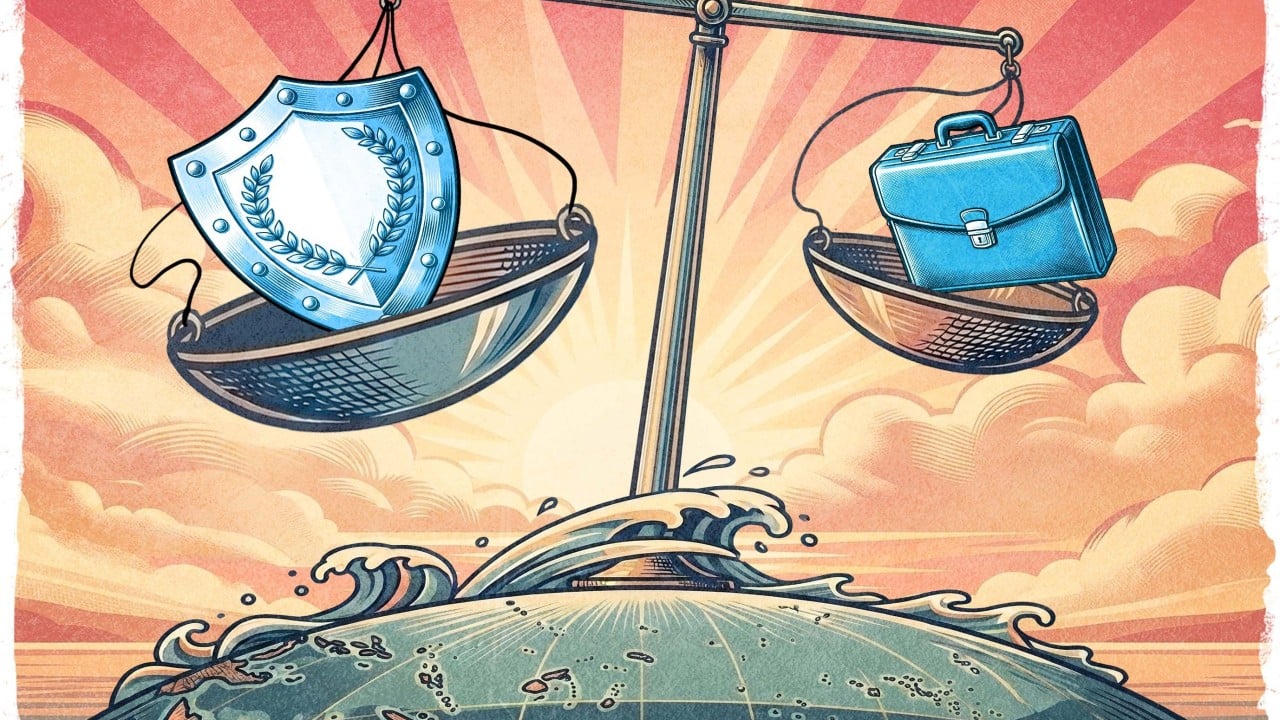
On one side stands the traditional security architecture. Australia, New Zealand, and the United States offer decades of shared history, police training programs, and maritime surveillance patrols designed to keep illegal fishing boats out of local waters. They speak the language of shared democratic values. They also bring strict bureaucratic hurdles, lengthy environmental assessments, and aid packages that often move at the speed of a rusted cargo ship.
On the other side stands a newer, much faster builder. Massive container ships pull into local harbors bearing cranes, asphalt, and steel. Chinese state-owned enterprises arrive with cash ready to deploy. They pave roads that have been potholed for decades. They build multi-story government complexes, upgrade wharves, and string fiber-optic lines across the ocean floor.
There are no lectures on governance attached to those checks. Just signatures, timelines, and concrete.
This is the tightrope.
Walk too far toward the Western security umbrella, and an island nation risks remaining trapped in a cycle of underfunded dependency, where local aspirations stall behind endless rounds of foreign compliance auditing. Lean too heavily into Chinese trade and infrastructure financing, and nations risk walking into a debt trap, quietly mortgaging their sovereignty one deepwater harbor at a time.
Nobody wants to choose. They want to pave their roads and keep their oceans clean.
The Architecture of Influence
Consider what happens when a small island government needs a new deepwater dock.
A Western consortium evaluates the project. They look at climate resilience, labor standards, and transparency metrics. Months pass. The budget balloons. The paperwork piles high on a mahogany desk in Canberra or Washington.
Meanwhile, a delegation from Beijing steps off a charter flight. They look at the same bay. They draw up plans in weeks. They bring their own engineers, heavy machinery, and financing terms that look manageable on paper until global interest rates shift or export revenues drop.
This is not merely about concrete. It is about surveillance, intelligence, and the future of maritime trade routes. A wharf built for commercial container ships today can easily host a naval replenishment vessel tomorrow. Undersea communication cables carry the data lifeblood of the entire planet. Whoever controls the physical laying of those cables controls the nervous system of modern commerce.
For the United States and its regional allies, the awakening has been sudden and slightly frantic. For decades, Washington treated the Pacific Islands as a neglected backyard, assuming historical ties would hold forever. Then came the security pacts, the reopened embassies, and the sudden realization that diplomatic neglect leaves an echo that money alone cannot easily fill.
Yet, throwing millions of dollars in aid at the problem often misses the human center of the equation.
The Cost of Being a Pawn
Walk down the main street of any Pacific capital on a Friday afternoon. You will see young men in faded rugby jerseys laughing outside corner stores. You will see elders sitting under the shade of banyan trees, watching the harbor traffic.
They are acutely aware that their islands are being discussed in high-level defense briefings in Washington, Beijing, and Canberra as strategic chokepoints or unsinkable aircraft carriers.
That framing hurts.
It reduces ancient cultures, brilliant navigators, and sovereign peoples to chess pieces on a board designed by superpowers. The people of the Pacific do not want to be a buffer zone for someone else's Cold War reboot. They want to survive the next category-four cyclone. They want their fisheries protected from illegal trawlers emptying their seas under the cover of night. They want their children to have universities, hospitals, and jobs that do not require moving across the world to Auckland or Sydney.
When a local prime minister accepts funding from a controversial foreign lender to build a new parliament building, Western media outlets cry foul, warning of impending debt servitude. But when that same prime minister asks Western capitals for climate adaptation funding to move an entire sinking village inland, the response is often a polite spreadsheet explaining why the ROI does not work out.
That hypocrisy is not lost on anyone here.
Security is not just about keeping foreign warships out of your territorial waters. Security is making sure your ancestors' graves do not wash into the lagoon because global carbon emissions keep climbing while diplomats argue over target dates.
The Unseen Horizon
The tide rolls back out, leaving patterns of ribbed sand and discarded plastic bottles on the beach.
Teroro stands at the water's edge, watching the horizon where the deep blue meets the pale sky. A gray hull cuts across the distance—maybe a patrol boat checking for poachers, maybe something else entirely. She adjusts her shawl against the ocean breeze.
The tightrope has no safety net. Every step forward requires balancing the urgent need for hospitals and paved highways against the terrifying permanence of losing control of one's own shores.
The superpowers will keep offering deals, signing communiqués, and drawing lines on maps. They will talk of security architectures and strategic corridors as if the ocean were empty space waiting to be claimed.
But down here, where the salt stings the eyes and the coconut palms bend before the trade winds, life goes on. Decisions are made in boardrooms and village halls, balancing the immediate hunger for progress against the quiet, enduring fear of what comes after the concrete dries.