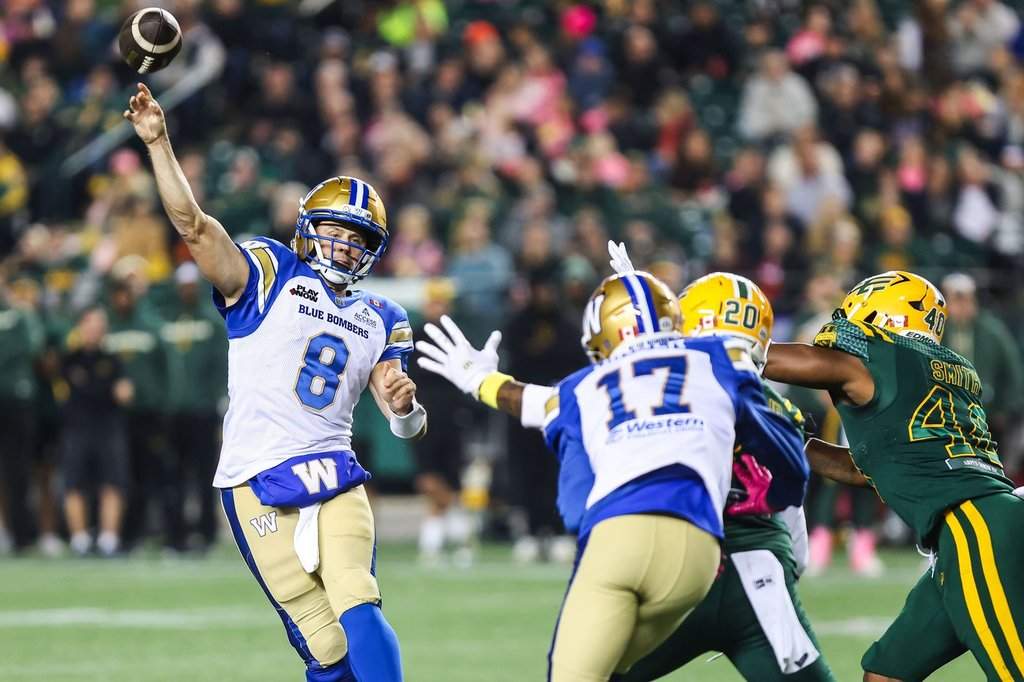
The Montreal Alouettes enter the CFL East Final against the Winnipeg Blue Bombers with a rare structural advantage. Their defensive architecture and special teams efficiency render the opposing quarterback's identity largely irrelevant to their pre-snap preparation. Most football analysis treats the starting quarterback as the sole determinant of offensive variance. That model fails when applied to a playoff matchup where Montreal's defensive scheme forces both a veteran pocket passer and a mobile short-yardage specialist into the exact same high-risk decision trees.
The Myth of Quarterback-Centric Preparation
Conventional sports media frames a quarterback controversy—such as Winnipeg toggling between an injured starter and a dynamic backup—as an insurmountable scouting nightmare. The logic assumes that preparing for two distinct physical profiles splits practice repetitions in half and degrades defensive execution. In reality, high-level Canadian Football League defenses do not defend individuals; they defend spatial distributions and time-to-throw thresholds. You might also find this similar story interesting: The Heavy Crown of Portugal After Cristiano Ronaldo Steps Away.
Winnipeg’s offensive identity relies on heavy personnel groupings, inside zone blocking, and play-action bootlegs designed to stress the flat defenders. Whether the snap goes to a traditional distributor or a dual-threat runner, the geometric constraints of the 65-yard-wide field remain fixed. Montreal defensive coordinator Noel Thorpe builds his system around post-snap disguise and interior gap integrity. By holding a two-high safety shell until the ball is snapped, Montreal denies the offense pre-snap leverage reads. The quarterback must process coverage rotations while the pocket collapses, neutralizing the preparation advantage of switching signal-callers.
Time-to-Throw Compression
The primary mechanism neutralizing quarterback variance is time-to-throw compression. Every passing play operates on an internal clock governed by defensive line penetration. As extensively documented in detailed reports by FOX Sports, the implications are worth noting.
- Threshold One (0.0 to 2.2 seconds): Quick-game concepts, hitches, and screens. Here, the quarterback's arm talent is secondary to pre-snap alignment recognition. Montreal counters this by pressing outside receivers and funneling inside releases directly into linebacker collision zones.
- Threshold Two (2.3 to 3.2 seconds): Intermediate crossers and play-action concepts. This is Winnipeg's historical comfort zone. Montreal disrupts this window through simulated pressures—dropping a defensive tackle into the hook-curl zone while blitzing a boundary halfback.
- Threshold Three (Beyond 3.2 seconds): Broken plays and scramble drills. If Winnipeg deploys a mobile backup, this window becomes dangerous. Montreal mitigates this by assigning a dedicated "contain-and-mirror" rusher on passing downs, sacrificing a fourth pass-rush move to keep the quarterback trapped inside the tackle box.
The Three Pillars of Montreal's Defensive Invariance
To maintain defensive stability regardless of who takes the snap for Winnipeg, Montreal relies on three interdependent operational pillars. If any single pillar fails, the system becomes vulnerable to explosive plays.
1. Early-Down Run Deconstruction
In three-down football, second-and-long is a statistical death sentence for an offense. Allowing a first-down gain of five or more yards opens the entire playbook for Winnipeg, enabling them to dictate tempo and disguise pass protection. Montreal prioritizes stopping the run with a light box—typically six defenders—allowing five defensive backs to patrol the intermediate zones.
This works because Montreal's interior defensive linemen execute two-gap control rather than pure upfield penetration. By occupying two offensive linemen per defender, the defensive tackles keep the weak-side and middle linebackers completely unblocked. The linebackers scrape laterally and strike the running back at the line of scrimmage. When Winnipeg faces second-and-eight or longer, the quarterback's athleticism matters far less than the offensive line's ability to survive a five-man rush.
2. Boundary Compression and Field-Side Baiting
The CFL field features an asymmetrical distribution of space when the ball is spotted on a hash mark. The wide side of the field offers nearly 40 yards of horizontal operating room, while the short side (the boundary) offers less than 20. Inexperienced or rust-affected quarterbacks instinctively gravitate toward the boundary because the throws are shorter and easier to time.
Montreal exploits this behavioral tendency through boundary compression. They align their best man-to-man cornerback on the boundary receiver with zero safety help over the top, effectively daring the quarterback to throw into a tight window along the sideline. Simultaneously, they overload the wide side of the field with zone defenders, baiting the quarterback into throwing deep crossers against moving coverage. A veteran starter might recognize the trap and check down; a backup will frequently force the ball into the boundary, where the sideline acts as an extra defender.
3. The Turnover Margin Multiplier
Playoff football amplifies the value of possession. In a 12-possession game, a single turnover shifts win probability by roughly 18 to 22 percent, depending on field position. Montreal's defense is engineered not merely to force punts, but to generate tipped passes and strip-sacks through coordinated rush lanes.
Rather than allowing edge rushers to sprint wildly upfield—which creates massive running lanes for a mobile quarterback—Montreal mandates strict depth control. Edge defenders rush to the depth of the quarterback's back foot and collapse inward. This forces the passer to step up directly into the arms of the interior tackles. When a quarterback cannot step into a throw, ball velocity drops and trajectory flattens, leading directly to batted passes at the line of scrimmage and interceptions by lurking underneath linebackers.
Offensive Counter-Weight and Clock Control
Defensive readiness cannot exist in a vacuum. Montreal's defense stays fresh and aggressive because their own offense is built to eliminate negative plays and control time of possession. Under quarterback Cody Fajardo, the Alouettes execute a low-variance, high-efficiency passing attack supplemented by timely quarterback draws.
Eliminating Negative Yardage
The greatest threat to Montreal's game plan is giving Winnipeg a short field. Montreal mitigates this by prioritizing completion percentage over air yards. Instead of hunting for 40-yard vertical shots against Winnipeg's disciplined zone coverage, Montreal utilizes high-percentage horizontal stretches—flood concepts, swing passes, and quick slants.
- First-Down Efficiency: Montreal targets a minimum four-yard gain on first down through inside zone runs or quick RPO (Run-Pass Option) slants. This keeps the offense ahead of the chains.
- Third-Down Conversion Discipline: On third-and-short, Montreal relies on heavy-package quarterback sneaks, converting at a rate that extends drives and forces Winnipeg's defense to log extra snaps in cold weather.
- Calculated Vertical Shots: Deep passes are reserved strictly for second-and-short situations, where an incompletion still leaves a manageable third-down decision, or when Winnipeg's safeties creep within eight yards of the line of scrimmage to stop the run.
The Weather Variable
Late-November football in Montreal introduces environmental friction that naturally compresses the talent gap between quarterbacks. Cold temperatures harden the leather of the football, reducing grip friction and decreasing spiral tightness on throws exceeding 25 yards. Swirling winds inside Percival Molson Memorial Stadium punish high-arcing deep balls.
These conditions disproportionately hurt a pocket passer relying on timing routes to the wide side of the field, while neutralizing the deep-ball threat of a strong-armed backup. The game inevitably shrinks to a 15-yard vertical box defined by physicality, tackling in space, and ball security. Montreal's roster is constructed for this exact environment: heavy, physical receivers who excel at yards after the catch (YAC) and an offensive line built for power-blocking schemes rather than finesse pass sets.
Special Teams as the Hidden Decider
When two defenses neutralize opposing quarterback adjustments, field position becomes the primary currency of the game. Montreal possesses a distinct structural edge in the third phase of football, specifically in punt coverage net yardage and return containment.
Winnipeg relies heavily on explosive kick returns to jump-start stagnant offensive drives, particularly when breaking in an unsettled quarterback situation. Montreal's coverage units utilize disciplined lane integrity—maintaining exact five-yard horizontal spacing downfield—to eliminate cutback lanes. By forcing Winnipeg's offense to start inside their own 20-yard line, Montreal forces the opposing quarterback to execute 10-to-12-play drives without a single penalty, dropped pass, or missed protection assignment. Statistically, sustained drives of over 10 plays against a top-tier CFL defense occur less than 14 percent of the time.
Limitations of the Defensive Blueprint
No defensive scheme is immune to failure, and Montreal's model carries specific structural risks that Winnipeg can exploit if their coaching staff adjusts effectively.
- Vulnerabilities to Tempo: Montreal's pre-snap disguise relies on communication between the middle linebacker and the free safety. If Winnipeg deploys a strict no-huddle, up-tempo offense, Montreal is forced into base coverages, stripping away their disguise advantage and exposing their cornerbacks to isolated matchups.
- The Quarterback Run-Pass Conflict: If Winnipeg's mobile backup enters the game and executes designed zone-read keepers rather than improvised scrambles, Montreal's light-box strategy faces a mathematical deficit. A running quarterback adds an extra blocker to the run fit, forcing a safety to crash down and leaving single coverage on the outside.
- Penalty Accumulation: Aggressive press coverage and simulated pressures walk a fine line with CFL officiating standards. Illegal contact beyond five yards and roughing-the-passer penalties provide automatic first downs that entirely bypass Montreal's third-down conversion dominance.
The Definitive Strategic Play
Montreal must reject conservative, prevent-style adjustments regardless of who takes the first snap for Winnipeg. From the opening series, the Alouettes should deploy a five-man simulated pressure package on 60 percent of first downs, overloading the strong side of Winnipeg's formation while dropping the boundary defensive end into the flat. This forces the opposing quarterback—whether injured veteran or energetic backup—to immediately process post-snap rotation under duress, establishes physical dominance at the line of scrimmage, and dictates the geometric boundaries of the East Final before Winnipeg's offense can establish a rhythm.


