The fluorescent lights of a late-night diner off Interstate 75 hum with a particular kind of exhaustion. It is the sound of a state that has been asked to save American democracy every two years since 2020, and is frankly tired of the noise.
Sit in a booth in Macon or Marietta, and you will hear the real math of American politics. It isn't calculated in cable news green rooms or Washington strategy memos. It is counted in the price of diesel, the closing of a rural maternity ward, and the quiet dread of a mother watching her utility bill climb while the summer heat presses against the window glass like a physical weight.
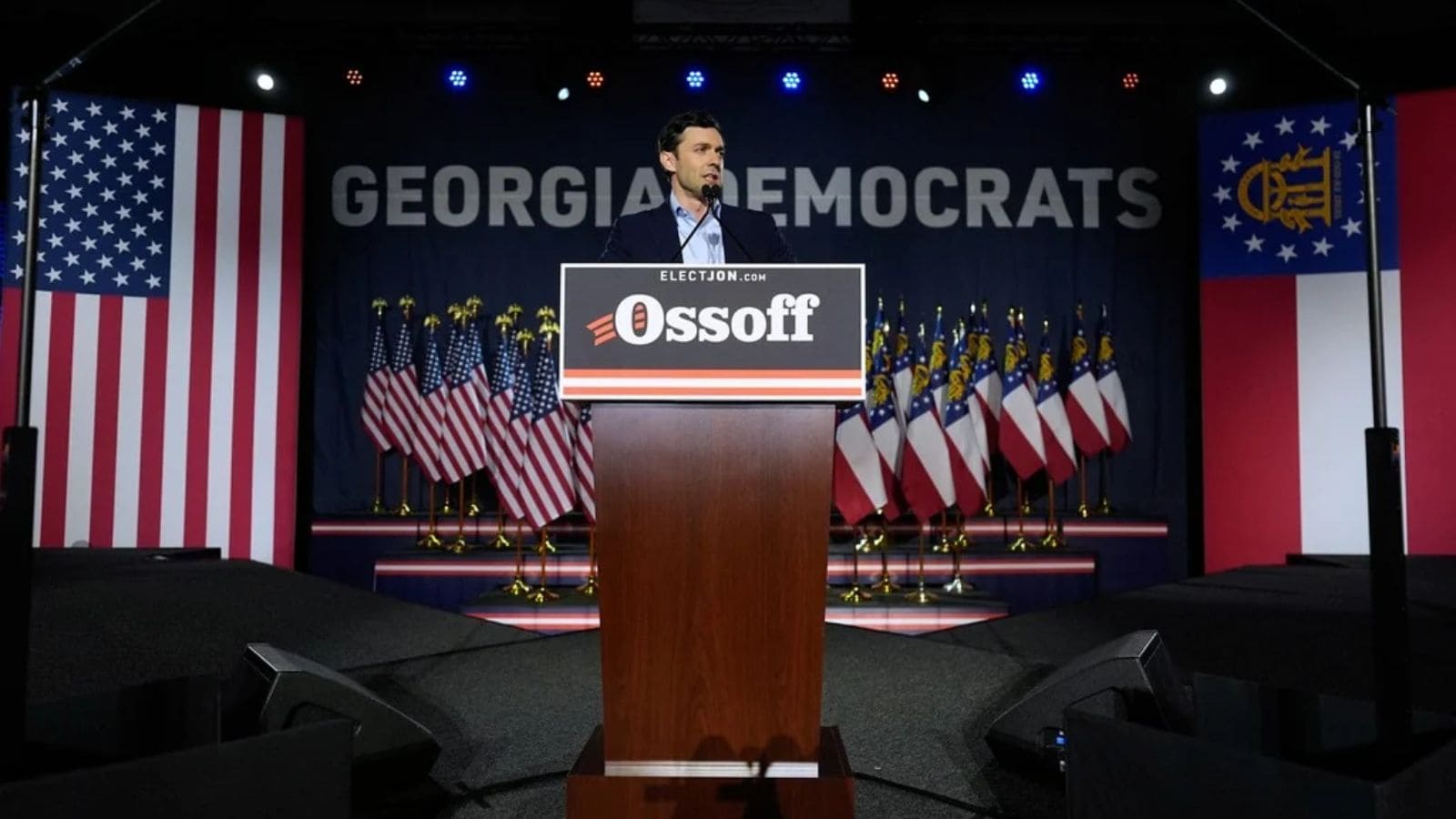
In November 2026, Georgia voters stepped back into the voting booth and made a choice that echoed far beyond the red clay of the Peach State. They sent Jon Ossoff back to the United States Senate. On paper, it is a standard political headline—an incumbent holding a battleground seat in a midterm cycle. Yet the tremor that followed that victory rattled the foundations of the Democratic Party from Atlanta to Washington, D.C., instantly transforming a thirty-nine-year-old former investigative journalist into the most compelling presidential prospect of his generation.
Survive.
That single word defines the modern political battlefield in the American South. When Ossoff first won his seat in the razor-thin January 2021 runoff, critics dismissed him as an accidental senator—a beneficiary of national anti-Trump fervor and the historic organizing machinery built by Stacey Abrams and the late John Lewis, under whom Ossoff had interned as a teenager. Pundits whispered that he was too young, too polished, too much of a coastal-educated documentary filmmaker to hold a state where pickup trucks outnumber Priuses by a wide margin.
They were wrong.
To understand why Jon Ossoff’s reelection has ignited serious whispers about the 2028 presidential race, you have to strip away the punditry and look at what actually happened on the ground in Georgia over the last six years. You have to look at the mechanics of survival in a state that remains fiercely divided, deeply skeptical of Washington, and ruthlessly unforgiving of politicians who treat voters like demographic checkboxes.
The Anatomy of a Battleground
Consider a hypothetical voter—let’s call her Elena—living in Gwinnett County, just northeast of Atlanta. Ten years ago, Elena’s neighborhood was reliably conservative, a quiet suburban expanse of cul-de-sacs and church parking lots. Today, her street speaks four languages, her kids attend a school bursting at the seams, and her family’s financial stability hangs on the fragile thread of suburban healthcare costs and small business lending rates.
Elena does not watch cable news. She does not care about Senate procedural rules or partisan Twitter feuds. When she looks at a politician, she asks one visceral question: Do you actually see me, or am I just a number on your fundraising email?
For decades, national Democrats struggled to answer that question in the Sun Belt. They either ran away from their own values in a panicked attempt to appease moderate voters, or they spoke in an academic dialect that alienated the very working-class families they claimed to champion.
Ossoff chose a third path. He treated the Senate not as a soapbox, but as an investigative newsroom.
Before he ever held public office, Ossoff ran Insight TWI, a London-based television production company that exposed corruption, war crimes, and organized crime across the globe. That background isn't a footnote on his resume; it is the operating system of his political career. When he arrived in the Senate in 2021, he didn't chase the cameras on the Capitol steps. He buried himself in oversight committees.
Think of a seasoned structural engineer inspecting an old bridge. Most politicians stand on the riverbank, waving flags and arguing about what color to paint the guardrails. The engineer puts on a hard hat, climbs beneath the deck with a flashlight, and taps the steel beams until she finds the rust eating through the load-bearing joints.
That was Ossoff in the Senate. He hauled executives from private prison companies, pharmaceutical giants, and freight rail monopolies into hearing rooms and dismantled their talking points with cold, forensic precision. When veterans in Georgia were waiting months for basic care due to VA backlogs, he didn't just issue a press release; he tracked the missing files down to the regional office level until the system moved. When mail delays in the Atlanta sorting facilities threatened to destroy small businesses and delay life-saving prescriptions, he turned the Postmaster General’s oversight hearings into a masterclass in public accountability.
Why Reelection Changes the Equation
Winning once in a wave election can be chalked up to luck. Winning reelection in a grinding, high-stakes midterm—when the political winds are swirling and every vote is contested in the trenches—proves durability.
In 2026, Ossoff faced the full weight of a Republican apparatus determined to reclaim a seat they viewed as rightfully theirs. Georgia’s GOP leadership, anchored by popular state-level figures and backed by tens of millions of dollars in outside spending, threw everything at him. They tried to tie him to national economic anxieties, painted him as out of touch with rural Georgia, and bet that the coalition that elected him in 2021 would fracture under the pressure of inflation and exhaustion.
Instead, Ossoff expanded his map.
He didn't just run up the score in the urban core of Fulton and DeKalb counties. He showed up in the soybean fields of south Georgia, the carpet mills of Dalton, and the military towns around Columbus and Augusta. He spoke the language of economic populism without the theatrical rage that has poisoned modern politics. He championed clean energy manufacturing—pointing to the billions of dollars in battery plants and solar facilities pouring into Georgia—not as an abstract environmental crusade, but as cold, hard factory jobs for rural counties that had been bleeding young people for forty years.
Watch how he moves through a room in Savannah or Rome, Georgia. There is an old-school discipline to his retail politics that feels almost anachronistic in an era of viral soundbites. He listens longer than he speaks. He remembers the names of county commissioners, local pastors, and union stewards. When he explains a complex piece of legislation—like capping insulin costs for seniors or expanding broadband access to rural clinics—he strips away the bureaucratic jargon until the policy feels as tangible as a paycheck on a Friday afternoon.
That translation skill is what separates a good senator from a viable presidential contender.
The Generational Hunger
Step back and look at the broader Democratic Party in late 2026. It is a party standing at a generational crossroads, searching desperately for its next standard-bearer.
For years, the Democratic bench has felt caught between two eras: an aging guard of institutionalists who still believe the norms of the 1990s can be resurrected, and a progressive wing whose rhetoric often plays better in Brooklyn and Berkeley than it does in Peoria or Macon. Voters across the country—especially younger voters and independent moderates—have grown weary of choices that feel like reruns of a movie they didn't like the first time.
I remember standing outside a polling place in suburban Atlanta during a brisk November morning, watching a twenty-four-year-old mechanic wait in line beside a seventy-two-year-old retired schoolteacher. Neither of them wore party merchandise. Both looked tired. When I asked the young man what brought him out before his shift, he shrugged and said, "I just want somebody who doesn't sound like they're reading off a script from twenty years ago. Somebody who actually has to live in the future they're voting on."
That sentiment is a quiet wildfire burning through the American electorate.
Born in 1987, Jon Ossoff is a millennial who would be forty-one years old on Inauguration Day in 2029. That demographic reality carries immense psychological weight. He is old enough to have weathered the brutal realities of Senate governance and two grueling statewide campaigns, yet young enough to understand intuitively the anxieties of a generation drowning in housing costs, climate instability, and technological disruption.
More importantly, he possesses a rare geographical credential. No Democrat has won the White House in the modern era without assembling a coalition that can compete outside the coastal strongholds. Jimmy Carter did it from Plains, Georgia. Bill Clinton did it from Little Rock, Arkansas. Barack Obama built an unprecedented Sun Belt expansion that carried Virginia, North Carolina, and Florida.
A Democrat who has twice proven he can win statewide in Georgia—forging an alliance between Black voters, suburban women, young professionals, and disaffected independents—possesses the exact electoral blueprint the party needs for 2028. He doesn't have to theorize about how to win the Sun Belt. He has the receipts in his pocket.
The Invisible Stakes of the Next Two Years
Of course, political gravity is unforgiving, and presidential speculation is a dangerous intoxicant. The graveyard of American politics is filled with "rising stars" who believed their own press clippings too early and burned up before reaching the starting line.
Ossoff’s vulnerabilities are real, and any honest assessment has to confront them without flinching. Critics from the left flank of his own party have at times questioned whether his cautious, institutional approach moves fast enough on systemic reforms like voting rights and healthcare expansion. Meanwhile, national Republicans have spent six years building an opposition research file thicker than an Atlanta phone book, waiting for the moment he steps onto a national debate stage to cast him as a sleek Washington insider masquerading as a populist.
There is also the sheer brutal math of governing in a polarized Congress. Winning a campaign requires inspiration; surviving a second Senate term while laying the groundwork for a national run requires walking a tightrope over a canyon in high winds. Every vote he casts between now and 2028 will be scrutinized by primary voters in Iowa and New Hampshire on one side, and swing voters in Pennsylvania, Michigan, and Arizona on the other.
Yet, if you watch how Ossoff operates, you notice something unusual: he rarely takes the bait.
In an era where politicians are rewarded by algorithms for outrage and performative cruelty, Ossoff’s superpower is emotional discipline. He does not scream at his opponents. He does not indulge in culture-war distractions designed to juice fundraising numbers. Instead, he keeps hammering on the fundamentals: fair wages, corporate accountability, affordable healthcare, and the basic competence of American government.
It is an approach that reminds older Georgians of the best traditions of Southern public service—leaders who understood that dignity is not weakness, and that persuasion works better than lecturing.
The Road Beyond Atlanta
Think back to that diner off Interstate 75, where the coffee is burnt and the rain streaks the neon sign outside. Politics, at its core, is not a parlor game played by strategists in Washington. It is a covenant between people who feel invisible and the leaders who ask for their trust.
Jon Ossoff’s reelection in Georgia did not happen because he discovered a magic slogan or ran the flashiest television ads. It happened because, over six relentless years, he convinced a skeptical, exhausted, deeply divided state that he was willing to do the unglamorous work of paying attention. He showed up when the cameras weren't rolling. He asked hard questions when powerful people wanted silence. He treated the people of Georgia not as pawns on an electoral map, but as neighbors whose lives mattered.
Now, as the dust settles on the 2026 midterms and the country begins its inevitable, restless turn toward 2028, the political world is looking south once again. They see a senator who survived the hardest proving ground in modern American politics and emerged stronger, sharper, and battle-tested.
The road from Atlanta to Pennsylvania Avenue is long, treacherous, and littered with the wreckage of premature ambition. Nothing is guaranteed. The national stage magnifies every flaw, tests every conviction, and strips away every illusion.
Yet on a quiet morning in Georgia, as red clay steam rises off the fields after an autumn rain, one truth hangs unmistakably in the air: the future of the Democratic Party is no longer being written in the marble corridors of Washington, and the young man who learned how to listen in the back pews of Georgia churches has just earned the right to be heard across the nation.