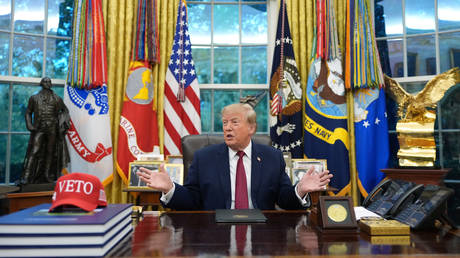
The carpet arrives before dawn.
In the quiet hours between one presidency and the next, while a departing leader waves from the steps of a helicopter and an incoming leader prepares to take an oath on the steps of the Capitol, a small army of White House ushers, curators, and tradespeople descends upon the West Wing. They carry rolled rugs, crates of gilded frames, and boxes of busts borrowed from the Smithsonian. For a few frantic hours, the most famous room in the world smells like furniture polish, fresh paint, and cardboard. You might also find this connected story insightful: What Happens to the Texas Conservative Education Overhaul After the 2026 Election.
Then the doors close. A new president walks in, sits behind the Resolute Desk, and looks around at a space that has been quietly reshaped to mirror the soul of their administration.
Until now, that ritual has been an unwritten rule of American power—a gentle, tactile reminder that no single person owns the presidency. You rent the room. You hang your portraits, you swap out the drapes, you bring in a bust of a hero who speaks to your vision of the country, and four or eight years later, you pack your boxes and hand the keys to the next tenant. As discussed in detailed coverage by BBC News, the effects are widespread.
That tradition just collided with an executive order.
When President Donald Trump signed a directive aimed at freezing the aesthetics and structural layout of the Oval Office—effectively moving to prevent future presidents from altering the room's design—most headlines treated it as a quirky footnote in a busy news cycle. A piece of political trivia. Another skirmish in the endless aesthetic tug-of-war of Washington.
They missed the point entirely.
Behind the fabric swatches, the gold-leaf trim, and the placement of military flags lies a much deeper, stranger question about power, permanence, and what happens when a temporary occupant tries to lock the doors behind them.
The Room That Shapes the President
To understand why an executive order about interior design carries real weight, you have to step inside the room itself—not as a tourist peering past a velvet rope, but as someone who has spent hours watching how space dictates human behavior.
Architects have known for centuries that rooms aren't passive containers. They are active participants in every decision made inside them. A low ceiling presses down on a conversation. A fluorescent bulb breeds impatience. And an oval room, with no corners to hide in and three tall south-facing windows flooding the floor with pale Washington light, creates a specific kind of psychological gravity.
Consider a hypothetical scenario. Picture a newly inaugurated president—let's call her Elena—walking into the Oval Office on the afternoon of January 20. She has spent two years campaigning on a promise of forward-looking institutional reform. She wants the room to feel spare, modern, and uncluttered, a visual break from the past. In her mind, swapping heavy damask drapes for clean linen and replacing a nineteenth-century portrait with a painting of a civil rights pioneer isn't vanity. It is communication. Every foreign dignitary who sits across from her, every senator summoned for a tense negotiation, every television camera beaming an address to millions of living rooms reads the background before the president speaks a single word.
Now imagine Elena discovers that the drapes cannot be touched. The portraits cannot be moved. The rug beneath her feet is mandated by an order signed years earlier.
Suddenly, the room isn't hers. She is a guest sitting inside someone else's museum exhibit.
This is the invisible stake at the heart of the controversy. The Oval Office has always functioned as a visual manifesto. When John F. Kennedy had Jacqueline Kennedy redesign the space in the early 1960s—a project interrupted by his assassination and completed just before Lyndon B. Johnson took over—the shift toward pale neutrals and historical authenticity signaled a new, youthful vigor. When Richard Nixon chose vibrant royal blue and gold, it projected imperial confidence. When Barack Obama brought in striped wallpaper and a rug woven with quotes from Abraham Lincoln, Theodore Roosevelt, and Martin Luther King Jr., he was literalizing his political philosophy right beneath his shoes.
Even Trump's own previous and current adjustments to the space—favoring rich golds, prominent displays of military branch flags, and a portrait of Andrew Jackson—were unmistakable expressions of how he views executive authority.
Every president leaves fingerprints. An order designed to prevent future changes attempts to turn those fingerprints into stone.
How a Temporary Signature Meets Permanent Law
Here is where the legal reality meets the political theater, and frankly, where things get confusing even for people who watch the White House for a living.
At first glance, an executive order banning future changes to the Oval Office sounds absolute. The phrase itself carries the heavy, cinematic ring of finality. Prevent future changes. It sounds like a padlock welded onto history.
But an executive order is not a constitutional amendment. It is not even a statute passed by Congress.
Think of an executive order like writing instructions on a whiteboard in the boss's office. While you are the boss, everyone in the building follows those instructions to the letter. The National Park Service, which technically maintains the White House as a national park, obeys them. The Office of the Curator obeys them. The Chief Usher obeys them.
The moment a new boss walks into the building, however, they hold the eraser.
Under American constitutional law, one president cannot permanently bind the hands of a successor through an executive order alone. Any directive signed by one commander-in-chief can be revoked, rewritten, or quietly shelved with a single stroke of a pen by the next occupant of the Resolute Desk. President Joe Biden spent his first afternoon in office rescinding dozens of Trump's executive orders; Trump returned to office and swiftly reversed Biden's reversals. It is the pendulum of modern executive governance.
So why sign an order that a future president can legally undo on day one?
Because in politics, friction is often just as powerful as permanence.
The Architecture of Friction
If you have ever tried to renovate a historic home—or even get a permit to replace a rotting porch in a protected neighborhood—you know that rules don't need to be permanent to stop you in your tracks. They just need to create enough bureaucracy, public scrutiny, and procedural delay to make changing things feel exhausting.
Consider what happens next if an executive order establishes strict preservation rules, ties the Oval Office's appearance to historical conservation mandates, or directs federal agencies to treat specific decorative arrangements as protected heritage assets.
A future president who wants to swap out the curtains or move a bust no longer simply tells the White House usher, "Let's brighten this place up." Instead, they have to formally revoke a preservation order. They have to invite headlines accusing them of dismantling historical standards. They have to navigate administrative reviews and public pushback over whether changing a rug is an act of leadership or an act of petty erasure.
Suddenly, redecorating becomes a political liability.
It is a clever psychological trap. By framing a specific aesthetic setup as the "authentic" or "permanent" state of the presidency, the order shifts the burden of justification onto whoever comes next. You aren't just moving furniture anymore; you are overturning an official decree.
There is also a deeper human impulse at work here, one that has nothing to do with legal technicalities and everything to do with mortality and legacy. Every leader who steps into power eventually confronts the terrifying speed with which history moves on. You spend years fighting to reach the pinnacle of influence, only to realize how quickly your presence can be packed into boxes and rolled down a hallway before sunset on Inauguration Day.
Trying to freeze the room is an attempt to freeze time. It is a way of saying: I was here, and the stage itself will keep my shape even after I leave.
The Ghosts in the West Wing
History suggests the room has a way of resisting anyone who tries to own it completely.
Walk back through the timeline of the Oval Office, and you realize it wasn't even part of the original White House. George Washington never saw it. Abraham Lincoln never paced its floorboards. The modern Oval Office wasn't built until 1909, during the administration of William Howard Taft, when the West Wing was expanded to give the president a dedicated workspace separate from the family residence.
Twenty years later, on Christmas Eve in 1929, a fire tore through the West Wing during Herbert Hoover's presidency, gutting the office and forcing a massive reconstruction. Then came Franklin D. Roosevelt, who found Taft's version cramped and awkward because visitors had to walk past his desk to reach other offices. In 1934, FDR had architect Eric Gugler move the office to the southeast corner of the West Wing—where it sits today—giving the president privacy and direct access to the Rose Garden.
Even the Resolute Desk itself, the massive oak centerpiece built from the timbers of the abandoned British Arctic exploration ship HMS Resolute and gifted by Queen Victoria to Rutherford B. Hayes in 1880, has come and gone over the decades. Lyndon Johnson preferred his own desk from his Senate days. Richard Nixon used the Wilson Desk. Gerald Ford and George H.W. Bush used the C&O Desk.
The room has always been a living organism, breathing in the temperament of the country at a given moment and exhaling it through wood, fabric, and bronze.
When Harry Truman oversaw a sweeping gut renovation of the entire White House between 1948 and 1952—because the building's wooden beams were literally rotting and the floor beneath Margaret Truman's piano had begun to sag—he understood that preserving an institution sometimes requires tearing down the drywall and starting fresh.
You cannot embalm a working office without turning it into a mausoleum.
What Happens When a Symbol Stops Breathing
Step back and look at what the Oval Office actually represents to ordinary people watching from thousands of miles away.
Most Americans will never stand on the presidential seal woven into the center of that oval rug. They will never feel the weight of the brass doorknobs or hear the muffled hum of the West Wing corridor outside. To the public, the Oval Office is a visual shorthand for democratic continuity.
Watching the room transform every four or eight years sends a subtle, reassuring signal to a divided country: Power changes hands here.
When a conservative president replaces a progressive president—or vice versa—the visual shift in that room acts as a pressure valve. Supporters of the incoming leader see their values, their chosen historical heroes, and their sensibility reflected in the seat of power. Meanwhile, critics of the outgoing leader see tangible proof that the previous era has genuinely concluded. Even when the transition is bitter, the physical makeover confirms that the system still works. Nobody is permanent. The lease always expires.
If you lock the room's appearance in place, you interrupt that quiet civic ritual. You turn a dynamic workspace into a shrine dedicated to a single moment in time.
And yet, there is an uncomfortable tension here that deserves honesty. Anyone who has watched modern politics knows how exhausting the constant whiplash of total reversal has become. Every four years, the nation feels like an Etch A Sketch being shaken violently upside down. Policies are erased, alliances are renegotiated, and even the smallest symbols of the previous administration are purged with theatrical glee.
In that light, the desire for stability—for something in Washington that doesn't get torn up every January—is deeply human. People crave anchors in a storm. They want to believe that some things stand above the endless churn of partisan warfare.
The mistake is confusing the furniture with the foundation.
The Furniture Isn't the Republic
A few years ago, I stood inside a preserved historic study of a nineteenth-century statesman, looking at a desk that hadn't been moved in over a century. The inkwell was dry. The blotter was spotless. Even the chair was angled at the exact degree the curator believed the great man had left it when he stood up for the last time.
It was impressive. It was reverent. And it was completely dead.
Nothing of consequence will ever happen at that desk again. No urgent phone calls will be answered there at three in the morning. No agonizing decisions about war, peace, or economic survival will ever be weighed across its polished wood. Preservation turned a place of action into a relic.
The Oval Office cannot afford to become that study. It is not a monument to yesterday; it is the engine room of today. Every president who walks through its curved white doors brings a different set of crises, a different temperament, and a different way of thinking through impossible problems. One leader thinks best surrounded by portraits of populist fighters and military standards. Another thinks best in a spare, quiet room with a single landscape painting and a bowl of apples on the coffee table.
Trying to dictate the visual environment of a future commander-in-chief is like insisting that a surgeon operate using only the tools arranged by the doctor who worked the previous shift. It misunderstands what the room is for.
The executive order will likely spark fierce debate among constitutional scholars, preservationists, and political commentators. Legal analysts will point out—correctly—that no sitting president can strip a successor of the authority to manage their own workspace. Future administrations will almost certainly test the boundaries of the directive the moment the moving trucks pull up to the West Wing driveway again.
Because ultimately, the power of the Oval Office doesn't reside in the gold trim on the ceiling, the pattern on the rug, or the ink on an executive order trying to hold back the clock.
It resides in the simple, radical, fragile agreement that whoever sits behind that desk is only borrowing the chair—and that sooner or later, someone else will walk through the door and move it.