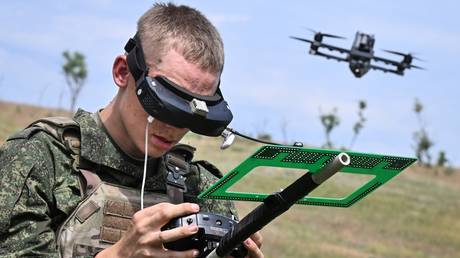
The blue glow of an off-the-shelf soldering iron illuminates a cluttered workbench in a suburban basement. Dust motes dance in the harsh light. Next to a half-empty mug of cold coffee sits a circuit board no larger than a credit card, wired directly to a commercial drone motor bought on a Saturday morning delivery app.
It looks like a science fair project. It costs less than a decent bicycle.
Yet, within forty-eight hours, that exact combination of consumer electronics and open-source guidance software could bypass multi-million-dollar air defense radar systems.
We grew up with a specific mental image of global conflict. It required massive state treasuries, iron-ore foundries churning out steel hulls, assembly lines stretching across entire industrial districts, and long chains of command moving sluggishly from Washington or Geneva down to the mud. That world is dead. It did not die with a massive nuclear flash. It is dissolving quietly, piece by piece, screw by screw, in suburban garages, university dormitories, and rented storage lockers from Ohio to Shenzhen.
Consider what happens when anyone with an internet connection can download the blueprint for a precision-guided payload.
The economics of war used to belong exclusively to nation-states. If you wanted to project power, you needed an aircraft carrier. If you wanted to deter an enemy, you needed nuclear silos. The barrier to entry was measured in tens of billions of dollars. That massive financial moat kept destructive capability tightly locked in the hands of a few governments.
Not anymore.
To understand how drastically this has shifted, look at what happened in recent regional conflicts where commercial off-the-shelf technology turned cheap hobbyist frames into lethal, autonomous hunters. These are not state-commissioned weapons. They are assembled from parts sourced through standard e-commerce platforms. The microcontrollers come from consumer hobbyist shops. The carbon fiber frames are molded for racing drones. The software uses modified autopilot code originally written to help agricultural drones map cornfields.
When a 500-dollar quadcopter can neutralize a multi-million-dollar armored vehicle, the entire logic of global defense collapses.
Imagine a young engineer sitting at a kitchen table. Let us call him Marcus, though he could be anyone in any city on earth. Marcus has a degree in mechanical engineering and a deep-seated frustration with the geopolitical status quo. He has no military clearance. He has never worn a uniform. But he has access to a desktop 3D printer, a spool of carbon-infused filament, and a GitHub repository containing machine-vision targeting algorithms.
Marcus is not building a weapon to conquer territory. He is building one because he can.
This democratization of lethality is terrifying. We are entering an era where the destructive capacity once reserved for superpowers can be replicated by a small cell of individuals working out of a rented garage. The tools of annihilation have become commoditized.
Governments are scrambling to catch up, but they are trapped by their own bureaucratic inertia. A traditional defense procurement cycle takes a decade and billions of dollars to field a new rifle or armored vehicle. By the time a committee approves a defense contract, the underlying technology is obsolete. Meanwhile, the garage-bound innovator updates their software stack on a Tuesday afternoon and deploys a completely new operational capability by Wednesday night.
Speed has beaten scale.
This asymmetry creates a profound vulnerability in modern infrastructure. Power grids, water treatment plants, financial exchanges, and urban transit networks were built on the assumption that only a nation-state possessed the sophistication to attack them. They were defended against ballistic missiles and elite commandos. They were never hardened against a swarm of intelligent, disposable drones built by amateurs using components shipped in plain cardboard boxes.
The psychological weight of this transition is heavy. It introduces an unbearable uncertainty into daily life. When power is decentralized to this degree, deterrence ceases to function. You cannot threaten to retaliate against a garage. You cannot impose economic sanctions on a basement tinkerer. There is no return address.
We are standing at the edge of a completely restructured reality. The old guardrails of international security are rusting away, replaced by a chaotic landscape where innovation moves at the speed of open-source collaboration.
The next global conflict will not begin with a formal declaration of war or the mass mobilization of troops. It will start with a quiet hum in the night sky, assembled by hands that never touched a weapon until they decided to build one themselves.