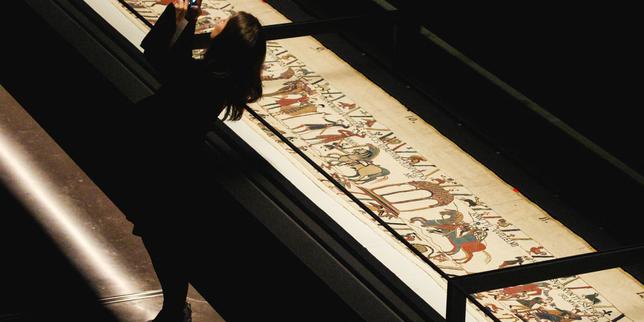
Standing in the dim, hushed corridor of a museum, watching visitors press their noses against glass as they lean at awkward angles just to catch a falling horse or a fleeing foot soldier, you begin to see the cost of verticality.
Gravity.
It never rests. For nearly a thousand years, it has tugged gently, relentlessly, downward on a strip of unbleached linen almost seventy meters long, pulling at wool threads dyed with madder root and woad, testing every stitch laid down in the eleventh century after the blood of Hastings had soaked into English soil.
The Bayeux Tapestry is not a tapestry in the strict weaving sense—it is embroidery, wool worked onto linen—and yet it holds more political drama, naval anxiety, and human hubris than half the history books ever printed. Soon, after crossing the Channel for a historic loan in London, its return to Normandy will bring a subtle, deliberate shift in posture. Instead of hanging upright like a frozen wave on a wall, the embroidery is slated to be displayed on a tilted table when it comes back from London.
Why tilt a legend? Why lay down a monument that has stood at attention for generations, and incline it just enough to meet the human eye without asking the linen to carry its own weight like a banner in a gale?
To understand what is actually at stake when a conservator angles a glass case by a few degrees, you have to step away from press releases and look closely at what happens to old fibers under stress.
The Weight of a Thousand Years on a Single Thread
I have spent enough years in archival vaults and conservation studios—and watched enough fragile objects travel from quiet provincial rooms into the bright spotlight of international loans—to know that movement is never neutral. Every crate unsealed, every humidity sensor calibrated, every change in lighting carries a quiet bargain. You give the public a chance to look; the object pays a tiny installment of wear.
With the Bayeux embroidery, that installment has been running for nearly nine centuries.
Linen is strong when young, crisp and resilient, woven from flax stalks retted in water and beaten until smooth. Over centuries, however, cellulose chains break down. Oxidation brittle-izes the weave. Wool dyed with natural pigments loses elasticity; light fades iron-gall and vegetable hues; air pollutants settle into microscopic crevices. When a textile of roughly sixty-eight meters in length and fifty centimeters in height hangs vertically, gravity pulls along the warp and weft in ways that can distort proportions, stress seams, and encourage sagging over time.
Picture a heavy wet coat hanging on a thin peg for ten winters in a row. You might not notice the stretch on Tuesday. You might not see it next month. Yet over decades, the shoulder droops, the fabric thins where the pull concentrates, and the original geometry slips just a fraction.
Now imagine that coat is made of ancient linen embroidered with hundreds of figures, ships, castles, and Latin inscriptions recounting Harold, William, and the bitter collision of 1066.
When conservators talk about presenting the Bayeux work on an inclined table upon its return from London, they are addressing two pressures at once: the physical toll of vertical suspension and the human ergonomics of viewing. A slanted surface lets gravity rest more gently across a wider support plane rather than tugging straight down along a sheer wall, while still angling the scenes toward visitors so they do not have to crane necks or crouch uncomfortably to read the story unfolding stitch by stitch.
I have to admit, whenever a treasure this famous packs up for a trip abroad—even across a stretch of water as storied as the English Channel—my stomach tightens a little. People ask me whether moving an ancient textile is reckless or necessary. Honestly, I don't think there is a clean, risk-free answer. Conservation lives in the tension between keeping something sealed in dark safety and letting living people encounter the thing that shaped their shared past. If we lock everything away forever, we protect the linen and starve the memory. If we move it carelessly, we feed the memory and fray the linen.
A Hypothetical Afternoon in the Conservation Lab
To see how a simple tilt changes the room, let us step into a hypothetical conservation studio in Normandy a few weeks before the returning crate arrives from London. This scene is invented to illustrate real conservation principles, though the physical challenges of linen, wool, and climate control are entirely real.
Claire—a fictional textile conservator standing in for the real specialists who spend their lives measuring relative humidity in tenths of a percent—adjusts a calibration lamp over a long, low table tilted at a gentle angle.
The air in the room smells faintly of clean cardboard, distilled water, and cool stone. Outside, rain taps against a courtyard window.
"Look at the border," Claire says to a younger colleague examining a high-resolution scan of one of the panels. "Where the lower margin meets the main frieze, you can see tiny micro-tensions where the wool loops sit proud of the linen."
For decades, visitors in Bayeux walked past a long, continuous display where the embroidery sat upright behind glass, illuminated carefully so harsh light would not bleach the madder reds or indigo blues. That setup allowed crowds to file along the length of the narrative, watching William's fleet cross the sea and Harold fall beneath the arrows. Yet viewing a narrow band on a flat vertical plane can create glare, force awkward posture, and keep the textile aligned with gravity's vertical pull.
A tilted table changes the geometry of attention. When an object rests on an inclined support, it is cradled rather than suspended. Engineers and conservators can design a continuous, supportive bed engineered to minimize stress points along the length of the cloth, while angling the surface toward the viewer's natural line of sight.
Think of reading a wide, illustrated scroll spread across a sloped lectern rather than pasted high on a wall. Your shoulders drop. Your eyes scan left to right without straining upward or bending double. The work feels closer—not physically touchable, of course, protected behind museum glazing and strict environmental controls—but visually less distant, as if the story is being held open for you rather than mounted like a trophy.
Why London and Normandy Are Bound by Thread
Anyone who has ever stood before the Bayeux Tapestry feels a strange tug-of-war inside the frame itself.
Is it French? It was made in England, most scholars agree, by Anglo-Saxon hands working with extraordinary skill—perhaps in Canterbury—and has lived for centuries in Bayeux, Normandy, closely tied to Bishop Odo, William the Conqueror's half-brother.
Is it English? Its subject is the Norman conquest of England, a turning point that reshaped English language, law, aristocracy, and identity forever.
Sending it to London and bringing it back to Normandy on an inclined display is more than a logistics puzzle involving climate-controlled trucks, vibration dampeners, and customs protocols. It is a quiet negotiation between two neighbors whose histories are braided together like wool and flax.
Whenever cultural loans happen between Britain and France, tempers can flare. Some worry about travel vibrations; others argue that sharing a masterpiece across borders honors the tangled history inside it. When the work returns from London to be shown on a tilted table, that return becomes a physical threshold: the journey across the water concludes, the crate comes home, and the presentation itself shifts into a new chapter.
Will visitors notice the angle of the table right away? Probably not in technical terms. Most people will walk in thinking about medieval knights, horses, and crowns. Yet the angle shapes how long they linger, how easily they follow the Latin captions running along the top, and how naturally they move from one scene to the next.
Beyond Glass and Irony
We live in an age where almost anything can be photographed in ultra-high resolution, zoomed in until you can count every twist of a single sheep's fleece, and scrolled past on a phone screen in six seconds.
A screen cannot give you the quiet weight of a room where nine-hundred-year-old wool rests under carefully tuned light. Nor can a photograph show you why conservators spend years debating a few degrees of incline, a fraction of a percent in humidity, or the exact path of a returning crate from London.
Consider what happens next: a visitor steps up to that sloped display in Normandy, leans slightly forward with hands clasped behind their back, and watches tiny embroidered men haul ships down to a beach across nine centuries of time.
The linen holds. The wool holds. And the angle meets the eye.