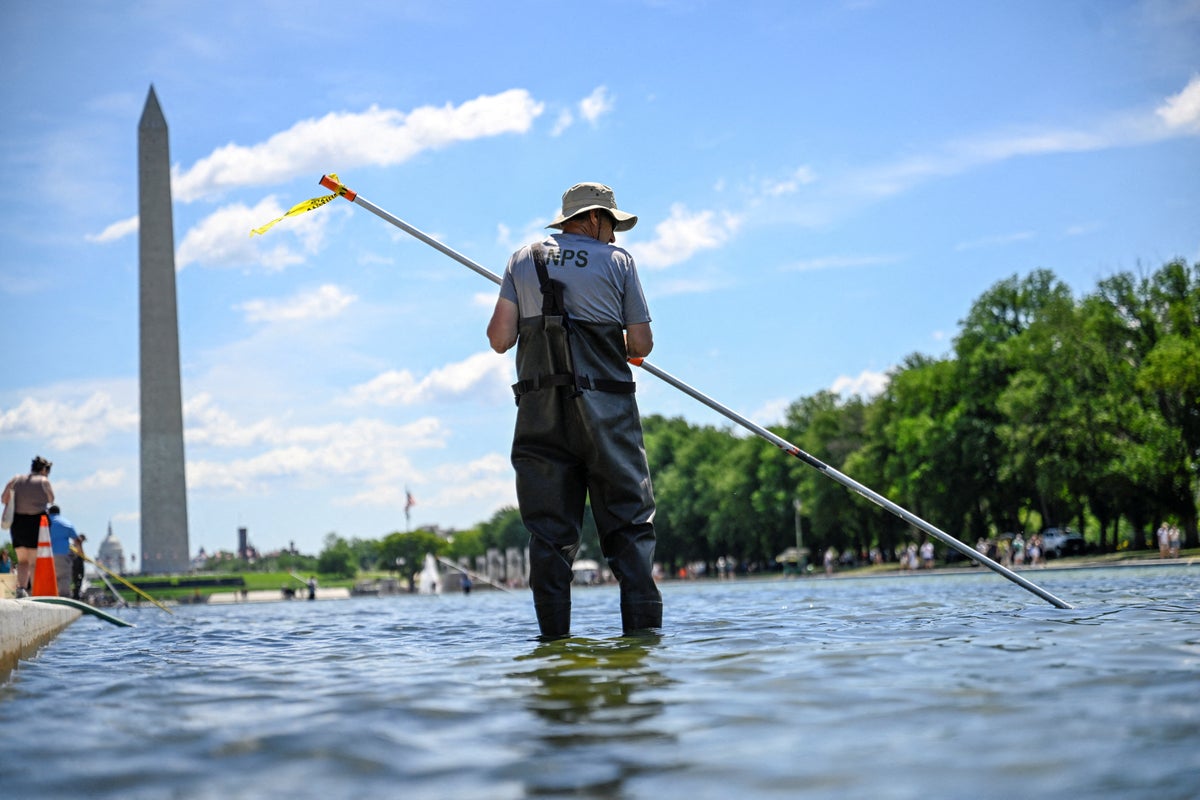
The federal government is preparing to drain the Lincoln Memorial Reflecting Pool less than three weeks after completing a rushed fourteen million dollar renovation. While the administration points to alleged acts of nighttime sabotage and political vandalism to explain the sudden peeling of the pool's new interior lining, public records and water management experts point to a far more predictable culprit: a failure to respect basic aquatic engineering, coupled with a highly irregular, fast-tracked procurement process. The decision to empty the six and a half million gallon basin threatens to leave the National Mall looking like an abandoned construction site just as Washington prepares for the country’s landmark 250th anniversary.
To understand why a major civic monument is peeling and choked with chartreuse-tinted algae, one has to look past the political rhetoric and examine the collision between high-end residential swimming pool aesthetics and massive, open-air water infrastructure. The current crisis is not a mystery to industrial engineers who manage large-scale public basins. It is the direct consequence of applying cosmetic solutions to deep structural realities.
The initial trouble stems from a fundamental misunderstanding of the pool's water source and structural behavior. In 2012, a major multi-million dollar overhaul modernized the century-old monument by disconnecting it from the capital’s expensive domestic drinking water system. Since then, the pool has drawn its supply from the nearby Tidal Basin. This is natural, untreated river water. It arrives rich in organic matter, ambient nutrients, and dormant spores. When exposed to intense summer heat and unobstructed sunlight across an area larger than six soccer fields, this water becomes a natural incubator for aquatic plant life.
The administration’s solution was to coat the massive concrete floor with a specialized industrial topping in a custom shade dubbed American flag blue. The stated objective was to create a bright, vibrant backdrop that would sharpen the reflection of the Washington Monument. However, basic thermodynamics worked against this plan from the first afternoon the floodgates reopened.
Darker colors absorb more solar radiation. By covering the historically muted, light-gray concrete floor with a deep blue coating, the project inadvertently turned the basin into a giant solar heat collector. Water temperatures spiked. Instead of suppressing organic growth, the dark floor acted as an accelerator for a stubborn genus of algae known as Desmodesmus.
+-------------------------------------------------------------------+
|               THE CORE THERMODYNAMIC CONFLICT                     |
+-------------------------------------------------------------------+
| BEFORE (Pre-2026):                                                |
| Light-gray concrete -> Reflects sunlight -> Lower water temps     |
|                                                                   |
| AFTER (Trump Renovation):                                         |
| Dark Blue Paint -> Absorbs solar heat -> Accelerated algae growth |
+-------------------------------------------------------------------+
When the water quickly turned a thick, murky green, the National Park Service was forced to react with aggressive measures. Crews began dumping massive quantities of hydrogen peroxide into the basin and running specialized underwater vacuum lines to pull up the accumulating mats of organic matter. It was during this emergency remediation that the second, more severe failure manifested. The newly applied industrial topping began to detach from the substrate, peeling away in large sheets and floating to the surface.
While the executive branch issued public statements claiming that bad actors had used blades to slash a 250-foot gash into the facade and poured destructive chemicals into the water, forensic engineering suggests a far more common structural failure: hydrostatic pressure and improper curing.
Applying an unvented, impermeable topping over an expansive, subterranean concrete slab that sits directly in a low-lying, marshy river basin creates a trap for moisture. As the intense June heat cooked the dark blue surface, moisture trapped beneath the concrete vaporized and expanded. Unable to escape, this pressure created blisters beneath the lining. When commercial pool vacuums were dragged across those stressed sections to clear the algae, the weakened material tore away from the base.
The timeline of the project further explains the physical failure. The entire operation was compressed into an eight-week window to ensure completion ahead of the July 4 celebrations. Industrial coatings applied to massive civic infrastructure require meticulous surface preparation, sandblasting, and extended curing windows under precise humidity conditions. Rushing the application through a volatile spring climate frequently compromises the chemical bond between the topping and the vintage concrete underneath.
The administrative trail behind the contract raises as many questions as the chemistry. The work was bypassed through standard competitive bidding channels, utilizing an expedited mechanism to award the contract to Atlantic Industrial Coatings. This firm had previously performed residential-scale pool work for commercial properties linked to the executive family's private portfolio. Furthermore, the specialized ozone nanobubbler filtration system intended to keep the water clear was sub-contracted to Greenwater Services, a firm tied to private neighbors at the Mar-a-Lago estate in Florida.
While the administration insists that the nanobubbler technology is successfully destroying the bloom and that the system simply requires a brief pause for physical repairs, regional water suppliers note that technology cannot entirely override geography. A shallow, stagnant body of water filled with untreated river inflow and baked under a mid-Atlantic summer sun will always revert to its natural state without massive, continuous chemical intervention.
Draining the structure now presents a fresh logistical headache. Emptying millions of gallons of chemically treated, algae-heavy water back into the local watershed requires coordination with environmental regulators to avoid disrupting local marine life. Once empty, the basin will require weeks of scraping, drying, and structural assessment before any patch repairs can even begin.
The immediate future of the National Mall’s center piece remains highly uncertain. Contractors are currently evaluating whether the entire fourteen million dollar coating must be stripped away or if localized bonding agents can stabilize the remaining sections. With the national spotlight intensifying as July approaches, the reflecting pool stands as a stark reminder that public infrastructure rarely responds well to the shortcuts of cosmetic real estate development.