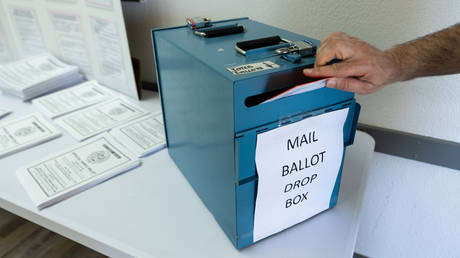
The mainstream media treated the US Supreme Court’s rejection of the post-election mail ballot challenges as a dramatic moral climax. To the left, it was a triumphant defense of democracy. To the right, it was a betrayal by a conservative-majority bench. Both sides are completely wrong.
The mainstream press lacks the institutional memory to understand how federal courts actually operate. They spun a narrative of judicial courage or judicial cowardice, ignoring the boring, bureaucratic reality. The Supreme Court did not rule that the mail-in voting expansions were flawless. They did not validate the shifting rules implemented by governors and election boards.
They simply did what the high court always does when handed a political hand grenade: they hid behind procedural technicalities to protect their own institutional capital.
This was not a grand declaration of constitutional clarity. It was a masterclass in judicial evasion. By refusing to rule on the merits of how mail-in ballots were handled, the justices chose short-term institutional peace over long-term legal certainty. The result is a broken, fragmented system where nobody knows the actual rules until after the votes are already counted.
The Lazy Consensus of Judicial Validation
Open any major newspaper from that week and you will see the same flawed premise. The pundit class universally agreed that the Court’s refusal to hear the challenges meant the underlying legal changes were sound. This shows a fundamental misunderstanding of appellate litigation.
A denial of certiorari is not an endorsement of the lower court's ruling. It carries zero precedential value. Justice Felix Frankfurter made this clear decades ago, noting that a denial means nothing more than that fewer than four justices thought the case should be heard at that specific time.
When the Court declined to hear the challenges regarding Pennsylvania’s mail ballot extensions, they did not say the Pennsylvania Supreme Court acted constitutionally. In fact, several justices openly signaled that they believed the state court had overstepped its bounds by rewriting deadlines set by the legislature. But the institutional instinct to avoid the spotlight won the day.
The media bought into the illusion that the courts exist to solve our biggest cultural and political fights. They do not. Federal courts are designed to be slow, reactive, and deeply risk-averse. When the stakes are at their highest, the justices routinely use procedural escape hatches to avoid making a decision that could delegitimize the bench in the eyes of half the country.
The Weapons of Mass Evasion: Standing and Laches
To understand how the Court escaped the fight, you have to look at the legal doctrines they used as shields. The most powerful of these is standing.
Under Article III of the Constitution, federal courts can only hear actual cases or controversies. You cannot sue just because you are angry or because you think a law is bad. You must show a concrete, particularized injury. In election law, showing that a rule might allow illegal votes is rarely enough to establish standing for an individual voter or candidate. The Court has systematically tightened standing requirements for decades, making it nearly impossible for citizens to challenge systemic election administration changes before an election happens.
Then comes the trap of laches. This is an equitable defense that essentially says, "You waited too long to complain, and changing things now would cause unfair chaos."
Look at the structural catch-22 this creates for challengers:
- If you sue before the election, your injury is labeled speculative, and the case is thrown out for lack of standing.
- If you sue after the election, the court rules that your challenge is barred by laches because you should have sued before the voting started.
It is a perfect procedural loop. I have watched corporate legal teams spend millions trying to navigate these exact types of judicial dead ends. The system is rigged toward inaction. The justices used this loop to perfection, ensuring they would never have to answer the real question: Can a state executive official or a state court unilaterally alter the rules passed by a state legislature?
The Ghost of Bush v. Gore
Every action the modern Supreme Court takes regarding elections is haunted by the year 2000. The intervention in Bush v. Gore damaged the court's public standing for a generation. It exposed the justices to the raw machinery of partisan politics, and the institution has been terrified of a repeat performance ever since.
Chief Justice John Roberts has spent his entire tenure trying to insulate the court from the perception of political bias. His judicial philosophy is rooted in institutional preservation. If the Court had taken the mail ballot cases and ruled on the merits, they would have been forced to either throw out hundreds of thousands of ballots or validate a system that millions of people distrusted. Either choice would have sparked a massive crisis of faith in the judiciary.
So, Roberts chose the third option: procedural silence.
Imagine a scenario where an umpire refuses to call a play at the plate because the stadium is too loud and both teams are ready to riot. That is what happened. The Court decided that preserving its own reputation was more important than resolving a critical constitutional conflict.
This is the trade-off that the cheerleaders of these rulings refuse to admit. The short-term win of avoiding a political explosion created a massive, long-term structural weakness in American election law.
The Cost of Judicial Silence
By refusing to clean up the mess, the Supreme Court guaranteed that future elections will be even more chaotic. We now have fifty different states operating under contradictory interpretations of federal election law.
In some jurisdictions, state courts are allowed to override election deadlines set by lawmakers under the guise of protecting the right to vote. In others, federal courts have stepped in to stop that exact behavior. This patchwork approach creates a landscape of total unpredictability.
Consider the core issue at the heart of the challenges: the Electors Clause of the US Constitution. It states that "Each State shall appoint, in such Manner as the Legislature thereof may direct," its electors.
Does "Legislature" mean strictly the elected lawmaking body, or does it include the state’s entire lawmaking apparatus, including courts and governors?
The Supreme Court had multiple opportunities to answer this clearly. By walking away, they left a massive gray area. Election administrators are now left guessing whether their emergency procedures will survive a post-election legal challenge. Voters are left wondering if their ballots will be thrown out retroactively because an appellate court decides a rule change went too far.
This is not how stable systems operate. Legal certainty is the foundation of public trust. When the highest court in the land refuses to provide that certainty, it abdicates its primary function.
Dismantling the Public Myths
Let us break down the standard questions that dominate public discussion on this topic, using the actual legal reality rather than partisan talking points.
Did the courts confirm there was no fraud?
No. The vast majority of these cases were dismissed on procedural grounds before any evidence could be presented, cross-examined, or evaluated. To say the courts verified the integrity of the vote is an outright lie. They simply stated that the parties bringing the suits lacked the standing to sue or filed their claims too late. The merits were left untouched.
Is mail-in voting inherently unconstitutional?
No, the Constitution gives states broad leeway to determine the manner of elections. The real question was never about the validity of mail-in ballots themselves; it was about who has the authority to authorize them. When a state health department or a governor extends a deadline without legislative approval, it creates a separation of powers crisis. That is the issue the Court refused to touch.
Did the conservative justices protect the administration?
Far from it. The conservative bloc was deeply divided. Justices Thomas, Alito, and Gorsuch repeatedly argued that the Court needed to take these cases to provide guidance for future election cycles. They understood that ignoring the problem would not make it go away. The center-of-gravity on the court, led by Roberts and joined by the newer appointees, chose the path of least resistance to avoid a political firestorm.
The Actionable Truth for the Future
If you are waiting for the federal judiciary to step in and create a clean, uniform, and trusted set of election rules, stop waiting. It is not going to happen. The Supreme Court has drawn its boundary line: they will not save political actors from the consequences of vague or poorly drafted election laws.
The fix will not come from a brilliant legal brief or a sudden burst of judicial courage in Washington. It has to happen at the state legislative level, long before the first ballot is printed.
States must draft explicit, airtight statutes that account for emergencies without leaving room for executive overreach. They must build fast-track judicial review mechanisms directly into their election codes so that challenges to rules are heard and settled months before the election, completely eliminating the laches defense.
Relying on the Supreme Court to settle partisan disputes is a failed strategy. The justices have made it clear that when politics enters the courtroom, they will lock the door and pretend nobody is home. Expecting anything else is pure delusion.