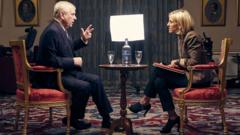
Picture the room before the camera light turns red.
The hum of an air conditioner settles into the heavy velvet drapes. Someone adjusts a lapel slightly off-center. Across from the subject sits an interviewer with a notebook full of dates, flight logs, and carefully phrased questions that sound polite on the surface while carrying the weight of a legal brief.
In November 2019, millions of people watched Prince Andrew sit down with the BBC’s Emily Maitlis at Buckingham Palace. For nearly an hour, viewers studied his posture, his cadence, his insistence that he had no recollection of ever meeting Virginia Giuffre at a London nightclub, his explanation about pizza at Woking, his claim that he stayed with Jeffrey Epstein in New York in December 2010 because it was the "honorable thing" to do in person rather than over the phone.
At the time, that interview felt like a self-contained earthquake. People dissected every phrase. Clips looped endlessly. It looked, for a brief moment, as though the public had seen the whole picture—or at least the entirety of what a prince was willing to admit under bright studio lights.
Then came the emails.
Document dumps, court unsealings, correspondence stretching across years, messages that did not have to survive the scrutiny of a primetime broadcast. Emails have a different texture than television. A television interview is a performance staged in real time, where a person tries to steer the narrative while the clock ticks. An email is a private artifact left behind in a digital drawer, written without knowing who might read it a decade later.
Comparing the two is not simply a parlor game for media critics. It forces a sharper question about memory, power, accountability, and what happens when public explanations collide with private paper trails.
The Architecture of a Television Alibi
Watch closely how a carefully rehearsed defense works on camera. It relies on neat boundaries.
On one side of the line sits the speaker: reasonable, slightly weary, perhaps a touch misunderstood by a noisy world. On the other side sit the allegations: messy, uncomfortable, inconvenient. When a public figure speaks to a major broadcaster, every sentence is weighed like gold bullion. A single slip can erase months of crisis management.
During the 2019 Newsnight interview, Prince Andrew leaned heavily on memory and character. He spoke about not sweating at the time due to a medical condition. He spoke about not being a "party animal." He spoke about traveling to New York to sever ties cleanly, framing a visit to a convicted sex offender’s home as an act of personal resolution.
To understand why those claims look different alongside later email disclosures, think of a brick wall built one word at a time. Each sentence in an interview is a brick. Individually, a brick might look solid enough. You can tap it with your knuckle and hear a dull thud. Yet when new documents surface—correspondence showing ongoing contact, logistical coordination, or tones far warmer than a "clean break" implies—those bricks start to rattle.
Let’s pause and be honest about the limits of any comparison like this. I wasn’t in that room at Buckingham Palace, and none of us can climb inside someone else’s head to separate genuine forgetfulness from convenient selective memory. Human recall is notoriously slippery. Ten years is a long time, even for people whose calendars are kept by staff.
Still, credibility is not built in a vacuum. It is built through consistency. When what someone says on television clashes with what they wrote—or what others wrote around them—in private messages, the gap between the two versions becomes the story itself.
Why Private Messages Hit Differently Than Broadcasts
Television demands polish. Email invites candor.
In a formal interview, a public figure knows the red light means the world is watching. Every pause feels loaded. Every denial is engineered to sound firm without sounding reckless. Even when an answer sounds baffling to viewers—like the famous pizza parlor remark—it is still part of a controlled broadcast environment.
Emails strip away the stage lighting. They show routine. They show who is checking in on whom, who is arranging travel, who is smoothing over awkwardness, and how relationships actually function day to day rather than how they are summarized in hindsight.
Here is a hypothetical scenario, purely to illustrate how written records change the weight of an old statement. Imagine a colleague tells you ten years after a major project that they cut ties with a controversial partner right after a single brief meeting. You might take them at their word. Then a stack of old messages turns up showing friendly check-ins, shared plans, and ongoing correspondence long after the supposed cutoff date. You wouldn’t even need a smoking gun to feel a jolt of skepticism. The timeline itself would tell a different story.
That is the shift happening whenever newly unsealed or reported Epstein emails are laid side by side with Prince Andrew’s BBC remarks. It isn’t just about one dramatic revelation or one sensational line. It is about pattern versus presentation.
When a public defense rests on distance—"I barely knew him," "I ended things properly," "I don’t remember"—any record showing proximity, familiarity, or continued contact erodes that distance. Even small details matter. A date out of sync. A tone that feels too cozy. A sequence of events that looks less like a decisive rupture and more like an ongoing connection that only became toxic in public view.
The Human Cost Behind the Headlines
It is easy to treat scandals involving royals and billionaires like a serialized drama. We argue over quotes. We rank moments by absurdity. We forget that behind the legal filings, the diplomatic fallout, and the media post-mortems are real human lives shaped by power imbalances.
For survivors, every new wave of documents and every old clip resurfacing on social media can reopen wounds that the public treats as content. While pundits debate phrasing and optics, real people live with the aftermath of abuse, exploitation, and institutional indifference.
There is also a quieter, broader stake here that affects ordinary citizens far removed from palaces or private jets.
Think about institutional trust. When powerful people explain themselves in high-profile interviews, those appearances function as a test of accountability. Viewers watch to see whether truth will prevail over spin, whether discomfort will lead to candor, and whether scrutiny will produce real consequences.
When later records complicate or contradict those public assurances, cynicism deepens. People start assuming that every polished explanation is just a script waiting to be exposed. That erosion of trust doesn’t stay neatly confined to one royal household or one disgraced financier. It bleeds into how the public views courts, media, elites, and truth itself.
I’ve spent enough time watching public controversies unfold to recognize that familiar sinking feeling when a neat story starts coming apart. At first, you think, Surely that can’t be right. Then another document surfaces, another timeline shifts, and you realize how carefully some narratives were constructed to keep uncomfortable truths out of frame.
Reading Between the Lines Without Losing Your Bearings
When headlines pair an old BBC clip with fresh email revelations, how should a thoughtful reader make sense of it all?
Start with discipline. Don’t confuse a contradiction on a minor point with proof of everything ever alleged, and don’t dismiss a pattern of contradiction as mere coincidence either. Good judgment lives in the space between outrage and gullibility.
Look at three practical questions whenever you compare a past interview against newer written records:
- Does the timeline hold up? Dates are stubborn things. If someone claims an interaction happened at one time or ended at a certain point, check whether correspondence points somewhere else.
- Does the tone match the claim? If a public statement describes a relationship as distant, formal, or strictly transactional, do the messages sound that way—or do they sound familiar, casual, or mutually accommodating?
- What is missing from the record? Emails rarely tell the whole story on their own, just as a single TV interview never captures every nuance. Look at what is corroborated across multiple sources rather than relying on a single fragment.
Notice how grounded that approach is. It doesn’t require sensationalism. It doesn’t require inventing motives where evidence is thin. It simply asks the evidence to stand up to basic scrutiny.
Power, Memory, and the Long Shadow of the Record
History has a funny habit of outliving press statements.
A television studio is bright, immediate, and ephemeral. A broadcast can dominate a weekend, spark a thousand hot takes, and then get buried under the next news cycle. Paper trails—and digital trails—are slower and far more patient. Years later, someone pulls a thread, unseals a file, or lines up an old transcript beside a saved message, and suddenly a moment that looked settled years ago feels wide open again.
For Prince Andrew, the 2019 BBC interview already altered his public standing almost overnight. Yet placing those remarks beside what Epstein-related emails reveal shows why that broadcast remains a touchstone: it wasn’t merely a bad PR night. It was a collision between a carefully framed public account and a much messier reality captured in writing.
Truth rarely arrives all at once in stories like this. Often, it surfaces piece by piece—a clip here, a page there, a quiet contradiction that refuses to stay quiet.
In the end, the camera light always goes off, the studio empties out, and the emails remain sitting right there in plain sight.