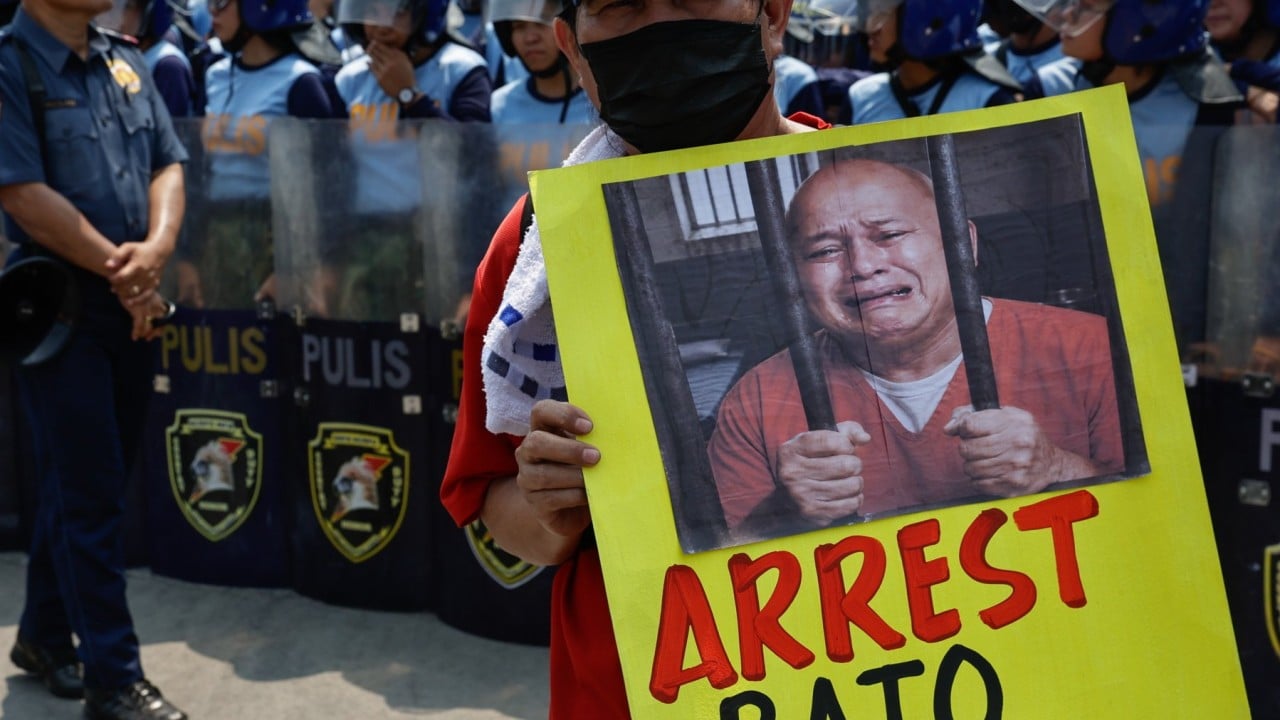
The political immunity that once shielded Ronald "Bato" dela Rosa is beginning to crack under the weight of international scrutiny and domestic shifts in power. As the primary architect of former President Rodrigo Duterte’s "Oplan Tokhang," the Senator now finds himself at the center of a tightening circle of investigations led by the International Criminal Court (ICC). The narrative is no longer just about the grim body count of the Philippine drug war; it has transformed into a high-stakes survival game where the hunters are rapidly becoming the hunted.
Dela Rosa’s current predicament stems from the sheer scale of the campaign he oversaw. Between 2016 and 2022, the Philippine National Police (PNP) reported over 6,000 deaths in anti-drug operations, though human rights organizations suggest the true figure exceeds 20,000. These were not just statistics. They were individuals, often from the poorest urban communities, killed in what the ICC suspects were systematic extrajudicial executions rather than legitimate law enforcement encounters.
The Breakdown of Political Protection
For years, the alliance between the Duterte and Marcos families provided a firewall against accountability. That alliance has disintegrated. President Ferdinand Marcos Jr. has signaled a departure from the previous administration’s isolationist stance regarding the ICC. While the Philippine government still officially questions the court’s jurisdiction, the aggressive rhetoric defending Dela Rosa and Duterte has cooled into a more pragmatic, wait-and-see approach.
This shift leaves Dela Rosa exposed. He is no longer the untouchable police chief riding high on populist fervor. He is a legislator in an administration that is increasingly keen on rebranding the Philippines as a nation that respects the international rule of law. The political machinery that once functioned as a shield is now being recalibrated, and Dela Rosa appears to be an inconvenient remnant of a bygone era.
The Mechanics of the ICC Investigation
The ICC's focus on Dela Rosa is not based on hearsay. The Prosecutor’s office has spent years compiling testimonies, forensic reports, and internal police documents. The investigation centers on the concept of "command responsibility." Under international law, a commander can be held liable for crimes committed by subordinates if they knew, or should have known, about the crimes and failed to prevent or punish them.
In Dela Rosa’s case, the evidence is often public and self-incriminating. His own speeches during his tenure as PNP Chief frequently encouraged aggressive action that bypassed traditional judicial processes. He didn't just command the force; he set the tone.
- Systemic Intent: The ICC looks for patterns. The similarity in police reports across different regions—claims that suspects "fought back" (nanlaban) despite evidence of close-range shots—suggests a top-down policy rather than isolated incidents of police misconduct.
- Failure to Prosecute: Out of thousands of killings, only a handful of cases resulted in convictions for police officers. This lack of internal accountability is a primary trigger for ICC intervention, as the court only steps in when a national government is "unwilling or unable" to prosecute.
The Farce of Legislative Immunity
Dela Rosa has often retreated behind his status as a Senator, suggesting that his mandate from the people somehow nullifies international legal obligations. This is a fundamental misunderstanding of how sovereign immunity works in the face of alleged crimes against humanity. Legislative immunity protects a senator from libel or arrest for minor offenses while the Senate is in session; it is not a blanket pardon for large-scale human rights violations.
The "farce" often referenced by critics is the Senator’s attempt to paint himself as a victim of political persecution. During Senate hearings, he has alternated between defiance and emotional appeals, portraying the drug war as a necessary evil for the nation's survival. This rhetoric is losing its sting. As more families of victims come forward to share their stories in public forums, the "heroic" narrative of the drug war is being replaced by a more nuanced and tragic reality of state-sponsored violence.
The Quad-Committee Pressure
While the ICC looms in the background, a more immediate threat has emerged from the Philippine House of Representatives. The "Quad-Committee"—a powerful alliance of four House panels—is currently probing the links between illegal gambling (POGOs), the drug trade, and the extrajudicial killings of the Duterte era.
This domestic investigation is arguably more dangerous for Dela Rosa than a court in The Hague. The committee has the power to summon witnesses who were previously terrified to speak. Recent testimonies from former police officials have begun to connect the dots between reward systems for killings and the highest levels of the PNP command structure.
"The money came from the top. We were told there was a quota, and there was a prize for every 'neutralization'."
— Summary of recent testimony from a high-ranking PNP whistleblower.
These revelations strip away the "law and order" veneer of the drug war. If it can be proven that a financial incentive system existed, the defense of "legitimate operations" collapses. It turns law enforcement into a bounty system.
Fugitive or Fighter
The question now is whether Dela Rosa will choose to face the music or become a fugitive. If the ICC issues an arrest warrant, the Philippine government faces a crossroads. They could ignore it, further straining relations with the West, or they could facilitate it to demonstrate their commitment to human rights.
Dela Rosa has publicly stated he would rather be "hanged by a Filipino court" than face foreigners. This nationalist posturing is a classic diversion. The issue isn't about the nationality of the judges; it is about the transparency of the evidence. For a man who built his career on the image of a "tough guy" who stands his ground, the prospect of an international trial represents the ultimate loss of control.
The Shift in Public Sentiment
Public opinion in the Philippines is notoriously volatile, but the data suggests a slow cooling of the "Duterte fever." While the former president remains popular, there is a growing appetite for accountability regarding the excesses of his administration. People are beginning to ask why the "Big Fish" in the drug trade were rarely caught while thousands of small-time users were killed in the streets.
Dela Rosa’s political future depends on maintaining a support base that views him as a protector. However, as the details of the "Tokhang" operations are laid bare in the House of Representatives, that image is being replaced by one of a bureaucratic enforcer who oversaw a period of unprecedented carnage.
The Role of the PNP Today
The current leadership of the Philippine National Police is in a delicate position. They must distance themselves from the legacy of the Dela Rosa years to rebuild public trust, yet many of the officers who participated in those operations are still in the ranks. The "re-greening" of the force—moving away from a culture of violence—is a slow and painful process.
Dela Rosa’s influence within the police force was once absolute. Today, it is a liability. New leadership is focused on "bloodless" anti-drug campaigns, emphasizing rehabilitation over execution. Every success of this new approach serves as a silent indictment of the methods Dela Rosa championed.
The Legal Dead End
There is no easy exit strategy for the Senator. If he remains in the Philippines, the Quad-Committee will continue to peel back the layers of his administration. If he travels abroad, he risks being detained in a country that recognizes ICC warrants. His world is shrinking.
The defense that he was "just following orders" or "doing what was necessary" has historically failed in international tribunals. From Nuremberg to Rwanda, the precedent is clear: the scale of the atrocity dictates the level of accountability. You cannot claim you were protecting the state while the state’s own machinery was being used to systematically eliminate its citizens without due process.
The Reality of International Law
The ICC does not have its own police force. It relies on the cooperation of member states. In the past, this has allowed leaders to evade justice for years. However, the Philippines is currently seeking deeper economic and military ties with the United States and the European Union to counter regional threats. Human rights records are a standard component of these diplomatic negotiations.
Marcos Jr. is aware that shielding Dela Rosa and Duterte indefinitely comes at a high cost to the country's international standing. The "special relationship" that once protected the Duterte administration is gone. In its place is a cold, transactional diplomacy where the Senator might eventually be traded for geopolitical stability or economic concessions.
The Weight of the Evidence
The most damning evidence against Dela Rosa isn't just the testimony of survivors; it is the paper trail. The "Command Circulars" issued during his time as PNP Chief explicitly laid out the framework for the drug war. These documents, once thought to be confidential or destroyed, are surfacing in legislative inquiries.
They describe a "neutralization" strategy that left little room for arrests. In the vocabulary of the drug war, "neutralize" became a synonym for "kill." When a General issues a circular using such language, and a spike in deaths immediately follows, the link is not circumstantial. It is direct.
The End of the Farce
The narrative of the "lovable tough guy" Bato—the man who cried in hearings and performed in skits—has reached its expiration date. The reality of the thousands of grieving families, the orphaned children, and the bullet-riddled alleys of Manila is far more enduring than a political persona.
Dela Rosa is now a man fighting on two fronts: a legal battle in The Hague and a political battle in Manila. In both arenas, the evidence is mounting, and his allies are thinning. The bravado that defined his rise to power is conspicuously absent in his recent public appearances. He looks like a man who knows the clock is ticking.
The transition from a national hero to a target of international justice is rarely swift, but in the case of Bato dela Rosa, it appears inevitable. The farce has ended, and the hard, cold reality of the law has begun to take its place. The Philippine government is no longer a monolithic shield; it is a complex organism that is slowly prioritizing its own survival over the protection of its former enforcers.
Justice in the Philippines has often been described as a "slow grind," but the momentum has shifted. The victims of the drug war, once silenced by fear, are now the most powerful voices in the room. Their testimonies are the foundation of the ICC’s case and the driving force behind the domestic inquiries. Dela Rosa is no longer the one asking the questions; he is the one who must finally provide the answers.
The Senator often speaks of his legacy, but legacy is not something a leader chooses for themselves. It is written by the survivors and the records left behind. For Dela Rosa, that legacy is increasingly defined by the blood-stained streets of a campaign that promised safety but delivered a crisis of conscience. The high-end villas and the senate seat provide little comfort when the shadow of an international warrant falls across the doorstep. The path forward for the Philippines requires a confrontation with this past, and Ronald Dela Rosa is the living embodiment of that necessity. There is no longer any room for theater. Only the facts remain.