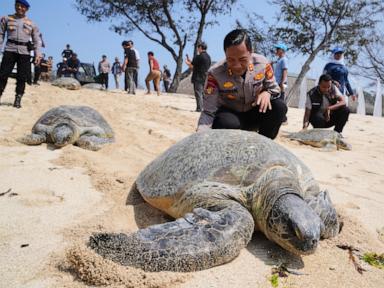
Every few months, the headlines roll in with clockwork precision. Twenty green sea turtles, rescued from a smuggling raid in Bali, flapping their flippers on a sun-drenched beach before sliding into the surf. Cameras flash. Conservationists smile. The public breathes a collective sigh of relief, convinced that a wrong has been righted and nature has been healed.
It is a comforting narrative. It is also largely an ecological illusion. Meanwhile, you can explore related stories here: Why Ealing is Wasting Time Naming Beavers While the Real Urban Ecology Burns.
If you track what actually happens to most rehabilitated reptiles once the media departs, the story turns bleak. We treat wildlife conservation like a Hollywood redemption arc, substituting emotional theater for rigorous biological management. Returning stressed, habituated, or improperly vetted chelonians straight to open water without addressing the systemic drivers of their capture is not conservation. It is public relations disguised as biology.
Let us dismantle the feel-good consensus. To understand the bigger picture, we recommend the recent article by Al Jazeera.
The Myth of the Instant Return
The standard script dictates that once authorities seize trafficked animals from poachers, the immediate priority is repatriation. Pack them into crates, haul them to the coast, and let the ocean reclaim its own.
Nature does not work that way.
Green sea turtles (Chelonia mydas) are complex migratory navigators with intricate physiological tolerances. A juvenile or sub-adult turtle pulled from a cramped smugglers' holding tank or a dirty market stall is not just inconvenienced; it is immunocompromised, stressed, and often suffering from dietary deficiencies or internal damage from swallowing foreign debris.
When you dump these animals back into the surf without a quarantine protocol or rigorous veterinary clearance, you aren't saving a population. You are potentially introducing pathogens into wild ecosystems. Captive environments are petri dishes for antibiotic-resistant bacteria and parasites. Throwing a carrier of a novel pathogen into a pristine coral reef is an ecological grenade.
Furthermore, rehabilitation centers often fail to test for behavioral imprinting. Turtles raised or held by humans for extended periods lose their innate warfulness. They associate human shapes with food or safety. Drop them onto a beach, and instead of diving for deep water or fleeing predators, they paddle toward the nearest tourist holding a smartphone. They are not returning to the wild; they are walking into a buffet line for local apex predators or drifting right back into the nets of the same coastal fishers who profit from the black market.
The Smuggling Chain Breaker That Isn't
Bali remains a central node in the Southeast Asian wildlife trafficking network. Demand for turtle meat, calipee, and decorative shell crafts persists despite international bans under CITES Appendix I.
When law enforcement executes a raid and seizes twenty turtles, the headline treats the event as a major blow to the syndicate. It is not. It is a minor inventory write-off for transnational criminal networks.
Poachers operate on volume and margin. The cost of losing a single batch of twenty green turtles is baked into the operating expenses of the underground trade. Raids disrupt local middlemen, but they rarely touch the financial orchestrators or corrupt officials who protect the trade routes.
More importantly, returning those twenty animals does nothing to alter the economic gravity of the local coastal communities. If a fisherman can make a month's wage in a single night by netting a nesting green turtle on a secluded beach in East Java or the Nusa Penida islands, government photo-ops on Kuta Beach will not stop him. Conservation fails when it treats poverty and economic desperation as moral failings rather than structural realities.
What Real Marine Conservation Looks Like
If we want to protect Chelonia mydas, we have to abandon the performative optics of the beach release and face uncomfortable biological and economic truths.
First, we must accept that not every rescued animal is a candidate for release. Permanent sanctuary placement, educational facilities, or managed breeding programs—while less photogenic—are often the only humane and safe endpoints for animals that cannot reintegrate into wild ecosystems without becoming immediate casualties.
Second, tracking matters more than tagging. If a turtle goes back into the water, where does it go? Without satellite telemetry, we are just guessing. Too many conservation budgets are spent on the spectacle of the release ceremony rather than the grueling, unglamorous telemetry work required six months down the line to see if the animal survived its first week.
Third, we have to pivot from reactive enforcement to proactive habitat and economic defense. Protecting seagrass meadows—the primary foraging grounds for adult green sea turtles—matters infinitely more than saving twenty individuals if the local coastal waters are choked by agricultural runoff and plastic pollution. If the habitat is dead, a successful beach release is merely a delayed execution.
Stop measuring conservation success by how many animals look good in a morning news broadcast. Start measuring it by the hard, quiet metrics of survivorship, habitat preservation, and the dismantling of the black-market supply chains that put those turtles in cages in the first place.
The ocean does not care about your applause. It cares about whether the ecosystem can sustain life when the cameras turn off and everyone goes home.