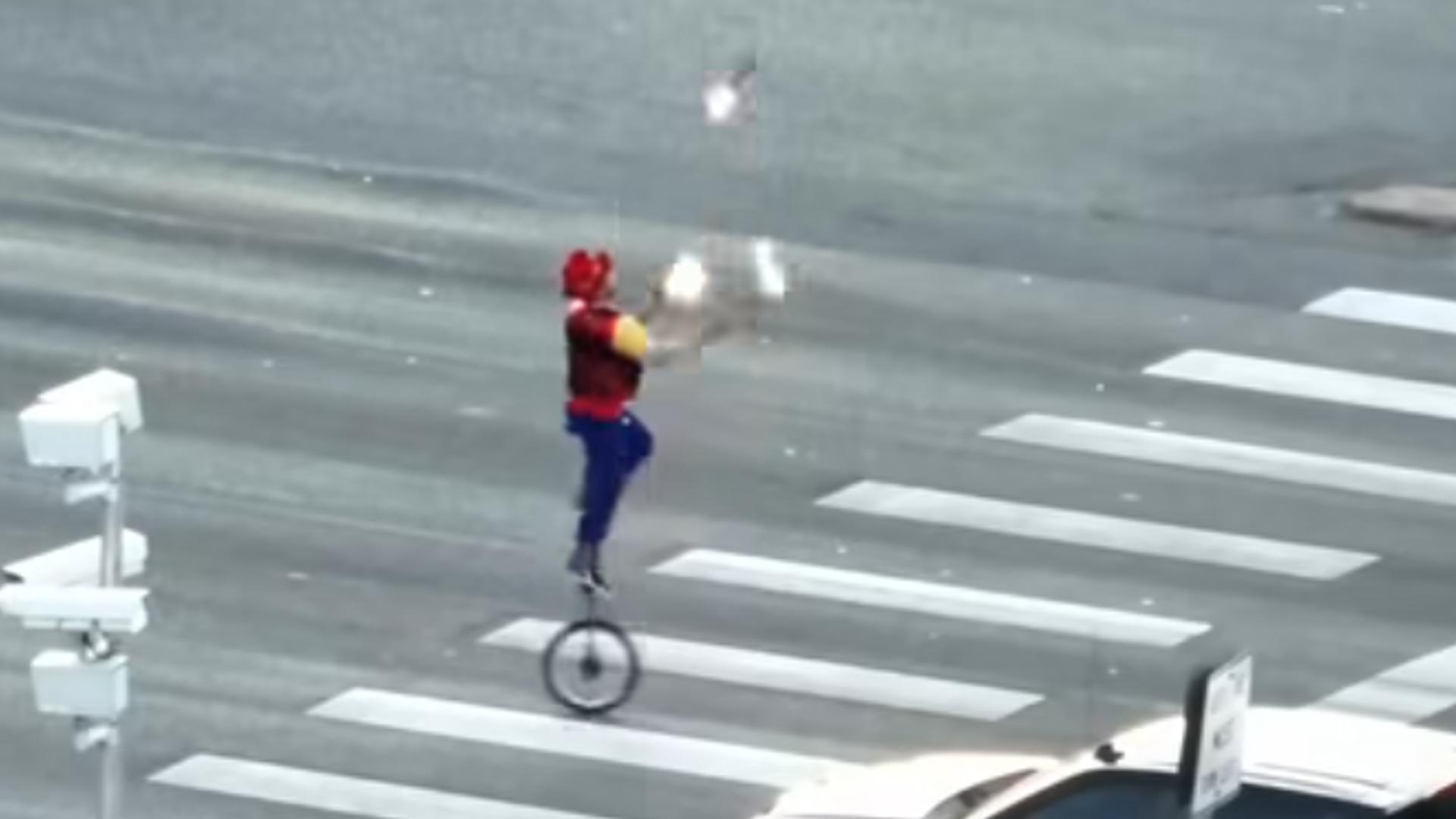
The intersection of specialized performance art and urban transit infrastructure creates a high-friction environment where traditional safety protocols and entertainment value collide. When a fire-juggling unicyclist occupies a pedestrian crossing, they are not merely performing; they are introducing a volatile variable into a highly regulated spatial system. To understand this event, one must analyze the physics of the performance, the legal frameworks of public thoroughfares, and the cognitive load placed on both the performer and the observers.
The Mechanics of Triple-Axis Performance
The difficulty of fire-juggling on a unicycle within a crossing relies on the management of three distinct physical challenges simultaneously. This is a task of extreme multitasking that requires the automation of motor skills to prevent catastrophic failure.
- Dynamic Equilibrium: Unlike a bicycle, a unicycle lacks longitudinal stability. The performer must maintain balance through constant micro-adjustments of the pedals and core. Adding a stationary or semi-stationary context, such as waiting for a light to change or performing within the confines of a marked crossing, increases the difficulty by removing the centrifugal stability found at higher speeds.
- Object Manipulation and Parabolic Consistency: Juggling three or more fire torches requires a consistent release point and height. In an outdoor environment, wind velocity and thermal updrafts from the torches themselves introduce unpredictability. The performer must compensate for environmental air currents while keeping the unicycle’s base stable.
- Combustion Management: The use of fire introduces a chemical risk. The torches typically utilize a fuel like Isoparaffin or kerosene, which have specific flash points. The primary risk factor is "fuel spray" or "wick shedding," where centrifugal force from the juggle throws uncombusted fuel into the environment or onto the performer.
Spatial Economics of the Pedestrian Crossing
A pedestrian crossing is a highly optimized node in urban planning, designed for the efficient movement of human capital across vehicular lanes. The introduction of a "busker" or performer into this space reconfigures the utility of the area from a transit corridor to a temporary theater. This shift creates a bottleneck effect.
The efficiency of a crossing is measured by its throughput. When a performer occupies the center of this space, they reduce the available width for pedestrians, forcing a compression of flow. This increases the probability of physical contact between bystanders, which in a high-traffic urban environment, elevates the risk of secondary accidents. Furthermore, the visual distraction—referred to as "attentional blink"—causes drivers to divert their focus from the signal or other pedestrians toward the performer. This momentary lapse in situational awareness is the primary driver of low-speed collisions in performance-heavy zones.
Legal and Liability Frameworks
Most municipal codes categorize the act of fire-juggling on a public street under several distinct violations, regardless of the performer’s skill level. The legal tension exists between the right to freedom of expression and the duty to maintain public safety.
- Encroachment and Obstruction: By remaining stationary in a crossing, the performer violates the primary function of the infrastructure. Most jurisdictions define obstruction as any act that impedes the "free and comfortable" use of public space.
- Fire Codes and Pyrotechnic Regulation: The use of open flames in proximity to the public usually requires a specific permit and a designated safety perimeter. The lack of a "fire watch" (a second person with a suppression device) makes the performer liable for any property damage or personal injury resulting from fuel spills or dropped torches.
- Distraction Liability: If a vehicular accident occurs because a driver was watching the performance, the performer can be held civilly liable for "creating a nuisance" or contributing to the conditions of the accident.
The Cost Function of Public Spectacle
The "value" of a street performance is often calculated by the audience in terms of novelty, but the true cost is borne by the city and the transit system. We can model the risk using a basic probability density function.
$$R = P(f) \times C(s)$$
Where $R$ is the total risk, $P(f)$ is the probability of a failure (dropped torch, loss of balance), and $C(s)$ is the consequence of that failure in a specific setting (presence of flammable materials, density of the crowd). In a standard park, $C(s)$ is low. In a busy intersection, $C(s)$ increases exponentially due to the proximity of fuel tanks in vehicles and the high density of people who cannot easily retreat.
The performer operates on a high-reward, high-risk margin. The visual contrast of fire against a grey urban backdrop attracts maximum attention, which translates to higher immediate tips (revenue), but the overhead—potential fines, gear damage, and physical injury—is rarely fully accounted for in the performer's business model.
Cognitive Load and Driver Distraction
The human brain is hardwired to prioritize the movement of bright, flickering objects (fire) and erratic motion (unicycling). This biological imperative, known as "stimulus-driven attentional capture," means that drivers at the intersection are cognitively unable to ignore the performer.
This creates a reaction time lag. If a light turns green or a pedestrian enters the lane unexpectedly, a driver who has been tracking the arc of a fire torch will take approximately 0.5 to 1.5 seconds longer to process the new information and apply the brakes. In urban safety, 1.5 seconds at 30 mph is the difference between a controlled stop and a 66-foot slide.
Strategic Operational Forecast
Municipalities seeking to mitigate the risks associated with high-stakes street performance must move away from total bans, which are difficult to enforce and often ignored. A more effective strategy involves the creation of Performance Transit Zones (PTZs).
These are designated areas within 50 feet of high-traffic crossings that provide the visibility performers crave without obstructing the physical flow of the crossing itself. By providing a fixed "stage" with fire-retardant flooring and a clear line of sight for pedestrians—but a restricted one for drivers—cities can decouple the entertainment value from the infrastructure risk.
The future of urban performance lies in this spatial separation. As cities become more dense and transit systems more automated, the tolerance for "random variables" like a fire-juggling unicyclist in a live lane of traffic will drop to zero. Performers who fail to adapt by moving their acts to controlled, high-visibility "buffer zones" will find themselves excluded from the urban core entirely through aggressive surveillance and immediate fine structures. The move toward "Smart Cities" will eventually automate the detection of such anomalies, triggering immediate responses that make the current era of "caught on camera" spontaneity a historical relic.