The mud cools between bare toes before the sun even clears the horizon. It is heavy, damp, and smells of ancient earth and the promise of rain.
Thousands are already moving. They walk in silence, a vast human tide flowing toward the waters of Hora Arsadi. They carry bundles of green grass and yellow flowers—Adey Abeba, the blossoms that signal the end of the rains and the turning of the year. For decades, carrying those flowers was an act of quiet defiance. Today, the air vibrates with something else entirely.
Sound.
Drums beat a deep, chest-caging rhythm. Voices rise in unison, a swelling wave of song that drowns out the memory of checkpoints, bans, and the heavy boot of state suppression. The festival of Irreecha is breathing again. And it is inhaling deeply.
The Cost of a Song
History is written by conquerors, but it is felt by those who are told to forget their songs.
For the Oromo people, the largest ethnic group in Ethiopia, Irreecha is not merely a seasonal gathering. It is a thanksgiving. It is an annual pilgrimage to thank Waaqa, the creator, for life, peace, and the harvest. It marks the transition from the dark, punishing months of heavy rainfall—the Kremt—to the sunlit warmth of the dry season.
Yet, for generations, expressing that gratitude was treated as a political threat.
Imagine standing on the shores of a sacred lake, your hands full of fresh grass to bless the water, knowing that soldiers are watching your every move. Imagine whispering your prayers because shouting them could get you arrested, beaten, or worse. Under successive regimes, Oromo cultural expressions, language, and public gatherings were systematically marginalized. The state feared unity. It feared a collective identity that could not be easily controlled or rewritten from a distant capital.
So, they banned the gathering. They fenced off the lake. They turned a sacred rite of gratitude into a forbidden crime.
Culture, however, is stubborn. It goes underground like a root system during a drought. It survives in kitchens, in whispered lullabies, and in the stubborn memories of elders who refused to let the fire go out. When the political landscape shifted dramatically in recent years, opening a narrow window for public expression, the response was not a gentle trickle. It was a flood.
Standing at the Water's Edge
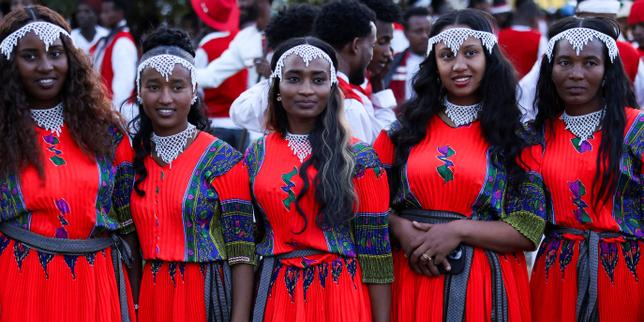
To understand the sheer magnitude of modern Irreecha, you have to look past the aerial photographs of millions of people dressed in vibrant white and red cotton garments. You have to look at the faces.
Consider a man named Gemechu. He is standing waist-deep in the shallows of the lake. Water drips from his beard. In his hand, he holds a cluster of green grass high above his head, dipping it into the water and splashing it over the shoulders of those standing near him. It is a blessing of purification and renewal.
Gemechu remembers the dark years. He remembers when attending Irreecha meant hiding your traditional clothing in a bag until you reached the outskirts of the town, changing behind bushes, and always keeping an eye on the horizon for dust clouds kicked up by military trucks.
"They tried to make us strangers in our own land," Gemechu says, his voice cutting through the distant roar of the crowd. "They told us our god had a different name, our language had no value, and our thanksgiving was a riot waiting to happen. But the river does not care about decrees. The water remembers."
When millions gather in a single space to celebrate peace and survival, the atmosphere defies simple categorization. It is joyful, yes. There is dancing that shakes the dust into the air, and laughter that echoes across the water. But underneath the celebration lies a profound gravity. Every song sung in the native Afaan Oromo language is a reclamation. Every raised bundle of grass is a flag of cultural endurance.
The Anatomy of a Revival
A cultural renaissance rarely happens overnight. It is built on the bruised backs of those who endured and the relentless persistence of a younger generation refusing to inherit silence.
In recent years, the central government has officially recognized and even supported the celebration, transforming it from an underground act of survival into a massive national event. Millions now travel not just from across Ethiopia, but from the global diaspora—from Minneapolis, Toronto, and London—just to touch the water on this specific morning.
Yet, rapid scaling brings its own complex questions.
When an ancient, localized ritual is broadcast to millions and becomes a tourism magnet, the intimate spiritual core risks being drowned out by the noise of modern spectacle. Politicians arrive in tailored suits, flanked by security details, eager to be photographed holding the sacred grass. Commercial stalls sprout up at the edges of the sacred grounds, selling plastic trinkets alongside traditional handicrafts.
Can a sacred thanksgiving survive its own monumental popularity?
The answer lies in the hands of the people who treat the mud beneath their feet not as a stage, but as an altar. As long as the elders continue to teach the youth why the grass must be green and why the water must be blessed, the commercial gloss remains just that—a thin layer of dust on top of a deep, flowing current.
The Final Chord
The sun climbs higher, burning off the morning mist over the lake. The drums slow their frantic pace, settling into a steady, hypnotic heartbeat that feels less like music and more like the pulse of the earth itself.
Tens of thousands of hands reach down simultaneously, scooping up the cool, dark mud and marking their foreheads and cheeks. It is a physical seal, a mark of belonging that cannot be washed away easily.
The crowd begins to disperse, not with the chaotic rush of a modern concert ending, but with the quiet, orderly grace of a river returning to its bed. They walk back toward the towns and villages, carrying the scent of damp earth and crushed grass into the rest of the year.
The silence is gone. The water has been blessed. And the river keeps moving forward.