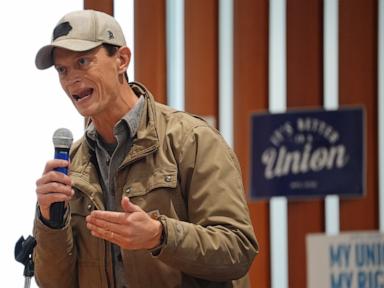
Political pundits love a lazy horse race. Give them a Democrat with statewide name recognition and a Republican outsider with deep pockets, and they immediately write the exact same script about "testing the party's grip on power."
They are looking at the wrong chessboard.
The 2026 Iowa gubernatorial matchup between Democratic State Auditor Rob Sand and Republican Zach Lahn is not a referendum on the GOP trifecta at Terrace Hill. Framing it as a traditional red-versus-blue tug-of-war misses the structural realignment tearing through Midwestern politics. When political analysts treat this race like a standard midterm temperature check, they ignore the fact that Iowa's partisan gravity shifted permanently over the last decade.
I have watched national strategists burn tens of millions of dollars in flyover states chasing ghosts from the Obama era. They look at voter registration spreadsheets, see a narrowing margin in a suburban county, and convince themselves a wave is building. It never arrives. Why? Because they confuse candidate appeal with party realignment.
If you want to understand what is actually happening between Rob Sand and Zach Lahn, stop reading national wire copy and start looking at the mechanics of populist branding, institutional fatigue, and the collapse of traditional party infrastructure.
The Myth of the Vulnerable Trifecta
The conventional wisdom goes like this. Republicans have controlled the Iowa governor's office, the state House, and the state Senate for years. They passed sweeping tax cuts, overhauled public education funding through Education Savings Accounts, and restricted abortion access. Eventually, the theory claims, the pendulum swings back. Voters get tired of one-party rule, a charismatic Democrat steps up, and balance is restored.
That theory is dead.
Political science data from organizations like the Pew Research Center and decades of election returns analyzed by the Cook Political Report demonstrate a clear reality across the rural Midwest. Ticket-splitting has collapsed. In 2012, voters routinely pulled the lever for a Republican president and a Democratic senator, or vice versa. Today, federal partisanship dictates down-ballot behavior with ruthless efficiency.
When Kim Reynolds decided not to seek another term, the political class instantly declared the seat wide open. They treated her departure as a vacuum that automatically favors the most prominent Democrat in the state. That assumption relies on a fundamental misunderstanding of why Reynolds won in the first place. She did not hold Iowa because of sheer personal charm; she held it because the Iowa Democratic Party hollowed out outside of Polk, Johnson, Linn, and Story counties.
Rob Sand knows this. His entire political survival strategy is built on rejecting the national Democratic brand while retaining its fundraising apparatus. Calling this race a test of Republican control implies that a Sand victory would signal a broader Democratic resurgence across the state legislature. It would not. Even in a scenario where Sand wins the governor's chair, he would walk into Des Moines facing entrenched Republican majorities in both chambers who have zero incentive to compromise with him. A Sand victory would not break the GOP grip on state government; it would simply create a permanent veto stalemate while Republicans continue to run the legislative machinery.
What Everyone Misses About Zach Lahn
On the other side of the ballot sits Zach Lahn, and the mainstream coverage of his candidacy is equally flawed. Reporters love to slot wealthy business figures and agricultural operators into the tired "outsider versus career politician" trope. They compare him to other self-funding executives who entered politics thinking a corporate resume translates to legislative competence.
This misses the real friction inside the Iowa Republican Party.
Lahn is not running against Rob Sand; he is running against the exhaustion of the Des Moines establishment. After years of complete legislative dominance, the Iowa GOP has developed the exact same bloat and insularity that destroyed the state's Democratic Party twenty years ago. Lobbyists write the bills. Leadership dictates the floor votes. Grassroots activists in places like Sioux County or Dubuque feel like their only job is to knock doors and shut up once the session gavel drops.
Lahn's appeal to primary and general election voters stems from a deep suspicion of careerist politics, even when those careers are built inside their own party. However, there is a massive trap waiting for candidates who run on pure business credentials. Running a private enterprise—whether in agriculture, venture capital, or manufacturing—operates on top-down command. You set a metric, allocate capital, and fire people who miss targets.
State government does not work that way. You cannot fire a state senator. You cannot liquidate an underperforming county school district without triggering a constitutional crisis and a localized revolt. I have seen dozens of successful executives step into statehouses and get eaten alive during their first budget cycle because they treated lawmakers like middle managers. Lahn has to prove he understands the difference between balance-sheet efficiency and political coalition building, or he will spend four years getting outmaneuvered by members of his own caucus.
The Watchdog Illusion and the Rob Sand Paradox
Let us talk honestly about Rob Sand, because the media coverage surrounding him borders on hagiography.
Sand is undeniably the most gifted retail politician the Iowa Democratic Party has produced in a generation. He hunts. He drives a truck. He visits all 99 counties every year and actually listens to people in rural diners instead of lecturing them. As State Auditor, he built an impeccable brand as a nonpartisan watchdog who goes after waste regardless of which party signs the checks.
Here is the contrarian truth that Democratic donors in New York and California refuse to hear. Being a great auditor makes you terrible preparation for being an ideological executive.
An auditor's job is retrospective. You look at money that has already been spent, find the receipts that do not match, and issue a report condemning the incompetence. Everyone loves the auditor because the auditor never has to make a binary policy choice that alienates half the electorate. You can oppose waste in Des Moines without ever taking a hard stand on water quality regulations, collective bargaining rights, or corporate tax structures.
The moment you step into the governor's office, the watchdog cloak vanishes. You have to sign a budget. You have to appoint agency directors. You have to take ownership of every failure in the Department of Health and Human Services and every pothole on Interstate 80.
Furthermore, Sand faces an impossible structural math problem. To win statewide in Iowa, he needs to run up massive margins in the urban centers—Des Moines, Iowa City, Cedar Rapids—while simultaneously holding his losses in rural counties to historic lows for a modern Democrat.
Think about what that requires. Urban progressive activists demand aggressive action on climate policy, social issues, and public education funding. Rural independent voters want lower property taxes, fewer Environmental Protection Agency mandates, and cultural moderation. You cannot satisfy both groups once you stop auditing budgets and start writing laws. Sand's entire political persona relies on ambiguity. A gubernatorial campaign strips away ambiguity with brutal speed.
Dismantling the Real Questions Voters Are Asking
If you look at what Iowans are actually searching for and debating at county fairs, they are not asking about "the future of the Republican trifecta." They are asking practical, self-interested questions that political pundits consistently misinterpret.
Does the governor actually control Iowa's economy?
Voters routinely blame or credit the governor for the price of corn, interest rates, and local property taxes. The premise is flawed. Iowa's economy is overwhelmingly driven by global commodity markets, Federal Reserve monetary policy, and federal farm bills passed in Washington, D.C. A governor can tweak marginal income tax rates or hand out targeted economic development grants through the Iowa Economic Development Authority, which often amount to corporate welfare that picks winners and losers. Neither Sand nor Lahn can control fertilizer costs or export tariffs. Anyone promising to single-handedly "fix" the rural economy from Terrace Hill is selling snake oil.
Will a new governor reverse recent education and tax laws?
Many public school advocates view this race as a chance to repeal Education Savings Accounts, while fiscal conservatives view it as a way to eliminate the state income tax entirely. Both expectations ignore legislative reality. Even if Sand wins, a Republican-controlled legislature will not put a repeal bill on his desk. Conversely, even if Lahn wins, the state is already staring down the barrel of massive revenue reductions from previously passed tax cuts. Economic gravity will force whoever wins to confront a tightening state budget. You cannot cut taxes to zero while simultaneously funding Medicaid, K-12 education, and infrastructure without eventually hitting a fiscal wall.
Why does rural Iowa vote against its apparent economic interests?
This is the most condescending question in modern journalism, famously popularized by books like What's the Matter with Kansas? It assumes that rural voters are too unsophisticated to read a budget spreadsheet. The reality is much simpler. Rural voters understand that economic policies from both parties rarely change their daily material conditions, so they vote on cultural alignment, regulatory burden, and institutional trust. When federal and state agencies tell a third-generation farmer how to manage drainage tiles on land their family has worked for a century, that farmer does not care about a marginal tax credit. They care about autonomy. Until political analysts respect that logic, they will continue to be shocked by election maps.
The Structural Reality of Modern Statehouse Races
To see where this race is actually heading, you have to strip away the personalities and look at the mechanics of modern state campaigns. Campaigns are no longer persuasion exercises; they are turnout machines fueled by asymmetric information.
Look at how modern campaigns operate on the ground:
- The Death of Local Media: Twenty years ago, the Des Moines Register, the Cedar Rapids Gazette, and local county weeklies dictated the narrative of a governor's race. Reporters followed candidates everywhere, fact-checked every stump speech, and forced nuanced policy debates. Today, newsrooms are decimated. Candidates bypass journalists entirely, speaking directly to segmented audiences through targeted digital video, podcasts, and curated social media feeds. Sand can appear as a moderate populist to a voter in Carroll County while his national fundraising emails portray him as a fierce defender of progressive values to a donor in Chicago. Lahn can talk like a pragmatic businessman to the Greater Des Moines Partnership while signaling hardline populist credentials on conservative talk radio.
- Asymmetric Fundraising: Money no longer buys elections, as countless self-funding billionaires have learned the hard way, but it does buy narrative control. Sand has proven he can raise millions from outside Iowa because national Democrats view him as their only viable statewide brand in the Midwest. Lahn brings personal wealth and access to conservative donor networks. The result is an arms race of negative television advertising that does not persuade undecided voters—it simply depresses turnout among the softer segments of the opposition's base.
- The Suburban Chokepoint: Everything in Iowa politics now runs through the ring of suburbs surrounding Des Moines—Dallas, Warren, and Polk counties—along with the eastern corridor around Davenport and Cedar Rapids. Rural Iowa is maxed out for Republicans. University towns are maxed out for Democrats. The entire election comes down to college-educated, mortgage-paying suburbanites who care deeply about public school quality, property tax assessments, and basic competence. They do not want ideological crusaders from either extreme.
Admitting the Flaws in the Contrarian View
Every analytical framework has blind spots, and dismissing traditional party dynamics carries real risks.
The biggest weakness in arguing that structural partisanship dictates everything is that black-swan events still break the rules. A massive agricultural recession, a sudden collapse in land values, or an acute public health or infrastructure failure can shatter partisan habits overnight. In 1986, during the height of the Farm Crisis, Iowa voters threw out traditional playbooks because the economic pain was immediate and undeniable. If commodity prices tank and local banks start foreclosing on family farms before November, no amount of structural political science will save the party currently holding the keys to the statehouse.
There is also the undeniable power of pure retail charisma. Politics is still a human business. Voters will occasionally ignore national party labels if they genuinely like and trust the person standing in front of them at a VFW hall. Rob Sand has demonstrated an unusual ability to cross that divide, and underestimating a candidate who has already won statewide in a difficult environment is a fast way to look foolish on election night.
How to Actually Read This Race
If you want to know who is going to win the Iowa governor's race without getting fooled by partisan spin, ignore the national polls, ignore the fundraising press releases, and watch three specific metrics over the coming months.
First, watch the primary hangover. Does Zach Lahn emerge from the Republican primary with a unified party apparatus behind him, or does he burn so much political capital fighting off rival factions that grassroots organizers sit on their hands in October? Republicans win Iowa through ruthless organizational discipline. Any fracture in that machine is fatal.
Second, watch Rob Sand's policy specificity. Every day Sand spends talking about auditing waste is a good day for his campaign. Every day he is forced to take a hard yes-or-no stance on federal Democratic policies, energy mandates, or state tax rates is a day he bleeds rural support. Look at whether Lahn successfully forces Sand out of his watchdog bunker and into a concrete policy debate.
Third, watch suburban property tax sentiment. Forget national culture war talking points. Property taxes are the third rail of local Midwestern politics. Whichever candidate presents a credible, mathematically sound plan to rein in local assessments without gutting municipal services and public schools will capture the suburban ring around Des Moines.
Stop treating the 2026 Iowa governor's race like a scoreboard for national party dominance. It is a collision between two completely different models of modern political survival: the hyper-personalized moderate brand versus the anti-establishment executive outsider. The winner will not prove that Iowa is turning blue or staying permanently red. They will simply prove who mastered the art of selling independence in an era of rigid partisanship.



