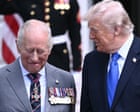
There is a specific kind of silence that fills a room when a head of state bites their tongue. It isn't the quiet of peace. It is the strained, teeth-gritting silence of someone clinging to a centuries-old rulebook while the person sitting opposite them starts rewriting reality in real-time. We watch these interactions with a morbid curiosity. We want to see if the mask slips. Usually, it doesn’t. But the effort to keep it on is what makes for truly compelling drama.
When you look at the recent friction between the British monarchy and certain political figures, you aren't just watching a diplomatic spat. You are watching a collision between two incompatible operating systems. One side functions on tradition, slow-motion protocol, and the unspoken rule that you never, ever talk about what happens in private. The other side—the populist, modern political machine—functions on the immediate, the visceral, and the belief that if you say something loud enough, it becomes the truth.
This is the central tension of modern statecraft. How do you maintain the dignity of an office when your counterpart is actively trying to turn the event into a personal marketing campaign?
The architecture of silence
King Charles III, like his mother before him, is a master of the performative void. He has spent a lifetime being trained to occupy a space without filling it with his own ego. That is the job. You are the furniture, the history, and the continuity. When a visiting president decides to use a state visit as a stage for their own specific grievances or fantasies, the King cannot simply fire back. He cannot hit "quote tweet" on reality.
He has to sit there. He has to smile at the right intervals. He has to endure the awkward pauses when the president goes off-script.
This isn't weakness. It is a rigid, almost superhuman exercise in restraint. The problem is that in an age of 24-hour social media cycles, restraint looks suspiciously like submission. When a president stands at a podium and fabricates a narrative about a private conversation or a shared moment, the King’s silence is interpreted by the press as agreement or impotence. It is neither. It is the cage of the constitution.
The president is allowed to lie. The King is not allowed to correct them. That is the asymmetry that drives the friction.
When fantasy meets the rigid record
Let's look at why this creates such an explosive dynamic. The modern president—the kind who deals in "fantasies"—needs an audience. They need an antagonist. They need someone who represents the "old way" so they can contrast it with their "new way." The monarchy is the perfect foil. It is literal, institutional, and rooted in a history that the president wants to claim for themselves.
When a president indulges in fantasies—claiming they were the favorite guest, or that they gave the King specific advice, or that they share some secret, conspiratorial bond—they are testing the bounds of reality. They know the King cannot contradict them. It is a one-way street.
This is a dangerous game. It creates a vacuum of truth. If the person holding the megaphone says the sky is green, and the person standing next to them is forbidden from speaking, the world begins to wonder if the sky might actually be a shade of neon lime.
I have seen this pattern play out in business negotiations and political campaigns for years. When one party stops caring about the facts and starts caring about the narrative, the party rooted in truth loses their leverage. You cannot debate someone who isn't playing the same game. You cannot facts-check a mood.
Why the public eats it up
We are complicit in this. We don't watch state visits for the policy discussions. Nobody is tuning in to hear the intricacies of trade tariffs. We watch for the body language. We watch for the slight grimace when the president leans in too close. We watch to see if the King will finally break character and say what everyone else is thinking.
The media knows this. They edit the clips to highlight the awkwardness. They focus on the handshakes that last a second too long. They create a narrative of a "clash" even when there isn't one. This puts even more pressure on the royal family to be perfect, which makes the inevitable slips—or the intentional bites of the tongue—so much more visible.
If you want to understand why these meetings feel so weird, look at the motivations. The president is there to win the news cycle. The King is there to preserve the institution. These are two different missions that cannot coexist without creating friction.
The survival of the stiff upper lip
You might wonder if this system is sustainable. Can a monarchy survive the age of the megaphone?
Honestly, it is the only way it survives. If the King started playing the populist game—if he started tweeting back, correcting the record, or engaging in the mudslinging—the institution would crumble. The monarchy only has power as long as it remains above the fray. Once it steps into the mud, it becomes just another political actor. And in a fight against a master of the mud, the King would lose every time.
The biting of the tongue is the survival strategy. It is an act of immense discipline. It proves that the institution is separate from the individual. It shows that while the president might be temporary and volatile, the monarchy is meant to be permanent and steady.
How to watch the theater
Next time you see a broadcast of these high-stakes meetings, don't listen to the commentary. Turn the volume down. Watch the eyes.
You will see the president looking around for a camera, checking the angle, trying to find the light. You will see the King, or his representatives, trying to steer the conversation back to the script. It is a dance where one person is doing a waltz and the other is doing a mosh pit.
You can learn a lot about leadership by watching who needs the attention. The person who demands the spotlight is usually the one who is most insecure about their position. The person who allows the other to have it—the one who holds their tongue—is the one who is confident that they will still be there long after the other person is gone.
This dynamic is not going to change. Presidents will continue to use the stage for their own ends. Kings will continue to smile through the discomfort. The fantasies will continue to be told. The only thing you can do is learn to spot the performance.
Stop looking for the truth in the press releases. Look for the silence. That is where the reality lives. Watch the person who doesn't have to speak to feel important. They are the ones who actually own the room. That is the lesson in every one of these "digested weeks" that the headlines miss. Stop waiting for the King to bite back. His restraint is the most powerful move he has.


