The internet doesn't live in the clouds. It lives in a series of fragile, garden-hose-sized tubes on the ocean floor. If you're reading this, you're relying on a network of undersea cables that handle 99% of global data traffic. That’s why it’s chilling that the UK Ministry of Defence just went public about a month-long cat-and-mouse game with Russian submarines hovering directly over this critical infrastructure.
Russian President Vladimir Putin didn't just send one ship. He sent a sophisticated team designed to disappear. The UK and its allies recently tracked a trio of Russian vessels—one Akula-class nuclear attack submarine and two highly specialized "spy" subs—as they maneuvered through the High North and North Atlantic. This wasn't a routine patrol. It was a calculated attempt to map, and potentially interfere with, the lifelines of the Western world.
The Decoy and the Spies
Modern naval warfare isn't always about torpedoes. Sometimes, it’s about distraction. The UK’s Defence Secretary, John Healey, pointed out that the Akula-class submarine was almost certainly a decoy. Its job was to be loud and visible enough to keep NATO’s eyes busy while the real work happened elsewhere.
The "real work" was carried out by the GUGI. That stands for the Main Directorate of Deep Sea Research. Think of them as Russia's most secretive underwater special ops unit. Unlike standard naval units, GUGI operates vessels capable of diving miles deep to plant wiretaps or prepare for sabotage. While we were distracted by the attack sub, these GUGI units were parked over the very cables and pipelines that keep the lights on and the banks running in London and New York.
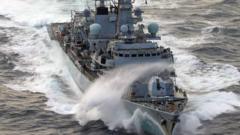
The UK didn't just watch. They launched a massive counter-operation involving the Type 23 frigate HMS St Albans, RAF P-8 Poseidon patrol aircraft, and specialized Merlin helicopters. They logged over 450 flight hours and dropped hundreds of sonobuoys to make one thing clear: "We see you."
Why These Cables are the Ultimate Target
You might wonder why Russia would bother with a few cables. It’s simple. If you cut the right three or four fiber-optic lines, you don't just lose Netflix. You lose the ability to settle international bank trades, coordinate military responses, and manage power grids. It’s a "grey zone" tactic—aggression that stops just short of open war but causes maximum chaos.
- Financial Impact: Trillions of dollars in daily transactions move through these Atlantic lines.
- Communication: Military and government leadership rely on these encrypted paths.
- Energy Security: It’s not just data; the operation also hovered over subsea pipelines.
Russia’s embassy in London, predictably, denied the whole thing. They called the UK’s claims "unfounded." But the Ministry of Defence didn't just release a statement; they released declassified images of Russian vessels based at Olenya Guba. They wanted the world to see that the "covert" operation was actually an exposed failure.
The Rise of the GUGI Threat
The GUGI isn't a new player, but they’ve become much bolder. Last year, the Russian ship Yantar—a known "research" vessel that carries deep-sea submersibles—was caught loitering near UK waters. In that instance, they even directed lasers at British pilots. This latest month-long submarine operation shows a significant 30% increase in Russian naval threats around the UK over the last two years.
It’s a deliberate test of NATO’s "Atlantic Bastion." Russia wants to know exactly how fast the UK and Norway can respond when things get weird in the High North. This time, the response was fast enough to force the Russian subs to retreat back to their bases without finishing whatever they started.
How the UK is Fighting Back
The UK government isn't just relying on old frigates. They're putting £100 million into the P-8 Poseidon program to ensure they can track these "ghost" subs more effectively. They're also leaning heavily into the Strategic Defence Review’s recommendations to use more autonomous underwater sensors.
Security isn't just about ships anymore. It’s about sensor density. The more "ears" we have on the ocean floor, the harder it is for a GUGI sub to park over a cable without getting a sonobuoy dropped on its head.
If you’re worried about your internet or your heating bills, you should be. This isn't just military posturing; it’s a direct threat to the infrastructure that supports your daily life. The best thing you can do is stay informed about these "grey zone" conflicts. They happen out of sight, but they have the power to change everything in an instant. Keep an eye on the Ministry of Defence’s updates on the High North—the next time Russia tries this, they might not be looking for a "bluff."