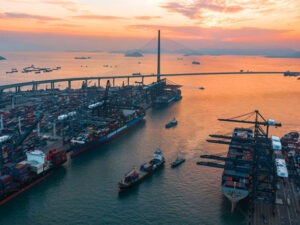
Saudi Arabia just hit a massive milestone that most of the world completely missed. They’ve successfully pushed the capacity of the East-West Pipeline to 7 million barrels per day. If you think that’s just another boring infrastructure stat, you’re looking at it wrong. This is about one thing: survival in a region where a single bad day in the Strait of Hormuz can send the global economy into a tailspin.
The Strait of Hormuz is the world's most dangerous choke point. Roughly 20% of the world’s daily oil consumption passes through that narrow strip of water. When tensions flare up between Iran and the West, the first threat is always the same. "We'll close the Strait." For decades, that threat held Saudi Arabia’s primary export route hostage. Not anymore.
By hitting this 7 million barrel goal, Aramco has effectively built a massive safety valve. They can now shift a huge chunk of their export volume away from the Persian Gulf and straight to the Red Sea. From there, it’s a straight shot to Europe and the Americas without ever having to peek through the Hormuz needle’s eye. It’s a geopolitical pivot that’s been years in the making.
The 7 Million Barrel Milestone is About Control
When you’re the world’s top oil exporter, you can’t leave your supply chain to chance. The East-West Pipeline—also known as the Petroline—stretches about 1,200 kilometers across the Kingdom. It connects the massive oil fields in the East (like Ghawar and Abqaiq) to the industrial port of Yanbu on the Red Sea.
The goal wasn't just to build a pipe. It was to build a pipe that could actually handle the load if the Gulf became a war zone. For a long time, the capacity sat around 5 million barrels per day. That’s a lot, sure, but it wasn't enough to fully bypass a total Hormuz shutdown. At 7 million barrels, the math starts to look very different.
The Energy Information Administration (EIA) has tracked these numbers for years. They’ve consistently pointed out that the Strait of Hormuz is the most significant "chokepoint" globally. By hitting this 7 million barrel target, Aramco isn't just moving oil. They’re buying insurance. If something goes wrong in the Persian Gulf, the Saudi economy doesn't just stop. They keep shipping from the West Coast.
Why the Red Sea is the New Front Line
Shipping out of Yanbu does more than just avoid Iran. It puts Saudi oil closer to the Suez Canal. It makes the trip to European refineries faster and cheaper. It basically reorients the entire Saudi export strategy.
We’ve seen what happens when the Red Sea gets messy too. The recent Houthi attacks on shipping showed that no route is 100% safe. But there’s a massive difference. The Red Sea is a wide-open waterway compared to the 21-mile-wide Strait of Hormuz. It's much harder to block.
Think of it like this. If the Strait of Hormuz is a single front door that someone can lock from the outside, the East-West Pipeline is a massive back door that opens into an entirely different neighborhood. You're no longer trapped in the house.
The Abqaiq Lesson
Do you remember the 2019 drone attacks on Abqaiq? That was the wake-up call. It didn’t just show that oil fields were vulnerable. It showed that the entire infrastructure needed to be more flexible. If you can’t get the oil out of the ground and into a pipe that goes somewhere else, you're a sitting duck.
Expanding the Petroline is a direct response to that vulnerability. Aramco spent billions to make sure that even if one part of the system takes a hit, the rest can keep the lights on globally. This isn’t just about making more money. It’s about being the most reliable supplier on the planet. Reliability is the only thing that keeps customers from switching to renewables even faster.
The Global Price Impact You'll Feel
Most people at the gas pump don't think about Saudi pipelines. They should. When there’s a "risk premium" on oil, you pay for it. That risk premium exists because traders are terrified that the Strait of Hormuz will be blocked.
If Saudi Arabia can prove that they can move 7 million barrels per day through the Petroline, that risk premium drops. Why? Because the market knows that even in a worst-case scenario, the oil is still flowing. It stabilizes the global market.
It also gives Saudi Arabia massive leverage within OPEC+. If they can guarantee delivery when other countries can’t, they set the terms. They become the "swing producer" not just because of how much oil they have, but because of how they can move it.
What This Means for Europe
Europe has been scrambling for alternatives to Russian energy. The Red Sea ports are perfectly positioned to feed that demand. By ramping up Yanbu’s capacity, Saudi Arabia is basically saying, "We’ve got you covered."
It’s a win for energy security in the West, and it’s a massive win for Saudi Arabia’s "Vision 2030." They want to be a global logistics hub. You can’t be a logistics hub if your main export route is constantly threatened by regional rivals.
The Technical Reality of Moving 7 Million Barrels
You don't just "turn up the volume" on a pipeline. This expansion involved massive upgrades to pumping stations. They had to add new turbines and improve the cooling systems to handle the friction and heat of moving that much crude across a desert.
It’s a feat of engineering that honestly doesn't get enough credit. We’re talking about moving a literal river of oil across a thousand miles of sand and mountains. Every single pump station has to work in perfect harmony. If one fails, the whole thing backs up.
Aramco has been quiet about the exact technical specs of the latest upgrades, but the result speaks for itself. They hit the 7 million barrel mark. That’s nearly 70% of their total daily production capacity.
It's Not Just About Oil Anymore
This pipeline infrastructure is also being looked at for the future. Saudi Arabia is betting big on hydrogen. They want to be the world’s biggest exporter of "Blue Hydrogen" and "Green Hydrogen."
Guess what you need to export hydrogen? Massive pipelines and ports. The work they’re doing on the East-West Pipeline today is laying the literal groundwork for the energy transition of tomorrow. They’re building the corridors that will move energy—in whatever form it takes—for the next 50 years.
What You Should Watch Next
Don't just look at the headlines about "tensions in the Middle East." Look at the shipping data coming out of Yanbu. If you see the volume there increasing, it means the East-West bypass is working. It means Saudi Arabia is successfully de-risking its economy from the Persian Gulf.
For investors and energy watchers, this is the most important story in the region. It’s a shift in the tectonic plates of the energy market.
Keep an eye on the following signals:
- New long-term supply contracts signed by European refineries specifically for Red Sea delivery.
- Further expansion of the Yanbu South Terminal to handle the increased load.
- Any news regarding the "Mu'ajiz" terminal, which is another key piece of this puzzle.
The era of being held hostage by the Strait of Hormuz is coming to an end. Saudi Arabia just built their way out of the trap. It’s a move that should make everyone—from Wall Street to the local gas station—breathe a little easier.