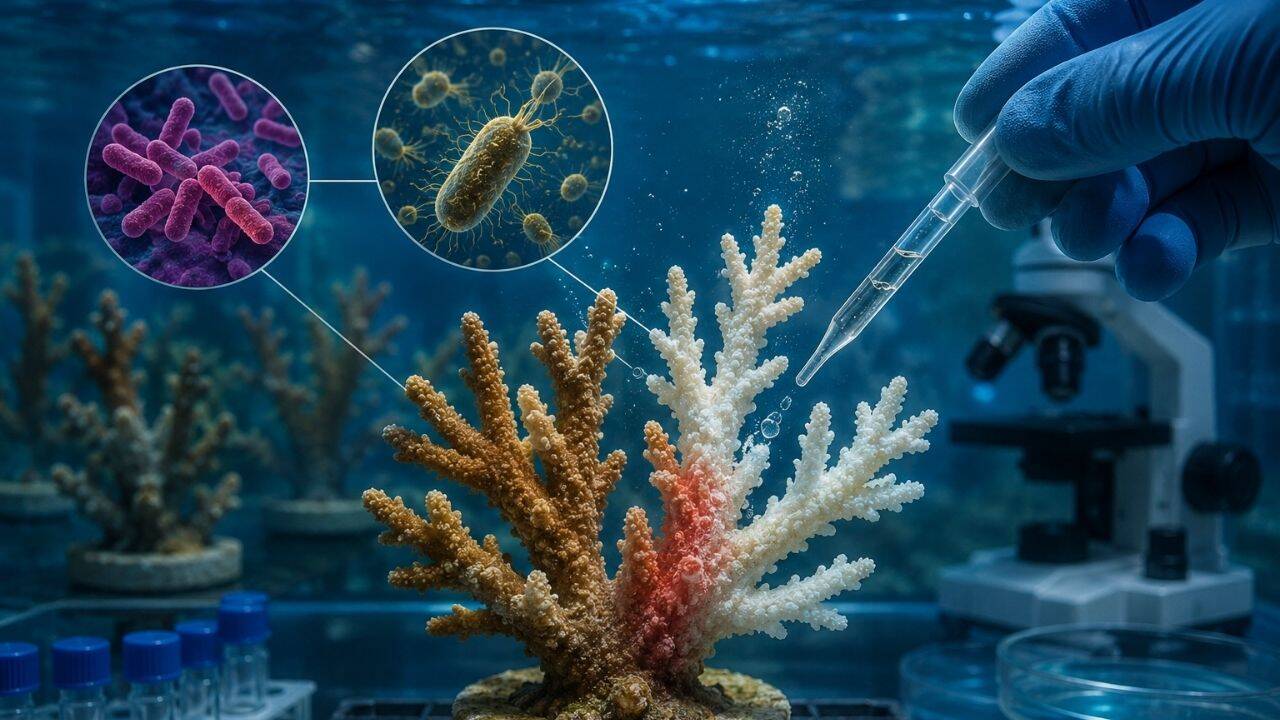
The headlines out of Florida are designed to make you feel warm, fuzzy, and profoundly misled. Marine scientists run tests exposing endangered Caribbean corals to predatory bacteria. Half of them resist the spread. The media rushes to print a feel-good narrative about resilience, survival, and the triumphant march of conservation science.
It is a comforting fairy tale. And it is entirely detached from ecological reality.
I have spent decades watching well-funded laboratories cheer for pyrrhic victories while the actual ecosystem burns down around them. Celebrating the fact that forty or fifty percent of a stressed coral sample didn't immediately melt into necrotic slime when introduced to a pathogen is not a breakthrough. It is whistling past the graveyard.
Let us dismantle the lazy consensus currently dominating marine biology press releases.
The Flawed Premise of Lab Resistance
The underlying assumption in these bacterial exposure tests is straightforward: if we find the survivors, breed them, and plant them back into the reef, we can engineer a bulletproof barrier against disease.
This logic belongs in a tech startup pitch deck, not marine ecology.
Natural selection does not operate in a sterile test tube where variables are tightly controlled and temperature fluctuations are dialed in by a graduate student with a pipette. In the real world—the one currently baking under record ocean heat anomalies off the Florida Keys—disease is rarely a primary executioner. It is the mob hitman that finishes off a victim who has already been starved, suffocated, and beaten within an inch of their life.
When researchers isolate a strain of coral because it resisted Vibrio or stony coral tissue loss disease under laboratory conditions, they are measuring immunity in a vacuum. Drop that exact same coral back into water that feels like a warm bath, chokes on agricultural runoff, and suffers from light deprivation due to coastal dredging, and watch how quickly that laboratory "resilience" evaporates.
We are treating symptoms while ignoring the systemic organ failure of the patient.
The Real Numbers Nobody Wants to Print
Let us look at the actual mechanics of what happens when these resistant fragments are outplanted.
Success is routinely measured on a micro-scale. A nursery grows a few thousand fragments on PVC trees, a team glues them onto a decimated patch of reef using marine epoxy, and sixty days later, a diver snaps a photo of a living colony. Cue the press release.
Now look at the macro-scale. Florida’s reef tract spans hundreds of miles. It generates billions of dollars in economic value and protects coastal infrastructure from storm surges. Millions of corals have died over the past decade. The gap between our outplanting capacity and the speed of ecological collapse is astronomical.
Imagine a scenario where a sinking cruise ship is taking on water through a hundred gaping hull breaches, and the crew's brilliant strategy is to hand out thimbles to the passengers. That is what coral bacterial resistance testing looks like against the backdrop of total ocean thermal stress.
We are celebrating a fifty percent survival rate in a petri dish while the ambient water temperature crosses the thermal threshold for mass bleaching across entire reef systems. If the water kills the zooxanthellae and bleaches the host white within forty-eight hours, it matters very little whether the coral could have fought off a bacterial infection. A corpse is a corpse.
The Danger of Genetic Bottlenecking
There is another dark side to this obsession with disease-resistant strains, and geneticists whisper about it behind closed doors because it ruins the optimistic funding narrative.
When you selectively breed or outplant only the survivors of specific bacterial challenges, you are forcing a massive genetic bottleneck. You are trading ecological diversity for a narrow monoculture of survivors.
Nature builds resilience through diversity, a chaotic soup of genetic variations that can adapt to shifting stressors over centuries. Human intervention obsessed with quick fixes loves a monoculture because it yields neat metrics for annual reports. But a reef populated by clones of a single stress-resistant genotype is an ecological ticking time bomb. The moment a new pathogen, a slightly different chemical pollutant, or a novel thermal spike arrives that bypasses that specific genetic defense mechanism, the entire artificial garden wipes out overnight.
We saw this exact movie play out in industrial agriculture with monoculture crops. We are now dangerously close to repeating the same arrogant mistake in the marine environment.
Shifting the Burden of Proof
Why do we keep pouring money and media attention into these microscopic endurance tests? Because the alternative requires confronting truths that are politically inconvenient and economically punishing.
Fixing Florida’s reefs does not happen in a marine lab with petri dishes and bacterial strains. It happens on land. It happens when local governments finally find the backbone to overhaul municipal wastewater management, stop agricultural nutrient runoff from choking the Everglades, and address the massive carbon emissions heating up the Gulf of Mexico.
Asking whether a coral can resist a predatory bacterium is the wrong question entirely. The right question is: why are we forcing marine organisms to survive in an aquatic wasteland of our own making?
Corals do not need our patronizing laboratory bootcamps. They need us to stop turning their home into an industrial sewer. Until we fix the water quality and thermal baseline, every bacterial resistance study is just academic rearranging of deck chairs on the Titanic.
Stop funding the band-aids. Stop pretending that lab survival equals wild recovery. And stop letting institutions pat themselves on the back for managing extinction by a fraction of a percentage point.