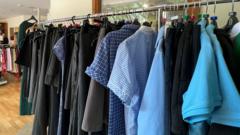
The headlines cheer like local politicians cutting a ribbon on a pothole repair. Officials announce that limits are reduced for branded school uniform items, treating it like a massive victory for working-class families. Parents are supposed to sigh with relief. Retail monopolies on pleated skirts adorned with school crests are supposedly cracking.
It is a complete illusion.
Lowering the limit on branded items does nothing to solve the financial bleeding caused by institutional dress codes. It simply shifts the profit margins from exclusive uniform suppliers to big-box supermarkets selling identical poly-cotton polo shirts at a different markup. The lazy consensus says that fewer logos equal more money in parents' pockets.
Mathematics and human behavior prove otherwise.
The Myth Of The Generic Substitution
Look past the press releases and examine how school uniform policies actually function in practice. When a school mandates specific cuts, precise shades of burgundy, or designated tartan patterns, they create a captive market.
I have watched school administrators spend months debating whether a navy blue cardigan needs an embroidered badge while the roof leaks over the science lab. They treat uniform policy as a proxy war for institutional discipline.
The standard argument goes like this: restricting schools to a maximum number of branded items levels the playing field. It stops children from flashing designer logos in the classroom.
That theory collapses the moment a parent walks down the aisle of a high street retailer.
A generic white polo shirt without a school logo might cost less than one with a crest. Yet, the moment the school dictates that only specific shades of trousers or skirts will pass inspection, the free market vanishes. Parents are forced to buy multiple iterations because the stitching frays after three washes or the sizing runs erratic.
Limiting branded items is a cosmetic fix for a structural scam. The uniform industry relies on mandatory mediocrity. Manufacturers cut corners on fabric durability because they know the customer base cannot shop around.
The Quality Trap
Imagine a scenario where a school bans logos entirely. Every child wears a plain white shirt and black trousers. Sounds egalitarian, right?
Now look at the wardrobe durability. Cheap garments made from synthetic blends fail faster. Low-income families end up replacing identical cheap trousers three times a year instead of buying one durable pair. The per-wear cost skyrockets.
Branded items were never the primary driver of high uniform costs. The real villain is the artificial obsolescence built into school wear guidelines. When schools change their crest design or tweak the acceptable shade of grey trousers every few years, existing wardrobes become obsolete overnight. Hand-me-downs die. Younger siblings cannot inherit garments from older brothers or sisters.
That is where the real wealth extraction happens.
Reducing the cap on branded items misses the forest for the trees. A school can limit branded pieces to zero, but if they mandate a hyper-specific shade of bottle green that only one approved vendor stocks, they have achieved nothing. They have simply swapped a visible monopoly for an invisible one.
What Parents Should Do Instead
Chasing policy updates from local education authorities is a waste of energy. If you want to stop bleeding cash on school clothes, you have to bypass the system entirely.
- Ignore the approved vendor list for baseline items. Socks, tights, plain shirts, and basic footwear can be sourced from anywhere. Schools rarely send students home for wearing supermarket-bought socks unless the administration is actively malicious.
- Organize uniform swaps independently. Do not wait for the Parent Teacher Association to sponsor a formal event. Set up direct neighborhood exchanges where parents trade clothes before the term starts.
- Inspect the fabric blend. Never buy 100 percent polyester if you want clothes to survive a term. Look for cotton-rich blends that tolerate high-temperature washing without shrinking or pilling.
- Challenge the policy directly. Push school governors for strict transparency on why specific uniform items must be purchased from single-source suppliers. Often, schools receive kickbacks or percentage kickbacks on sales, disguised as administrative convenience fees.
The obsession with reducing branded items is a distraction. It lets schools claim they are solving a cost-of-living crisis while leaving the underlying machinery of mandatory consumption completely untouched.
Stop celebrating minor adjustments to broken rules. Demand the total abolition of dictated suppliers.