The Smell of Kerosene
Kerosene smells like cold metal and burned promise.
Stand at the edge of any tarmac where modern military aviation lives, and you will smell it before you see anything. It hangs in the humid air of coastal airbases and the bone-dry heat of desert scrublands alike. It is the scent of immense power contained within skin thinner than an automobile's hood, wrapped in radar-absorbent geometry.
In Washington, decisions are made on parchment and glowing monitors. They are debated in vaulted congressional chambers where men and women in tailored suits discuss balance sheets, strategic partnerships, and export licenses with the detachment of stockbrokers reviewing quarterly returns. But thousands of miles away, the reality of those decisions hits the dirt with a physical thud.
The approval of forty-eight F-35 Lightning II aircraft for Saudi Arabia is not merely a transaction. It is an earthquake measured in radar cross-sections.
For decades, the skies of the Middle East operated under a strict architectural law. Israel held an exclusive license to the fifth-generation stealth horizon. That monopoly was more than a military advantage; it was an article of psychological faith. It was a guarantee written into American law, known as the Qualitative Military Edge, ensuring that no matter how turbulent the region became, the Jewish state possessed the technological ceiling to defend its borders against any coalition of rivals.
Now, that ceiling has cracked.
The Architecture of Invisibility
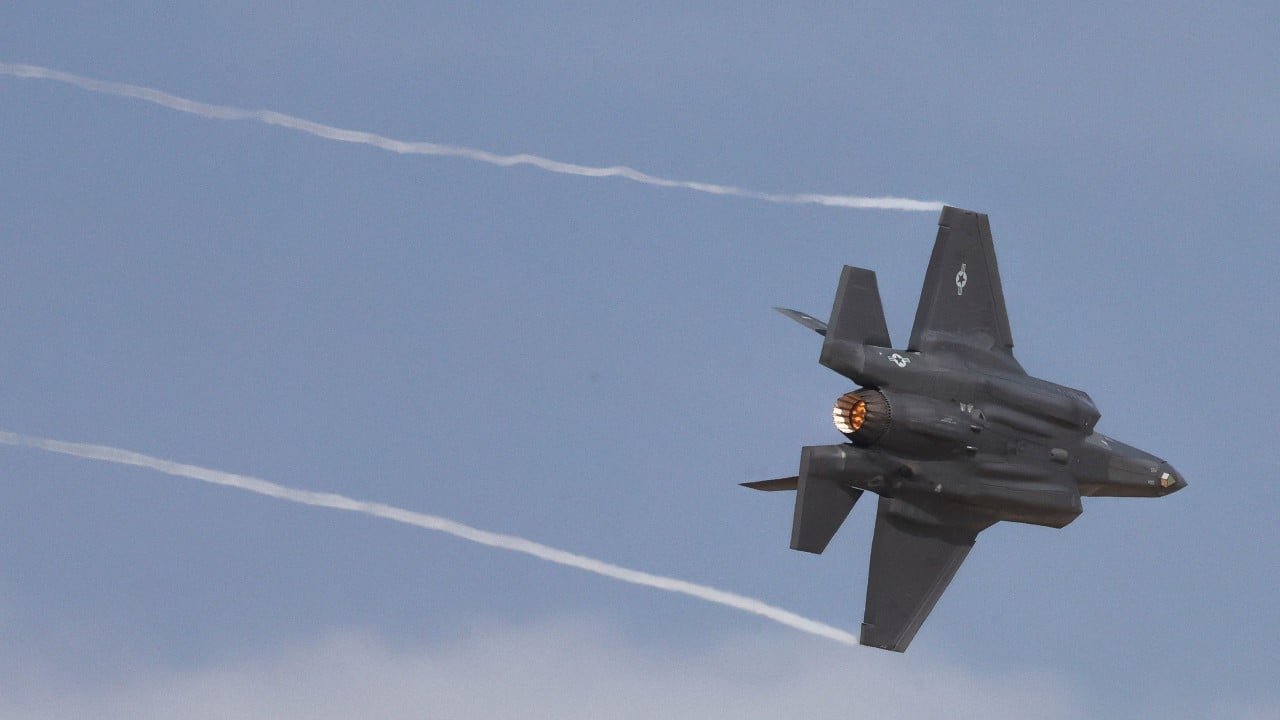
To understand why forty-eight airplanes can shift the tectonic plates of international relations, you have to understand what an F-35 actually is.
It is not an airplane. Not really.
Think of it as a flying supercomputer that happens to possess wings. Every second, its sensors ingest gigabytes of raw electronic data, fusing radar tracks, infrared signatures, and radio frequencies into a unified, omnidirectional bubble of awareness. A pilot flying an F-35 does not look out a window to see the world. They look through the skin of the aircraft using distributed aperture cameras. They see through the floorboards. They see missiles launching hundreds of miles away before human eyes on the ground can process the flash.
When you hand forty-eight of these nodes to a nation like Saudi Arabia, you are not just selling hardware. You are transferring a digital nervous system.
Consider David, a senior strategic researcher sitting in a dimly lit office in Tel Aviv, staring at a topographic map of the region. For years, David and his colleagues calculated defense readiness based on predictable asymmetries. They knew the radar ranges of older fourth-generation fighters like the F-15 or the Eurofighter Typhoon. They knew how to thread radar needles through mountainous terrain, how to exploit blind spots, how to calculate interception windows down to the second.
Against a fifth-generation stealth platform, those old calculations are useless.
An F-35 does not announce its presence. It arrives like a silent thought. Its radar cross-section is roughly the size of a golf ball, wrapped in composite skins designed to swallow electromagnetic waves whole. When David looks at the map now, the borders look porous. The physical distance between Riyadh and Tel Aviv—some twelve hundred miles of desert and mountain—shrinks to nothing when crossed by a machine that cruises at supersonic speeds without lighting its afterburners.
The anxiety in Israel is not born of paranoia. It is born of arithmetic.
The Ledger of Diplomacy
In Riyadh, the mood is altogether different.
Imagine Faisal, a mid-level procurement strategist for the Royal Saudi Air Force, standing on the observation deck of an air base outside of Tabuk. The sun is sinking below the horizon, painting the desert in bruised shades of violet and orange. He watches a formation of older Tornado jets thunder overhead, their twin engines roaring with a visceral, Earth-shaking noise that rattles the glass in the windows.
Faisal loves the sound. But he knows it is obsolete.
In modern air combat, noise is a signature, and signatures are death. To survive in the twenty-first century, Saudi Arabia cannot rely on sheer mass or brute-force petroleum wealth. The kingdom is transitioning. Vision 2030 is not just a slogan printed on glossy brochures; it is an existential scramble to diversify an economy before the world stops buying crude oil. A nation preparing for a post-oil future cannot afford to remain a consumer of security. It must become a producer, a partner, an indispensable technological anchor.
For years, Riyadh looked at Washington with a mixture of frustration and dependency. The American security umbrella was vast, but it came with humiliating conditions, congressional hand-wringing, and moral lectures on human rights. Every major arms purchase was treated in Washington as a referendum on Saudi domestic policy, turning military procurement into an embarrassing public spectacle.
The F-35 deal changes that calculus.
It signals that Washington values Riyadh not just as a customer of last resort, but as a primary pillar of regional architecture. It is an acknowledgment that the tectonic plates of global power are shifting eastward. If the United States does not supply the stealth jets, Beijing or Moscow stands ready in the wings with open checkbooks and fewer questions.
So the transaction was approved. It was approved because the cost of saying no was deemed higher than the cost of saying yes.
The Invisible Stakes
Diplomats speak of strategic alignment. They talk about deterrence, interoperability, and counterweights against regional adversaries like Iran. They use sanitized language to mask the grim reality of what these weapons are built to do.
War is rarely about malice. More often, it is about fear.
When two nations eye each other across a desert, each upgrading its capacity to kill at a distance, a dangerous psychological feedback loop takes hold. One nation buys stealth jets for deterrence; the neighboring nation perceives those jets as an existential threat and demands its own countermeasures. The spiral tightens.
Consider the technical hurdles alone. Operating an F-35 is not like flying a Cessna. It requires a digital tether to the manufacturer, continuous software updates managed from servers in the United States, and an army of specialists trained in specialized maintenance yards. The Autonomic Logistics Information System, or ALIS, is the invisible umbilical cord linking every F-35 back to Lockheed Martin's servers in Fort Worth, Texas.
If Washington holds the remote control to the software updates, can the jets truly be used independently? That question haunts both capitals. For Washington, maintaining algorithmic control is a safeguard, a way to ensure that American technology is never turned against American interests or close allies. For Riyadh, that same control is a lingering humiliation, a reminder of sovereign vulnerability wrapped in high-tech armor.
Meanwhile, the Israeli defense establishment weighs the intangible costs. The Qualitative Military Edge is not a static number written in a statute book; it is a moving target. If regional adversaries acquire the same stealth capability, Israel's doctrine of preemptive deterrence must evolve. More air defenses. More cyber warfare capabilities. More reliance on artificial intelligence to track targets that human eyes cannot see.
The arms race accelerates. Not with the thunder of marching boots, but with the quiet, click-clack of software compilers and cryptographic key exchanges.
The Geography of Power
Geography has always dictated destiny in the Middle East. Mountain ranges create natural redoubts; coastlines invite trade and invasion; vast deserts isolate populations and force centralization.
Today, geography has been conquered by altitude and stealth.
When an F-35 cruises at forty thousand feet, national borders are invisible lines drawn on old paper. The pilot does not care about the Sykes-Picot agreement, or the shifting boundaries of empires long dead. They care about radar horizons, emitter locations, and data link integrity.
This technological leveling creates a strange paradox. As military hardware becomes more sophisticated, the margin for human error shrinks toward zero. A miscalculated radar transmission, an accidental border breach by a supersonic platform, or a misread electronic signal could escalate into a regional conflagration before diplomats have time to pour their morning coffee.
The forty-eight jets will not be delivered tomorrow. Training pilots takes years. Building secure hangars, encrypted communications infrastructure, and specialized maintenance facilities requires billions of dollars and mountains of concrete.
Yet the psychological reality has already arrived.
In Tel Aviv, strategists are redrawing their threat models. In Riyadh, military planners are imagining a future where their pilots fly the most advanced aircraft on Earth. In Washington, politicians are calculating the price of influence in a multipolar world where American hegemony is no longer unchallenged.
The Final Horizon
The sun sets completely over the Tabuk air base now. The desert chill rolls in with startling speed, turning the heat of the day into a biting frost.
Faisal walks back toward the base command center, his boots crunching on the gravel. Above him, the sky is clear, washed in deep indigo, sprinkled with ancient stars that have watched empires rise and crumble into dust across these same sands.
For thousands of years, the masters of this region measured power in horses, in swords, in oil wells, and in blood spilled upon the dunes. Now power is measured in nanometers of semiconductor chips, in radar-absorbent coatings, and in lines of encrypted software code written by engineers sitting in suburban office parks half a world away.
The jets are coming. The balance has shifted. And the night is very quiet.


