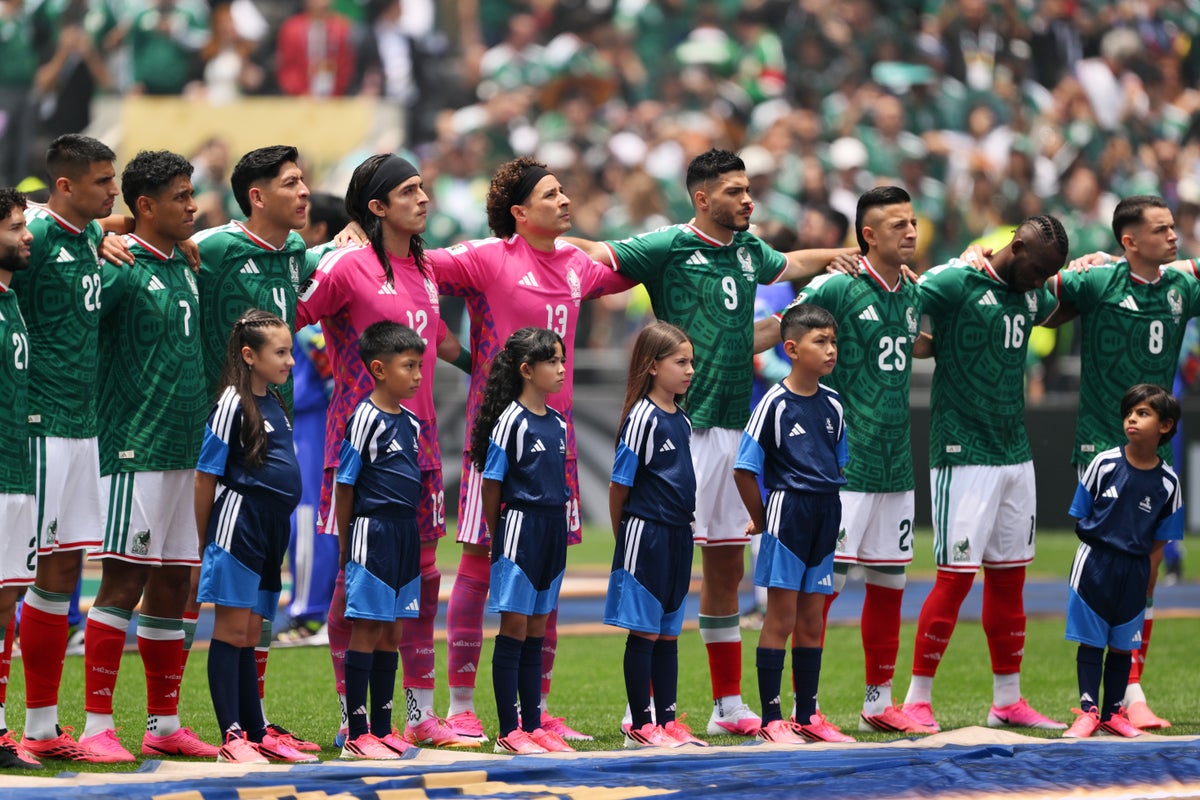
The afternoon sun in Guadalajara does not just shine; it heavy-coats the concrete in a thick, golden lacquer. Underneath a faded billboard advertising the upcoming World Cup, ten-year-old Mateo traps a scuffed leather ball with his instep. His sneakers are worn smooth at the toes. He mimics the stutter-step of his favorite forward, launches a strike against a rusted garage door, and celebrates the thunderous clank with a silent, double-fisted pump to the sky.
Watching him from a plastic chair outside a nearby tiendita is his uncle, Alejandro. Alejandro smiles, but his eyes never stop moving. They track a dark SUV with tinted windows as it idles at the corner, its exhaust coughing plumes into the heat. In Mexico, football is a religion, a lifeline, a beautiful fever that consumes the soul. But these days, the stadium lights casting long shadows across the grass look less like a celebration and more like a stage where two entirely different worlds are about to collide.
Mexico is preparing to co-host the world’s biggest sporting event. Stadiums are being retrofitted, infrastructure budgets are swelling, and officials speak in glowing terms about national pride and global tourism. Yet, just beyond the perimeter of the shiny newly painted arenas, a parallel authority governs the rhythm of daily life. The cartel violence that has plagued the nation for decades is not pausing for the tournament. It is merely watching, adapting, and finding its own ways to profit from the spectacle.
For families like Mateo’s, the excitement of the game comes with an unspoken calculus.
The Cost of the Ticket
To understand the reality on the ground, you have to look past the promotional videos showing vibrant cultural dances and roaring crowds. Consider the logistics of a modern mega-event. When hundreds of thousands of international tourists descend upon a region, they bring money, energy, and an insatiable demand for hospitality. In the boardrooms of organized crime, this is viewed simply as a massive influx of new consumers and fresh territory to dominate.
Local business owners face a terrifying dilemma. A restaurant owner near a designated fan zone might see the World Cup as a once-in-a-lifetime opportunity to clear their debts. But with that surge in foot traffic comes the inevitable knock on the back door. The piso—the extortion tax levied by local criminal syndicates—scales up alongside the revenue.
Imagine running a family diner. You spent months securing permits, upgrading your kitchen, and dreaming of the international crowds. Then, a quiet man sits at your counter, orders a coffee, and names the exact price of your survival during the tournament weeks. If you pay, your profit vanishes. If you refuse, the consequences are written in the daily police blotters. It is a quiet extortion that never makes the sports headlines, yet it dictates the economic reality of the host cities.
The numbers back up the anxiety. Security analysts point out that homicide rates and forced disappearances in central Mexico have remained at historic highs, completely decoupled from the government’s assurances of safety. The state promises ironclad security corridors for athletes and dignitaries. Elite police units will line the highways leading to the venues. But these hyper-secure bubbles only highlight the vulnerability of the neighborhoods just a few blocks away.
Two Realities on One Field
The paradox of the beautiful game in a fractured landscape is that it serves as both an escape and a mirror. When the national team scores, the collective roar from a crowded bar can drown out the ambient anxiety of the streets. For ninety minutes, the invisible borders drawn by rival factions dissolve. Rich, poor, terrified, and bold—everyone wears the same green jersey.
But the whistle always blows to end the match.
Alejandro remembers a time when a football match meant piling into the back of a pickup truck and driving across state lines without a second thought. Today, a road trip to see a live match requires a strategic briefing. Which highways are controlled by which cartel? Are there illegal checkpoints active along the route? Is it safer to travel at dawn, or does the midday heat offer better cover?
"You learn to read the road like a referee reads a game," Alejandro says, his voice dropping as another car passes the shop. "You look for the signs. A sudden absence of oncoming traffic. A group of men standing by a pickup with no license plates. You don't look them in the eye. You just keep driving and pray your jersey doesn't look like the wrong color to them."
This is not a metaphor. The territorial fragmentation of Mexico means that traveling through certain regions is an exercise in high-stakes navigation. The government has pledged tens of thousands of national guard troops to secure the tournament, but the civilian population knows that troops are temporary. The tournament will last a month. The cartels are permanent.
The Invisible Infrastructure
The preparation for a global sporting event requires massive logistical support: new roads, communications networks, and hospitality hubs. In areas where the state’s grip is weak, these construction projects become battlegrounds for control. Criminal organizations routinely hijack supply chains, extort contractors, and dictate who gets hired.
Think of it as a dark mirror to the official tournament organization. While FIFA officials discuss ticketing algorithms and broadcast rights, local commandants are calculating the value of the diesel fuel needed for the stadium generators. The economic windfall of the event is filtered through a sieve of corruption and coercion before a single peso reaches the honest street vendor selling tacos outside the gates.
This creates a profound sense of cognitive dissonance for the people living through it. On the television, pristine pundits talk about the legacy of the tournament. On the ground, the legacy is measured in the reinforcement of local monopolies over basic goods like water, avocado distribution, and public transport.
The international community largely looks away from this friction. Fans buy their packages, sponsors approve their ad campaigns, and the bright lights of the broadcast ensure that the background darkness remains invisible to the global audience. The spectacle demands a clean frame.
The Final Whistle
Night begins to fall over Guadalajara. The golden lacquer turns to a deep, bruised purple. Mateo’s game is winding down. His shins are bruised, and his shirt is soaked through with sweat, but his smile is wide and unfiltered. For him, the World Cup is still a dream of pure magic, of heroes jumping through the air and defying gravity.
Alejandro stands up, stretching his back, and calls the boy inside. He catches the ball cleanly under his arm, a protective gesture that has nothing to do with the sport. He knows that the coming months will bring a strange circus to his city—a whirlwind of corporate logos, international anthems, and superficial joy.
He will buy the tickets if he can afford them. He will cheer until his throat is raw when Mexico takes the field. He will let Mateo believe, for as long as possible, that the world is as fair and orderly as the white lines painted on the grass.
But as they walk back toward the small house, locking the heavy iron gate behind them, the distant sound of a siren cuts through the evening air, a sharp reminder that when the stadium lights eventually go dark and the world packs up its cameras, the real game will continue to be played in the dark.