The sea around the Ryukyu Islands does not look like a battlefield. Most days, it is a shifting canvas of cobalt and turquoise, broken only by the white crests of waves hitting the coral. But for the people living on the small, emerald patches of land like Yonaguni or Ishigaki, the water has begun to feel crowded. It is a psychological weight. You cannot see the tension from a satellite, but you can feel it in the vibration of a low-flying jet or the silhouette of a gray hull cutting through the dawn mist.
Earlier this week, that vibration turned into a tremor.
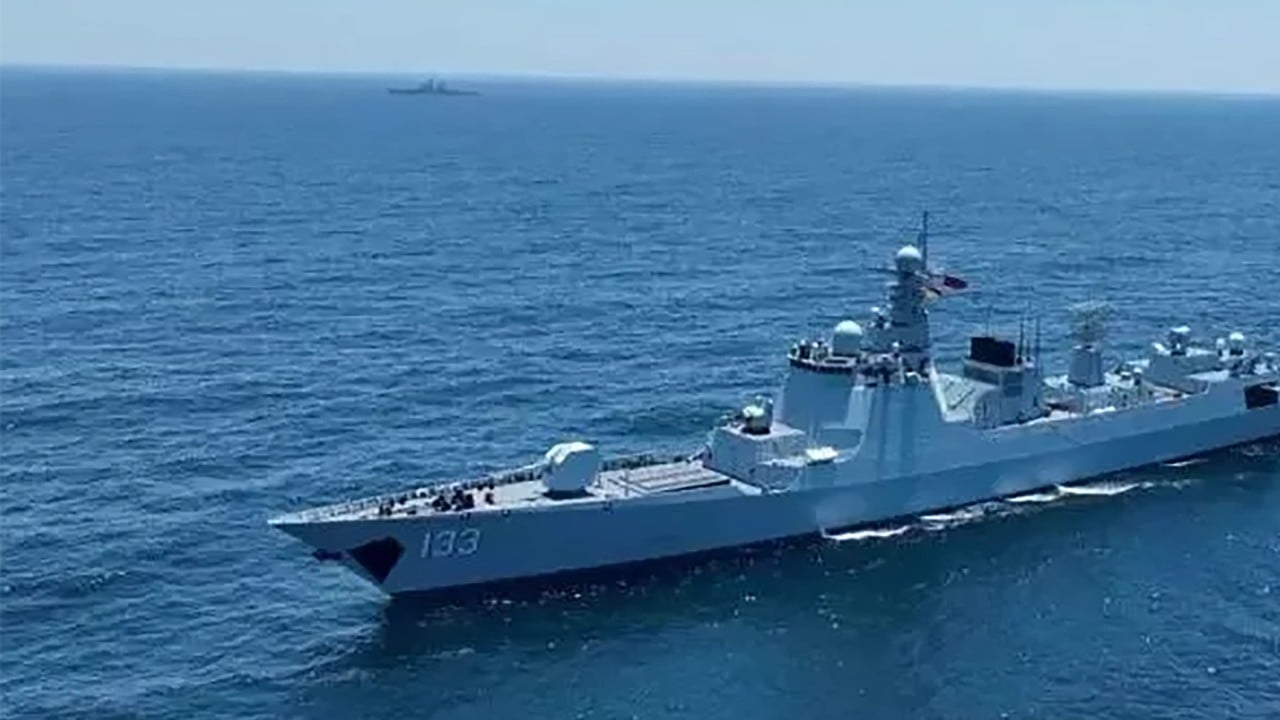
Six People’s Liberation Army (PLA) warships, including a powerful Type 052D destroyer and a Type 054A frigate, didn't just sail through the East China Sea. They executed a rare and pointed transit through the waters off Japan’s southwest islands. To a casual observer, it was a routine naval maneuver. To those tracking the geography of a potential conflict, it was a dress rehearsal for an encirclement.
The Geography of Silence
Imagine you are a fisherman off the coast of Iriomote. Your life is measured in catches and tides. Suddenly, the horizon is occupied by steel. These aren't the familiar white hulls of the Japanese Coast Guard. These are the sharp, aggressive angles of Chinese warships, bristling with vertical launch systems and phased-array radars.
They are moving through the "First Island Chain." This isn't just a term used by basement-dwelling geographers; it is the physical cage that China feels it must break to become a true global maritime power. When these ships pass between Okinawa and Miyako, or skim the waters near the Senkaku Islands, they are testing the locks on that cage.
The Japanese Ministry of Defense tracked these vessels as they moved south, then looped back. This wasn't a straight line from point A to point B. It was a message written in wake and diesel fumes. By operating in these specific "choke points," the PLA is proving that in the event of a crisis involving Taiwan, they can operate on both sides of the island simultaneously. They are signaling that they can cut off the back door.
The Invisible Stakes
Why does a transit in the Miyako Strait matter to someone in Tokyo, London, or New York? Because the world’s economy is a fragile nervous system, and these waters are its primary carotid artery.
Nearly half of the world's container ships pass through the Taiwan Strait. If those waters become a "no-go zone" because of naval posturing or active blockade, the ripples don't just hit the beaches of Taiwan. They hit the price of the phone in your pocket, the availability of the medical grade chips in your local hospital, and the stability of global markets.
But the human stakes are more intimate. Consider the hypothetical case of Sato-san, a resident of Ishigaki. For decades, his biggest worry was the seasonal typhoon. Now, he watches the Japanese Self-Defense Forces install missile batteries on his island. He sees the bunkers being built. He understands that if the "Taiwan Contingency" becomes a reality, his home is no longer a tropical paradise. It is a "front-line platform."
The PLA knows this. Every time they send a flotilla through these straits, they are reminding the people of Japan and the leaders in Taipei that the geography of the Pacific is changing. The distance between "peace" and "posturing" is shrinking.
The Language of Steel
When diplomats speak, they use words like "unilateral changes to the status quo" or "maritime domain awareness." These are sterile phrases designed to mask the heat of reality. The reality is that China is currently engaged in the largest naval buildup since World War II.
The ships spotted this week—the Type 052D destroyers—are often compared to the American Arleigh Burke-class. They are capable of defending a fleet against air attacks and striking targets hundreds of miles away with cruise missiles. When these ships appear in the Miyako Strait, they aren't lost. They are calculating.
They are calculating the response time of the Japanese F-15J jets scrambling from Naha. They are calculating how far the U.S. 7th Fleet is willing to let them go before a destroyer of their own shadows the line. It is a high-stakes game of chicken played with billion-dollar machines and thousands of young sailors.
The frequency of these transits is what has Tokyo on edge. A few years ago, such an event would have been a front-page scandal. Now, it is becoming a Tuesday. This "normalization" of Chinese presence in Japan’s territorial contiguous zones is a deliberate strategy. If you do something often enough, the world stops being shocked. Then, when you do something slightly more aggressive, the baseline has already shifted.
The Fog of Certainty
There is a dangerous temptation to assume we know how this ends. Pundits talk about 2027 as a "window" for invasion. Military planners speak of "anti-access/area denial" bubbles. But the truth is far more chaotic.
The sea is a place of friction. A miscalculation, a collision between a fishing boat and a frigate, or a misinterpreted radar signal in the middle of a tense night could ignite a fire that no diplomat can extinguish. This week's naval transit was a controlled demonstration of power, but the sea doesn't always stay controlled.
Japan’s response has been a quiet, frantic buildup. They are transforming the "Nansei" (Southwest) island chain into a string of fortresses. They are buying Tomahawk missiles. They are thickening their presence where there used to be only sand and sugar cane.
This isn't because Japan wants war. It's because they have realized that "peace" is not a natural state of being in the Pacific anymore. It is something that must be guarded with an iron grip. The sight of those six Chinese ships wasn't just a news alert; it was a physical manifestation of a new era.
The Sound of the Tide
As night falls over the East China Sea, the warships are often just blinking lights on a radar screen or a faint hum in the distance. To the rest of the world, it is a headline about "regional tensions." To the sailors on those ships, it is a long watch in a cramped hull. To the people on the islands, it is the sound of the world changing.
We are watching the slow-motion closing of a door. For decades, the Pacific was an American lake, a wide-open expanse where trade flowed without permission. That era is over. The transits off southwest Japan are the signature on the death certificate of the old order.
The ships eventually move on, heading back toward the mainland or deeper into the Philippine Sea. They leave behind nothing but a wake that eventually smooths over. But the water is different now. It is heavier. It carries the weight of a silent, steel-plated warning that the islands are no longer isolated, and the horizon is no longer empty.
The next time the gray hulls appear, they might be closer. They might stay longer. And eventually, the people on the shore will stop looking at the turquoise water and start looking only at the steel.