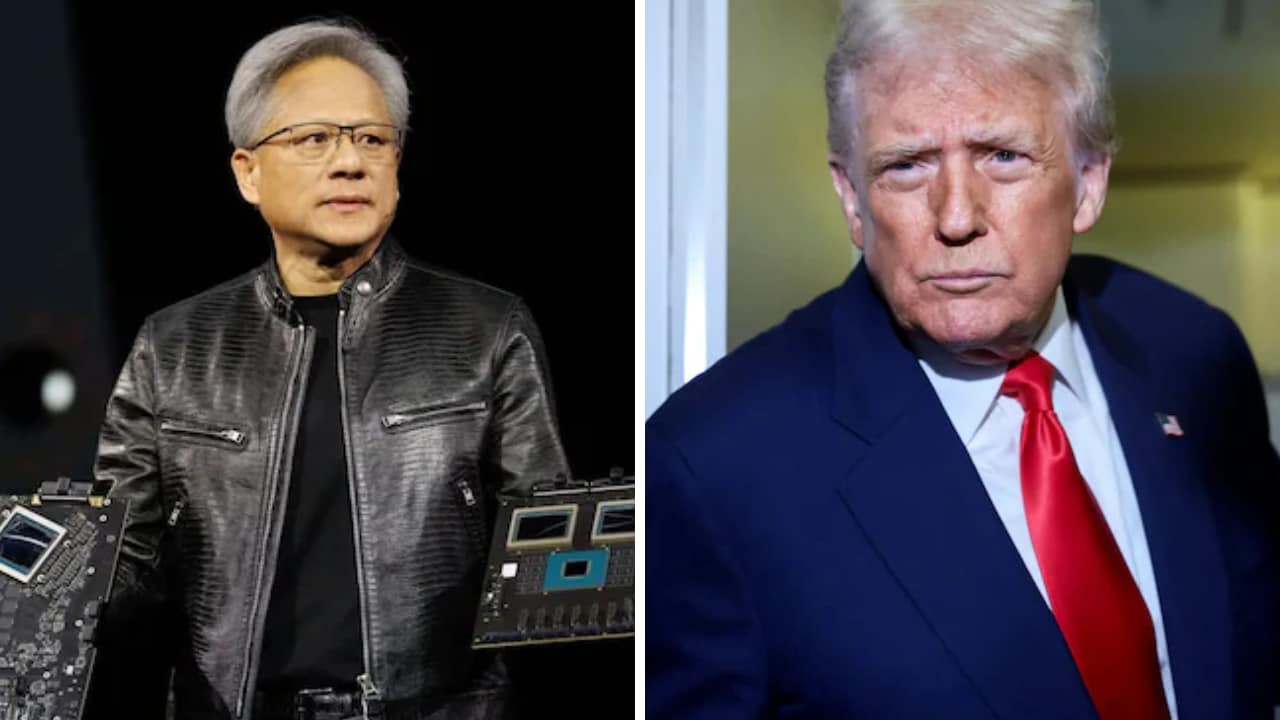
The modern technology ecosystem runs on momentum, market capitalization, and a shared mythology that tomorrow must be infinitely larger than today. When Donald Trump patched into a live public appearance via phone to speak directly with Nvidia chief executive Jensen Huang, dismissing existential anxieties surrounding artificial intelligence as a political hoax, he was not merely offering an off-the-cuff observation. He was codifying a gospel of unbridled acceleration. The exchange, broadcast to a rapt audience, converted a high-profile industry panel into an impromptu political rally for data centers, silicon manufacturing, and unfettered economic expansion. Yet behind the theater of presidential phone calls and dismissive rhetoric lies a deeper friction point between corporate ambition and the tangible physical limits of our electrical grid.
For years, the architecture of the artificial intelligence boom has relied upon a straightforward premise. Compute power scales exponentially, models grow larger, and economic utility follows close behind. To sustain this trajectory, hardware giants like Nvidia require massive electrical capacity, scarce cooling water, and millions of square feet of real estate dedicated to server farms. When Trump described these data centers as the oil of the next quarter-century during his conversation with Huang, he hit upon the precise metric that matters to Washington and Silicon Valley alike. This is no longer a software experiment confined to academic laboratories. It is an industrial transformation requiring physical resources on a scale humanity has rarely attempted to coordinate.
The framing of artificial intelligence safety warnings as a hoax serves a very specific administrative and financial purpose. By reducing complex ethical debates, catastrophic risk scenarios, and regulatory oversight to partisan posturing or foreign interference, political leaders and corporate beneficiaries can clear the path for frictionless deployment. The narrative posits that any friction introduced into the pipeline—whether through environmental reviews for power-hungry server clusters, export controls, or safety testing mandates—acts as an explicit gift to geopolitical rivals like China. In this worldview, caution is unpatriotic, and hesitation is equivalent to surrender.
The reality on the ground is considerably more complicated than a simple binary between progress and obstruction. Huang himself has walked a careful line, nodding to the president's dismissal of apocalyptic scenarios while simultaneously acknowledging the courage of internal whistleblowers who raise legitimate alarms about corporate governance and structural safety. This duality exposes the internal contradictions of the current tech boom. Executives want the market confidence that comes with boundless optimism, even as engineers within their own organizations quietly warn about unverified failure modes, systemic biases, and the concentration of immense processing power in very few hands.
Strip away the political posturing, and the core debate is about control. Who gets to decide how fast these systems evolve, and who absorbs the downside risk when infrastructure demands strain local power grids to their breaking point? Local communities across the United States are increasingly pushing back against the rapid zoning approval of massive data hubs that consume as much electricity as small cities. These are not ideological debates driven by foreign actors or political malice. They are practical struggles over municipal water supplies, electrical rates, and carbon emissions. Dismissing these concerns as a hoax does nothing to generate the megawatts required to keep thousands of graphics processing units running at full capacity.
The convergence of political muscle and semiconductor dominance creates a formidable alliance. When the White House and the primary hardware supplier align to brush aside systemic risks, regulatory oversight becomes an uphill battle. Yet, history suggests that ignoring physical and systemic constraints rarely makes them disappear. It merely defers the bill until a point of crisis is reached. Whether the bottleneck manifests as an unstable power grid, a severe environmental backlash, or an unpredicted failure in an autonomous system, the consequences will extend far beyond the stage of a technology summit.
The race for computational supremacy is moving faster than our institutional capacity to evaluate its secondary effects. By framing every cautionary voice as an enemy of progress, industry leaders and political allies risk creating an environment where no one is left to tap the brakes until it is far too late. The servers continue to hum, the data centers rise across rural landscapes, and the political narrative remains locked on outrunning the competition at any cost.
The Real Reason AI Safety Debates Are Ignored
This video provides an in-depth look at how political figures and tech executives manage the intense public debate surrounding artificial intelligence regulations and market expansion.