The air inside a Boeing 737 is recycled, thin, and carries the faint, sterile scent of disinfectant and coffee grounds. For most of us, that smell signals a business trip, a long-overdue vacation, or the uncomfortable but mundane reality of being squeezed into seat 22B. We worry about legroom. We worry about the Wi-Fi. We check our watches and hope the tailwinds are kind so we can make our connection.
But for five-year-old Liam Ramos, the hum of the jet engines wasn't the background noise of a family holiday. It was the soundtrack to a displacement.
Liam didn’t choose his seat. He didn’t pack his own bag. He sat there, a small child in a world built for giants, clutching the hand of his father as the ground fell away beneath them. They weren't flying toward a bright future or a temporary escape. They were being moved. Like cargo. Like data points on a spreadsheet.
The Logistics of a Broken Heart
When we talk about the airline industry, we often speak in the language of logistics. We discuss "passenger throughput," "on-time performance," and "operational efficiency." It is a cold, mechanical vocabulary that masks the human weight of what is actually happening in those pressurized tubes at 30,000 feet.
Delta Air Lines is a titan of this world. They pride themselves on a "people-first" culture. Their marketing campaigns are filled with soaring music and images of tearful reunions at arrival gates. They want you to believe that every flight is a bridge between two hearts.
Then there is the video.
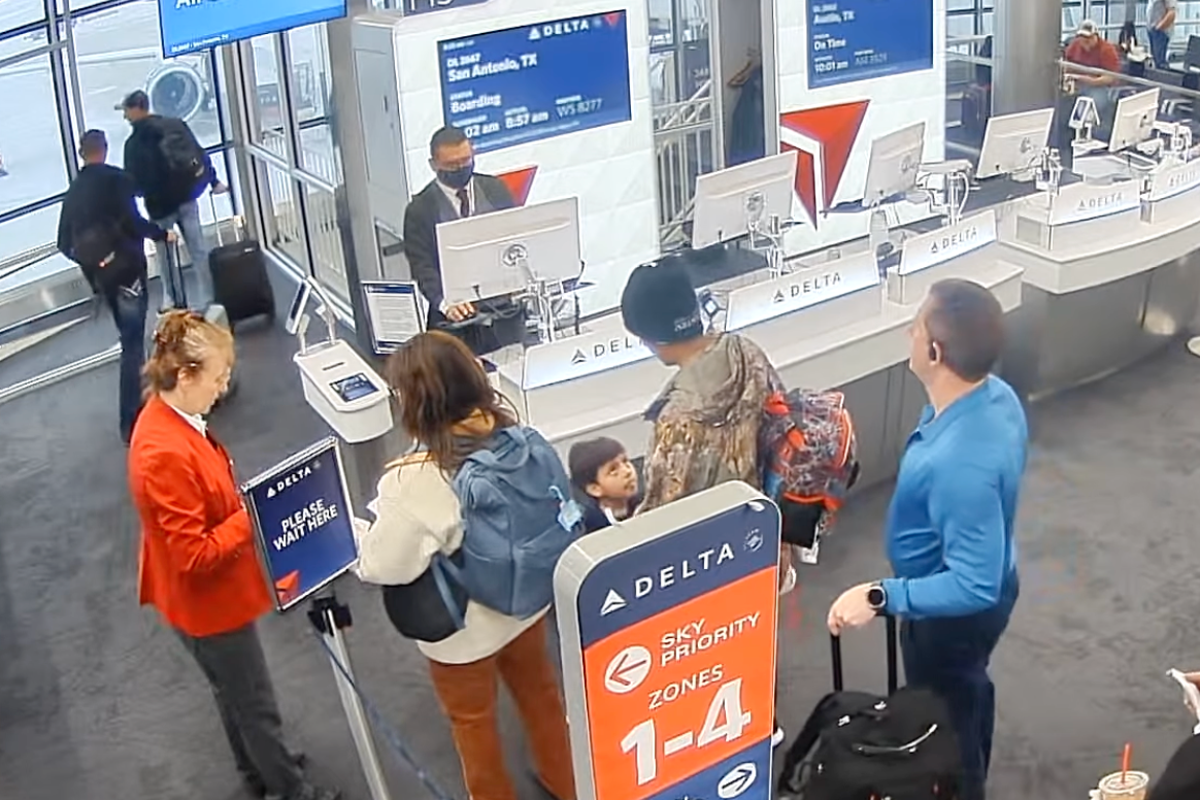
In the grainy, shaky footage that recently surfaced, we see the reality that the marketing department leaves out. We see Liam. We see his father. We see the heavy, invisible presence of Immigration and Customs Enforcement (ICE). The cabin, once a place of transit, becomes a mobile holding cell. The flight attendants, trained to offer pretzels and soft drinks, become the unwitting stewards of a deportation machine.
The disconnect is jarring. On one hand, you have the corporate mission statement, polished and gleaming. On the other, you have a five-year-old boy being flown across state lines to a detention center in Texas. This isn't a failure of logistics. It is a failure of imagination. It is what happens when a corporation decides that its contract with the government is more important than the soul of its passengers.
The Invisible Passengers
Imagine, for a moment, that you are sitting three rows behind them.
You are scrolling through movies on your seatback screen. You are deciding between a romantic comedy and a documentary about nature. You feel the slight jolt of turbulence and reach for your ginger ale. You are a "customer." You have rights. You have a loyalty program number.
But what about the person next to you?
What if the man in the window seat isn't going home? What if the child in the middle seat is entering a system designed to process him like a number?
The industry calls this "special handling." It’s a sanitized term. It groups children like Liam with unaccompanied minors or passengers with mobility needs. It flattens the jagged edges of human suffering into a checklist for the ground crew.
The weight of this reality is something most travelers never have to carry. We assume that the plane is a neutral space, a temporary limbo between Point A and Point B. We don't want to think about the fact that the same wings carrying us to a wedding are carrying someone else to a cell.
But the silence of the other passengers in that video is deafening. It is the silence of a society that has become accustomed to the "efficiency" of cruelty. We have outsourced our morality to the fine print of a carriage agreement. We have decided that as long as the flight is on time, we don't need to ask who is being forced to fly.
The Architecture of the Descent
Texas is big. From the air, it looks like an endless patchwork of brown and green, stitched together by the silver threads of highways. For a child like Liam, it must have looked like the edge of the world.
When the wheels hit the tarmac in Harlingen, the sound is a violent reminder of gravity. The flight ends, but the journey into the labyrinth of the American detention system is just beginning. This is where the "people-first" airline hands off its cargo. The doors open, the humid Texas air rushes in, and the sterile safety of the cabin is replaced by the harsh fluorescent lights of a processing center.
Consider the psychological toll of that descent.
For a five-year-old, the world is supposed to be predictable. Parents are supposed to be protectors. Home is supposed to be a fixed point. But for Liam, the very act of flight—something that should be wondrous—became a mechanism of separation and fear.
There is a specific kind of trauma that comes from being moved against your will by people in uniforms. It creates a baseline of anxiety that doesn't just go away when the paperwork is filed. It lives in the nervous system. It triggers every time a loud noise echoes or a door locks.
We are told that these flights are necessary for "border security." We are told that laws must be followed. But laws are not divine commandments; they are choices made by men and women. And when those laws require us to use our commercial infrastructure to transport children to cages, we have to ask what kind of "security" we are actually buying.
The Cost of Looking Away
The airline industry is currently facing a reckoning, though they might not admit it yet. In an age of instant video and global connectivity, the "invisible" parts of their business are being dragged into the light.
It is no longer enough to offer free messaging and better snacks.
When Delta or any other carrier accepts a contract to move detainees, they are making a brand choice. They are saying that their assets—their planes, their pilots, their gate agents—are available for the enforcement of a system that frequently targets the most vulnerable.
They will argue that they are simply a "common carrier." They will say they cannot discriminate based on who the government tells them to fly. They will hide behind the legalities of their federal contracts.
But there is a difference between what is legal and what is right.
There is a difference between following a regulation and participating in the erasure of a child's dignity.
We often think of "big" problems as being unsolvable. We think of immigration policy as a gargantuan, tangled knot that no one can untie. But the story of Liam Ramos isn't about the whole knot. It's about one single strand. It's about a specific flight, a specific day, and a specific decision to look the other way while a five-year-old was buckled into a seat he never asked for.
The Echo in the Cabin
The video ends before we see what happens to Liam and his father after they leave the plane. We don't see the processing. We don't see the cold nights or the uncertainty of the legal proceedings. We only see the transit.
But that transit is the part we all share.
Every time we board a flight, we enter into a temporary community. For a few hours, our lives are literally in each other's hands. We breathe the same air. We move at the same speed.
If we allow that community to be used as a tool for state-sponsored trauma, we lose something vital. We lose the idea that the sky is a place of freedom. We turn our airports into annexes of the carceral state.
Liam Ramos is five. He will grow up with the memory of that flight. He will remember the way the clouds looked from the window, and he will remember the fear in his father's eyes. He will remember that a giant silver bird took him away from everything he knew and dropped him in a place where people wear badges and carry clipboards.
The next time you hear the chime of the seatbelt sign, listen closely.
It isn't just a signal to sit down. It is a reminder of the order we have built. It is the sound of a system that values the schedule over the soul.
The plane will land. The passengers will deboard. The cleaning crew will come in to remove the crumbs and the discarded napkins, erasing every trace of the people who were just there. They will prep the cabin for the next group of travelers, for the next "people-first" journey.
But the air in the cabin still holds the ghosts of the children we’ve decided are someone else’s problem.
The flight is over. The engines are silent. But the question remains, vibrating in the stillness of the terminal: when did we decide that some passengers aren't people at all?
The boy is gone, but the seat is still warm.