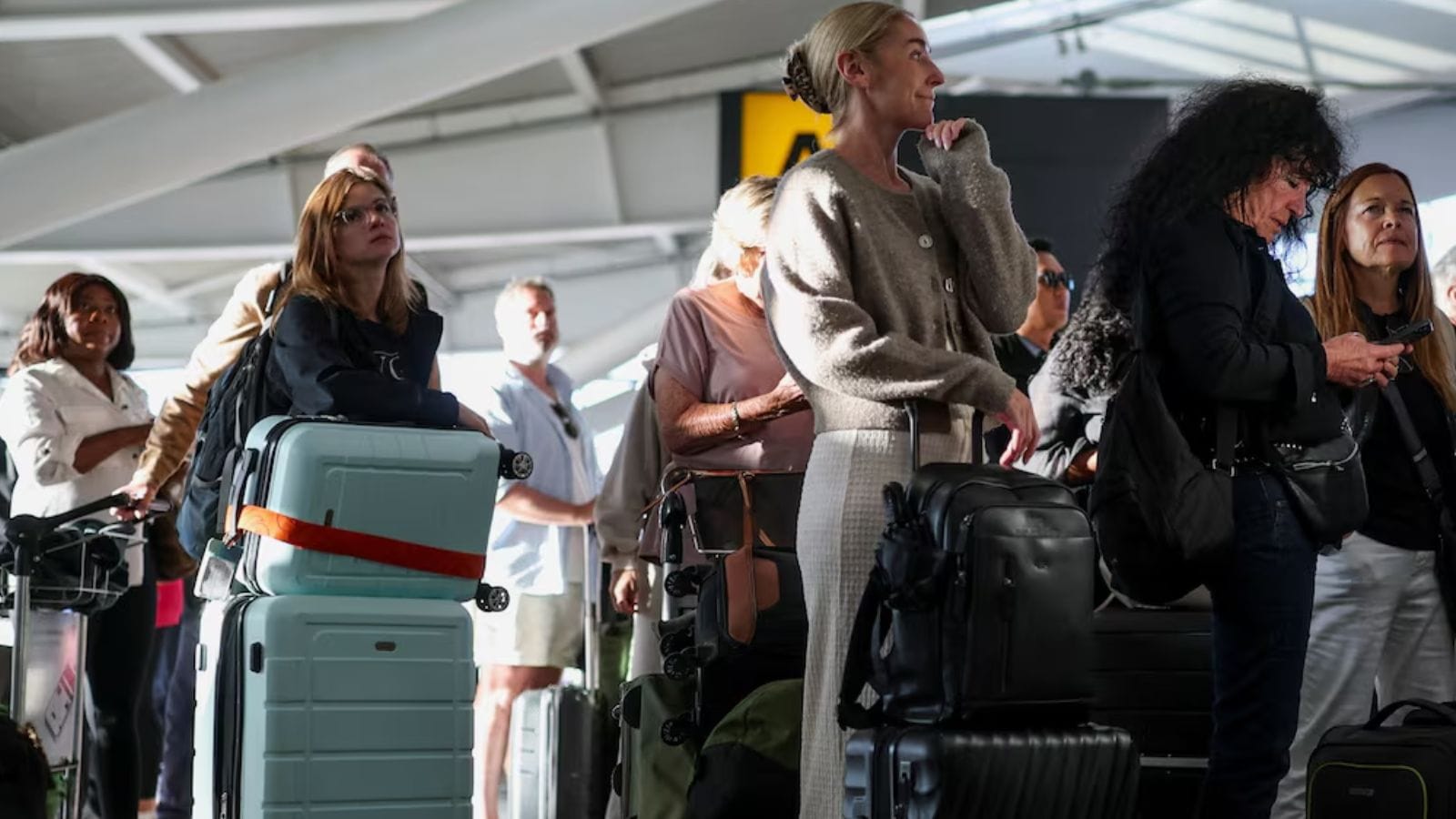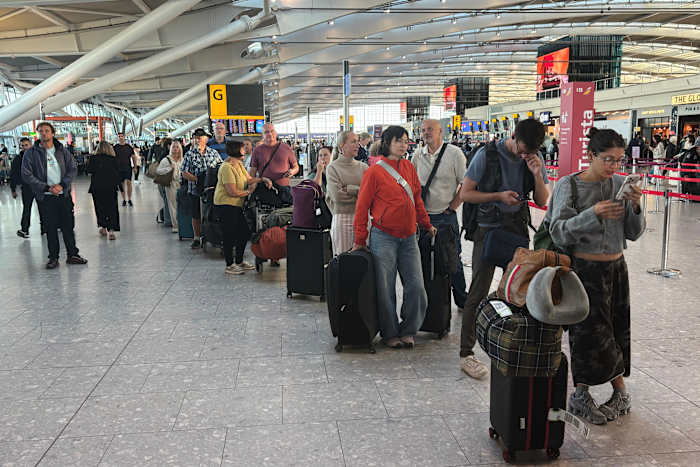
The coffee in Terminal 5 was lukewarm, tasting faintly of boiled aluminum and burnt patience. Outside, the rain drove sideways across the tarmac, blurring the runway lights into smeared orange streaks. Inside, twenty thousand people stared at a departures board that had ceased to function as a guide to the future and had instead become an abstract painting of failure.
Every single name flickered. Every flight number blinked out of existence. One thousand seven hundred and fifty times, a gate closed forever on someone's wedding, someone's funeral, someone's desperate attempt to catch a meeting that would save a livelihood.
Consider Arthur. This is a hypothetical scenario, but it is happening right now in a dozen different terminals. Arthur is seventy-four. He wears a tweed jacket with leather patches on the elbows that smell faintly of pipe tobacco and old libraries. He has a boarding pass folded into a neat rectangle in his breast pocket. His destination is Porto, where his granddaughter is turning five, an age where children still believe that grandparents are slightly magical creatures who live in airplanes and hotels. Arthur arrived three hours early. He drank his tea. He read three chapters of a biography of Churchill. Then the screens went black. Then they turned red. Then they announced that the digital architecture underpinning the island's entire aviation network had quietly, catastrophically fractured.
We live in an era that worships speed. We treat the sky as a highway, a predictable corridor of aluminum and jet fuel designed to whisk us from breakfast in London to dinner in Barcelona without a second thought. We check our phones while hurtling through the stratosphere at six hundred miles per hour, complaining that the Wi-Fi is too slow. We treat aviation as a utility, right alongside running water and electricity.
Until it stops.
When the software collapses, the modern world reveals itself to be not a concrete fortress, but a house of cards balanced on a very narrow pin.
The trouble did not start with a storm. There was no theatrical lightning strike, no dramatic Hollywood explosion. It began in a windowless room somewhere outside London, inside a rack of server blades humming quietly in the dark. A single line of corrupted code, a routine software update pushed out by an automated pipeline to maximize efficiency, collided with a legacy database built when Tony Blair was still answering questions in Parliament.
That is the hidden irony of our age. We run twenty-first-century jets on twentieth-century scaffolding.
Think of it like a medieval cathedral built upon a foundation of dried mud. From the outside, the flying buttresses are majestic. The stained glass catches the morning sun. But beneath the flagstones, the earth is shifting. When the update hit, the database didn't crash; it panicked. It began spitting out phantom flight plans. It created aircraft that existed in the digital ether but not on the tarmac, while leaving real planes—tons of metal, kerosene, and breathing human beings—stranded in holding patterns over the Channel, burning through their reserves while air traffic controllers tried to remember how to use paper strips and grease pencils.
Arthur doesn't know about server racks or legacy databases. Arthur only knows that the woman behind the desk has stopped looking him in the eye.
This is the psychological toll of a digital breakdown. The dehumanization of catastrophe. When a plane crashes due to weather or mechanical failure, there is a terrible, tragic clarity to it. But when a flight is canceled because a server in Slough dropped a packet, nobody is to blame. Or rather, everyone is to blame, which means no one is. The automated voice on the public address system offers the same hollow platitude every seven minutes: Your comfort is our priority.
It is a lie. Comfort was abandoned three hours ago when the air conditioning units in Terminal 5 tripped offline under the heat of twenty thousand panicked bodies.
By midday, the terminal floor had transformed into an indoor campground. Suitcases became makeshift pillows. Children played silent games on discarded cardboard coffee carriers. A young woman in a sharp business suit sat cross-legged against a concrete pillar, her phone pressed to her ear, weeping quietly into the mouthpiece as she explained to her boss that she would miss the pitch that her firm had spent six months preparing for. Her mascara had run down her cheeks in thin, black tracks.
We talk about the economy in billions of dollars. We talk about airline stocks dropping four points, of logistical supply chains snapping, of quarterly losses that will require restructuring. But the economy is not a spreadsheet. The economy is that weeping woman in the suit. The economy is Arthur folding and unfolding his boarding pass until the paper begins to fray at the creases.
The pilots are trapped, too. Captain James has been in the cockpit of a Boeing 777 for four hours. He and his crew arrived at dawn, prepped the flight deck, ran the diagnostics. They are ready. The engines are spooled. But the digital clearance to push back never arrived. Under aviation law, a crew can only stay on duty for a fixed number of hours before fatigue compromises safety. At 2:15 PM, Captain James has to make an announcement that turns his stomach: Ladies and gentlemen, I am sorry to report that our crew has timed out. We are going back to the gate.
A collective groan rises from the cabin, heavy and physical, like the sigh of a dying beast.
Behind that announcement lies a labyrinth of scheduling rules designed to keep us safe from tired pilots, but which now serve to paralyze the system further. You cannot simply swap Captain James for another pilot, because the other pilots are stranded in Edinburgh, or Manchester, or Frankfurt, waiting for planes that are parked in the wrong hemisphere. The entire ballet of global travel relies on a delicate, invisible synchronicity. One missed beat throws off the entire choreography.
Consider the sheer scale of the logistical nightmare unfolding behind the scenes. Ground crews are sprinting between gates with orange cones and marshalling wands, but they are fighting blind. Baggage handling systems have reverted to manual mode, which means thousands of red plastic bins are piling up in the subterranean bowels of the airport like colorful, useless bricks. Luggage destined for Tokyo is currently sitting beside luggage destined for Tel Aviv, lost in a labyrinth of conveyor belts that have lost their memory.
We have engineered a world that is too complex for us to fix when it breaks.
That is the quiet terror of technology. We build systems to remove human error, to make our lives faster, cleaner, more efficient. We outsource our memory to hard drives and our navigation to satellites. But in doing so, we create single points of failure so vast that when they crack, millions of people are left stranded in the dark, waiting for someone to reboot the universe.
Arthur is still sitting on his blue plastic chair. The battery on his phone died an hour ago. He has no idea if his son in Porto has received his message, or if he is standing at Arrival C waiting for a grandfather who never descends the escalator.
The rain has stopped outside. A thin, watery shaft of late-afternoon sunlight breaks through the cloud cover, illuminating the dust motes dancing in the stale air of the terminal.
On the concourse, a lone gate agent steps up to the microphone. She has been on shift for fourteen hours. Her voice is hoarse, raspy with exhaustion. She doesn't read from the corporate script anymore.
Listen to me, she says, and her voice echoes off the glass and steel. Every flight out of London is grounded until tomorrow morning. Go home if you live here. If you don't, find a patch of floor. We are trying.
There is no applause. There is no anger. Just a profound, heavy silence as the realization settles over the thousands of stranded souls. The sky is closed. The wires are dead. We are back on earth, tethered to the ground, waiting for the morning light to show us how to begin again.