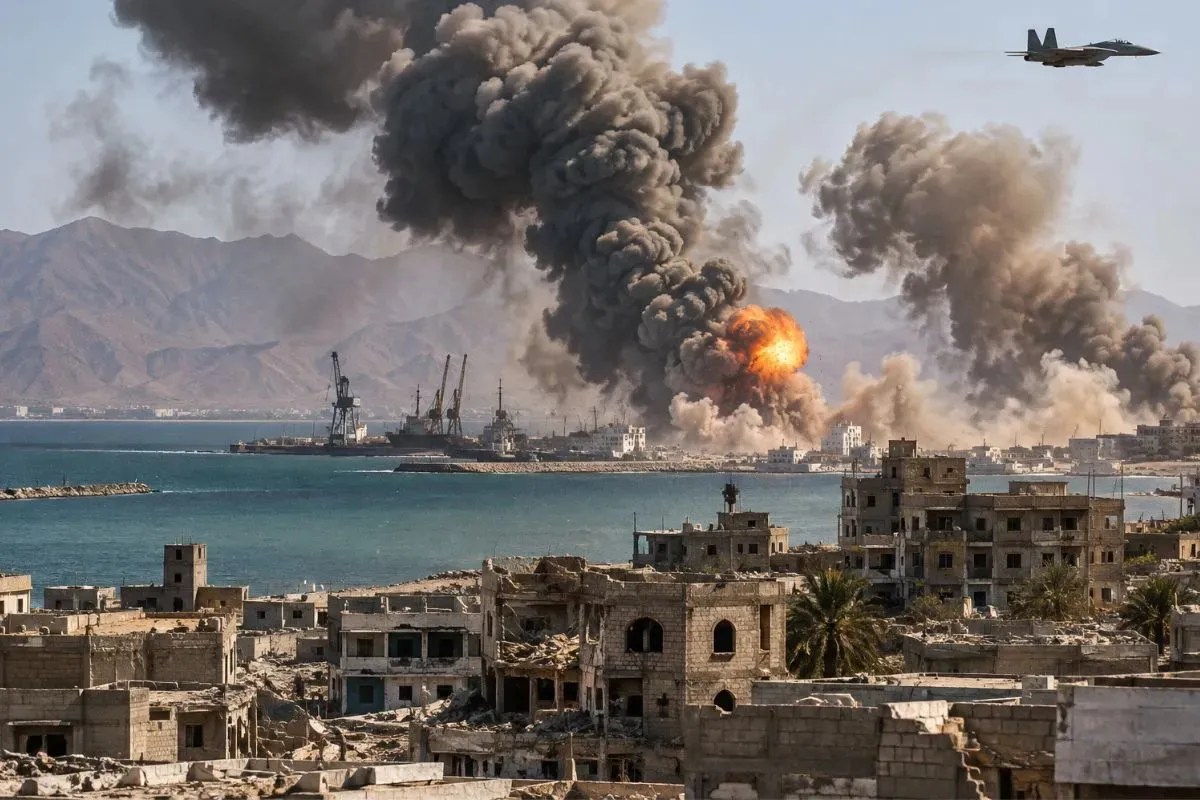
Headline reports of a small boat firing on a liquefied natural gas (LNG) tanker near Yemen—followed by return fire from an embarked security team—capture the immediate drama of a maritime encounter while leaving out the structural forces that govern risk in the Gulf of Aden and southern Red Sea. A single incident summary treats the event as a self-contained exchange of gunfire. In practice, an encounter between a high-value gas carrier and a fast skiff sits at the intersection of asymmetric maritime economics, vessel geometry and freeboard, strict rules of engagement, seasonal sea states, and freight-market pricing.
When a competitor article stops at "shots were fired and security fired back," it conflates distinct operational categories. Small-arms fire from a skiff or small craft carries a different physical and tactical profile than stand-off missile or unmanned surface vessel strikes. Equating every alert near Yemen with a single threat model distorts routing decisions, crew readiness, and charter-party negotiations.
What Headline Reporting Leaves Unexplained
A standard wire-style report answers three surface questions: where the vessel was roughly located, what immediate kinetic action occurred, and whether the immediate threat withdrew. It rarely separates verified facts from unconfirmed attribution or operational context.
In maritime security reporting around Yemen, four analytical gaps recur across basic news coverage:
- Attribution ambiguity: Sighting a small boat firing shots near a commercial vessel does not by itself prove whether the perpetrators are opportunistic pirates, smuggling networks operating opportunistically, or actors tied to broader regional hostilities. Motive and command structure require corroborating intelligence beyond a single bridge report.
- Tactical intent versus kinetic effect: Small-arms fire from an open skiff at range can intimidate bridge watchkeepers or probe defensive posture, whereas closing distance with ladders or heavier weapons signals boarding or interdiction intent. Treating warning shots, harassing fire, and a coordinated boarding attempt as identical distorts threat statistics.
- Vessel class specificity: An LNG tanker is not a standard general cargo ship or a single-hull product tanker. Its cargo containment system, deck piping, vapor management, and high freeboard shape how a small craft approaches and what an attack can realistically achieve.
- Second-order commercial impact: Even when a security team deters a small boat without casualties or hull breach, the event alters voyage logs, war-risk insurance premiums, charterer vetting, and scheduling buffers across the wider corridor.
Separating confirmed observations from educated hypotheses is essential before any commercial or operational adjustment is made. A confirmed fact is a documented report of a small craft approaching, gunfire occurring, and an embarked security team responding. An educated hypothesis is an inference about whether the craft operated from a mothership, sought ransom or cargo disruption, or tested response times—each of which carries different probabilities depending on distance from shore and sea conditions.
The Cost Function of Asymmetric Small-Craft Harassment
Small-craft harassment persists near chokepoints and transit lanes because its cost structure favors low-signature actors over capital-intensive naval patrols. A fiberglass or aluminum skiff powered by outboard motors requires minimal capital expenditure, blends into regional fishing and coastal traffic on radar and optical sensors, and can disperse rapidly once challenged.
From the perspective of an attacker, the cost function has three main components:
- Capital and operating cost: Skiffs, outboard engines, fuel, and small arms are inexpensive relative to the insured value of an LNG carrier and its cargo. Even when a mothership is used to extend operating range offshore, the marginal cost of an unsuccessful approach remains low if the crew escapes unharmed.
- Detection and attribution cost: Crowded shipping lanes and vast sea areas make continuous tracking of every small hull difficult. When attackers withdraw toward open water or coastal areas without leaving verifiable identification, attribution costs remain high for regional authorities and commercial operators alike.
- Expected payoff asymmetry: Against a high-value LNG cargo, even a low probability of boarding, forcing a speed or course change, or triggering a broader security scare yields outsized leverage compared with the cost of launching a skiff.
Environmental conditions modulate this cost function throughout the year. When monsoon winds and rough seas subside—such as the transition after the southwest monsoon in the Arabian Sea and Gulf of Aden—smaller craft operate with greater stability and reach. Calm sea states lower the operational barrier for small boats while increasing the range at which low-freeboard hulls can maneuver alongside larger vessels.
LNG Tanker Physics and Vulnerability Realities
Popular commentary often assumes that any gunfire near an LNG tanker threatens an immediate catastrophic explosion. The physical reality of liquefied natural gas transport is more nuanced, though no less serious from a safety and operational standpoint.
LNG is transported at atmospheric or near-atmospheric pressure at roughly minus 162 degrees Celsius. On modern membrane or spherical-tank carriers, the cargo is held inside insulated containment systems protected by thick outer hulls, cofferdams, and high freeboard when laden. Methane vapor released into open air does not detonate like high explosive unless mixed with air within a specific flammability range (roughly 5 percent to 15 percent by volume) and exposed to an ignition source; more commonly, a release creates a cold vapor cloud or pool/jet fire if ignited near a leak point.
Small-arms rounds fired from a bobbing boat rarely penetrate heavy outer hull plating in critical cargo spaces at stand-off range. However, vulnerabilities still exist on deck and around exposed systems:
- Exposed piping, valves, and instrumentation: Deck manifolds, cryogenic transfer lines, sensors, and communication or navigation gear on the bridge wings and superstructure face higher exposure to stray or aimed rounds than thick double-hull sections.
- Deck crew and bridge personnel: Bridge windows, exterior walkways, and exposed weather decks create risk to human life during an engagement, making rapid evasive maneuvering and citadel or interior shelter procedures vital.
- Operational distraction: Gunfire forces immediate bridge focus onto threat tracking, evasive helm orders, and security coordination, increasing the risk of navigational error in congested traffic if bridge team resource management is not disciplined.
Understanding these physical boundaries prevents two opposite errors: dismissing small-arms fire as harmless because a skiff lacks heavy ordnance, or panicking over worst-case explosion scenarios that misrepresent containment engineering.
Deterrence Mechanics and Embarked Security Teams
When a vessel's security team returns fire or fires warning shots, the immediate goal is deterrence and denial of boarding rather than prolonged combat. An embarked security team operates under strict legal, flag-state, and contractual constraints, as well as graduated escalation protocols.
Consider a representative operational sequence during a close approach in high-risk waters. Watchkeepers spot a fast-moving skiff closing on a steady bearing despite radar and VHF warnings. The master increases speed where safe, alters course to create unfavorable approach angles and wash, and activates defensive measures such as water cannons, acoustic hailing, or evasive zig-zagging while the security team takes designated firing positions. If the craft persists within threat range or displays weapons or boarding gear, warning shots or aimed defensive fire may be used in accordance with applicable rules of engagement to force the craft to break off.
This defensive model works by raising the immediate survival cost for an approaching boat at the exact moment it tries to close the final meters. Once a skiff loses speed or takes fire, boarding becomes far harder and the risk to attackers rises sharply.
Yet armed security is not a universal shield. Its effectiveness depends on line of sight, sea state, illumination or thermal detection at night, team positioning, and ammunition/weapons fit. Moreover, gunfire carries escalation risks: firing in congested waters or near uninvolved vessels can create collateral hazards, and aggressive posturing can sometimes provoke heavier responses if an actor is already armed for confrontation rather than opportunistic boarding.
Cause-and-Effect Across Freight, Insurance, and Routing
A single shooting incident near Yemen ripples outward through maritime economics along a clear causal chain. Even when the tanker proceeds without structural damage, stakeholders adjust pricing and risk allocation.
First, war-risk underwriters re-evaluate transit exposure across affected zones. An uptick in reported approaches, gunfire, or boarding attempts—especially when combined with seasonal calm seas or broader regional tensions—pushes underwriters to tighten breach-of-warranty terms, shorten coverage windows, or raise additional war-risk premiums.
Second, charterers and vessel operators weigh transit time against security cost. Rerouting around longer maritime paths—such as around the Cape of Good Hope instead of the Suez and Red Sea corridor—adds voyage days, increases fuel burn, ties up LNG carrier capacity, and tightens delivered gas supply schedules between exporting basins and importing markets. Conversely, staying on shorter routes preserves transit time and fuel efficiency but concentrates exposure to security alerts, delays, and insurance surcharges.
Third, spot and time-charter freight rates respond to effective vessel availability. When longer voyages absorb hull-days or when owners demand higher risk compensation for transit through contested waters, charter rates and delivered LNG price spreads reflect that friction.
A Five-Step Operational Assessment Framework
For shipping executives, charterers, and risk managers evaluating a report of small-boat gunfire near Yemen, reacting to the headline alone is a recipe for misallocated capital. A disciplined workflow converts raw incident alerts into sound decisions:
- Verify source credibility and incident class: Cross-check the report against established maritime security advisories and distinguish small-arms approaches or attempted boardings from missile, drone, or mine events. Confirm distance from shore, sea state, and whether boarding equipment or a mothership was reported.
- Audit physical and procedural hardening: Review the specific vessel's freeboard, citadel readiness, bridge protection, communications redundancy, and embarked security team vetting and rules of engagement prior to entry into the high-risk area.
- Model voyage economics under both routing choices: Compare total voyage cost—including fuel, canal or port charges, war-risk insurance, charter hire, and inventory/demurrage exposure—across the direct corridor and alternative longer routes.
- Enforce dynamic watchkeeping and reporting discipline: Require heightened lookouts, AIS and radar correlation, pre-planned evasive maneuvers, and immediate standardized reporting to regional maritime centers so fleet-wide awareness stays current without delaying tactical response.
- Stress-test commercial contracts and contingencies: Clarify off-hire clauses, deviation rights, crew welfare protocols, and force majeure or war-clause triggers with counterparties before a vessel enters a volatile zone.
Where Strategy Fails: Limitations and Edge Cases
Every risk-management framework has boundaries where standard playbooks break down. Overconfidence in defensive routines is one common failure mode: a string of repelled approaches can lull crews into treating small-craft encounters as routine rather than lethal threats.
Another limitation lies in threat evolution. Tactics that deter unarmored skiffs using small arms do not stop stand-off projectiles, explosive unmanned craft, or coordinated multi-craft swarms. Applying a piracy-only mindset in an environment with overlapping state and non-state hazards leaves blind spots.
Economic models also face limits when geopolitical shocks move faster than market pricing. Sudden escalations or sudden de-escalations can invert rate spreads and insurance costs within days, making rigid long-term routing rules costly. No single measure—neither armed guards, nor speed, nor rerouting—eliminates risk entirely; each trades one set of costs and exposures for another.
Strategic Action for Operators and Charterers
Treat every small-craft gunfire report off Yemen as a signal to re-price corridor risk dynamically rather than a standalone anomaly. Audit embarked security readiness, verify bridge and deck protection protocols, and run side-by-side voyage cost simulations comparing direct transit against longer alternative routes before vessels commit to the passage—adjusting routing and insurance coverage at the voyage level as verified threat patterns and seasonal sea conditions shift.


