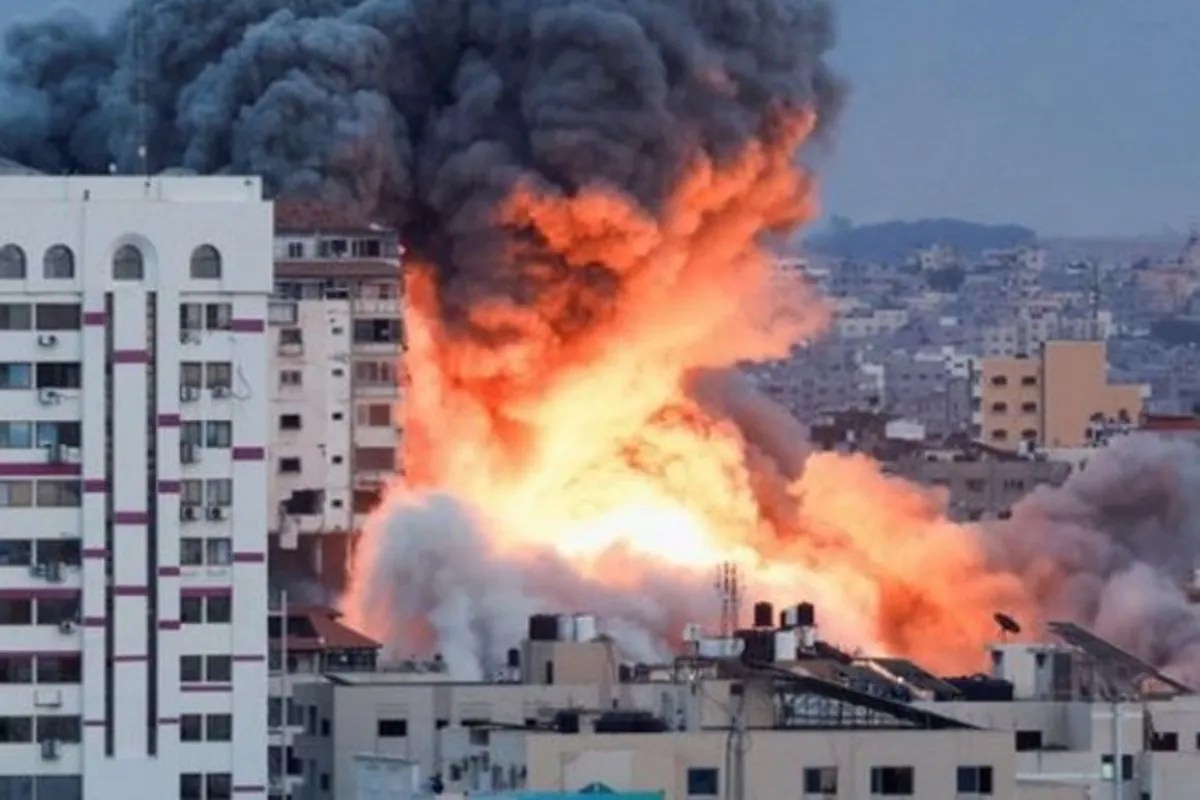
The coffee in the porcelain cup had gone cold hours ago, a dark, motionless mirror reflecting a ceiling scarred by old cracks. Outside the reinforced window, the southern horizon did not look like a front line. It looked like any other Mediterranean afternoon, hazy with dust, cicadas droning in the dry brush, the light turning everything the color of aged honey. Then came the sound. It was not a sharp crack, but a heavy, subterranean shudder that traveled up through the floorboards and settled directly behind the ribs.
By sunset, the arithmetic of a Tuesday afternoon had been rewritten by fire.
Eleven souls extinguished in a single blink across the Lebanese frontier. Five more wounded, their bodies now mapping out the sudden, fragile geography of hospital corridors in towns whose names only appear on evening broadcasts when the worst has already happened.
We talk about escalation as if it were a weather pattern. We speak of strikes and counter-strikes, of trajectories and radar cross-sections, as though these were abstract chess moves executed by distant machines. But war is profoundly domestic. War happens in kitchens where bread was half-kneaded. It happens in the narrow alleyways of border villages where neighbors know the exact cadence of each other’s footsteps on gravel.
Consider a hypothetical living room just fifty meters from where the blast wave hit. A grandmother’s framed photograph tilts slightly on the sideboard, shaken loose from its nail. Dust settles over plastic flowers. In that room, five minutes before the horizon tore open, someone was worrying about vegetable prices, or whether the electricity would hold out through the evening, or if the cousin in Beirut had managed to find work. Those ordinary, mundane anxieties—the sacred boredom of daily life—were vaporized in less time than it takes to draw a breath.
This is the invisible tax of geography. To be born within sight of a dividing line is to live with a metronome ticking in your chest, counting down intervals of quiet between inevitable storms.
The strikes launched into Lebanon this week did not arrive in a vacuum. They are the latest violent punctuation marks in a sentence that has been running for generations. Every trajectory carries history. Every interception echoes decades of unhealed grievances, broken ceasefires, and the terrible, blinding certainty of retaliation. When military briefers stand in air-conditioned rooms miles away, pointing laser pointers at satellite maps, they speak of military assets and strategic deterrence. They do not speak of the deafening silence that settles over a schoolyard when the children have been told to stay home indefinitely. They do not measure the weight of a mother’s hand as she checks her child’s pulse in the dark, wondering if the walls of their ground-floor room are thick enough this time.
We have normalized the abnormal. We scroll past casualty counts on our glowing screens between updates on weather and sports, our brains developing an iron scar tissue to cope with the sheer volume of distant grief. That is the real danger. Not just the falling steel, but the hardening of the heart that lets us hear that eleven people died and simply keep scrolling.
Pause. Look at that number again. Eleven human universes—memories, inside jokes, secret fears, favorite songs, morning routines—erased before suppertime. Five more bodies broken, facing long, grueling months of operations, physical therapy, and the psychological fallout of surviving what others did not.
There is an old journalistic impulse to look for a turning point, to ask when the cycle will break, as if history were a machine with a loose bolt that a clever mechanic might finally tighten. But the truth is more exhausting and more frightening than that. The cycle continues because each act of violence becomes the justification for the next. The grief of the survivor becomes the fuel for the soldier. It is an infinite loop fueled by human pain, paid for in currency minted from broken homes.
When the dust finally settled over the rubble in southern Lebanon, the evening air grew cool, indifferent to what had just occurred. The stars came out over the hills, indifferent to the makeshift bandages and the weeping in the corridors. But down below, in the quiet dark, the real work of endurance began—the work of picking through fragments, of burying the dead, and of waiting with baited breath for the next tremor to rise up through the floorboards.