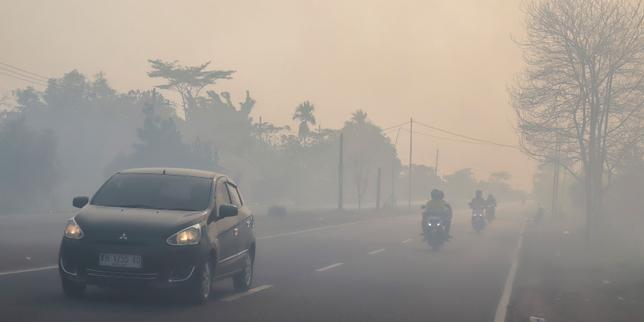
The air does not simply change; it hardens. You wake up before dawn, and instead of the cool, wet breath of the Sumatran morning, your throat catches on a metallic grit that tastes like old pennies and burnt hair. Outside the window, the sun is not a star. It is a dull, bruised orange coin suspended in a thick, yellow shroud.
Two hundred thousand hectares.
Say the number out loud. It sounds clean. It looks neat in a quarterly report or a morning news ticker. Two hundred thousand hectares of green. Two hundred thousand hectares of breathing earth, ancient peat, towering dipterocarp trees, and habitats older than memory, reduced to ash since the year barely began.
And the authorities are looking at their calendars, looking at the dried husks of fields, looking at the shifting winds, and they are whispering the sentence that keeps firefighters awake at night: The worst is still coming.
I remember standing near the edge of the Riau province a few years back, watching the haze swallow a village whole. It wasn't a wall of fire with roaring dragons and dramatic movie sparks. It was creepier than that. It was a silent, subterranean ghost. Peat fire does not burn above ground first. It cooks from the inside out. You can walk across what looks like solid, damp soil, feeling nothing unusual, until the ground gives way beneath your boot and your leg plunges into a glowing, smoldering pit of carbonized hellfire that has been eating the forest from the roots up for weeks.
That is what Indonesia is facing right now.
To understand what 200,000 hectares actually means, stop thinking about maps. Think about breath. Think about a child sitting in a classroom in Jambi, coughing into a cloth mask while the school day is canceled for the third week in a row because the pollutant index has broken every dial on the board. Think about the orangutan mother moving her baby higher and higher into a shrinking canopy, until the trees stop and there is only sky, smoke, and the rising heat.
Every dry season brings a rhythm to this part of the world, but human hands always accelerate the beat. The formula is brutally simple. Clear the land. Burn the brush. Plant the palm oil. Repeat. But when the dry seasons stretch longer, when the rains arrive late or not at all because the global climate engine is coughing and spluttering, that routine clearing turns into an uncontrolled furnace.
We treat earth like a balance sheet. We weigh economic yields against environmental tolls as if they exist on separate pages. But the ash falling on the roofs of Kalimantan does not care about export quotas. It settles into the lungs of grandmothers. It coats the leaves of rubber trees until they suffocate. It billows upward, crosses borders, and becomes a shared, smoky blanket that turns neighboring skies into dystopian gray screens.
Consider what happens next.
As the dry months deepen, the moisture left in the soil evaporates completely. The peatlands, which should act like giant, spongy sponges holding carbon locked away for millennia, dry out into powder. When a peat forest burns, it releases not just carbon dioxide, but centuries of stored ancient breath back into the atmosphere in a matter of hours. It is an ecological betrayal on a staggering scale. The fire becomes self-sustaining. You can pour water on the surface until your tanks run dry, but below, in the dark, the earth keeps chewing through its own history.
We look at these disasters as distant tragedies, items to swipe past on a glowing rectangle while waiting for a train. We distance ourselves because the scale is too vast to comprehend. Two hundred thousand hectares is roughly the size of a small nation or a massive metropolitan sprawl, turned into charcoal while we drink our morning coffee.
Yet, behind every hectare is a story of loss. Not just of wildlife or trees, but of a way of life. Smallholder farmers whose traditional rotation methods are overwhelmed by sudden, hyper-aggressive mega-fires. Indigenous communities whose sacred groves are reduced to soot, taking with them generations of oral history tied to specific medicinal plants that will never grow there again.
The smoke clears eventually. The rains always return. But the soil remembers. The atmosphere remembers. And as the authorities sound their warnings for the months ahead, the real question is not whether the fires will spread.
The question is how long we can keep watching the world burn from behind a pane of glass before we realize we are standing in the same room.