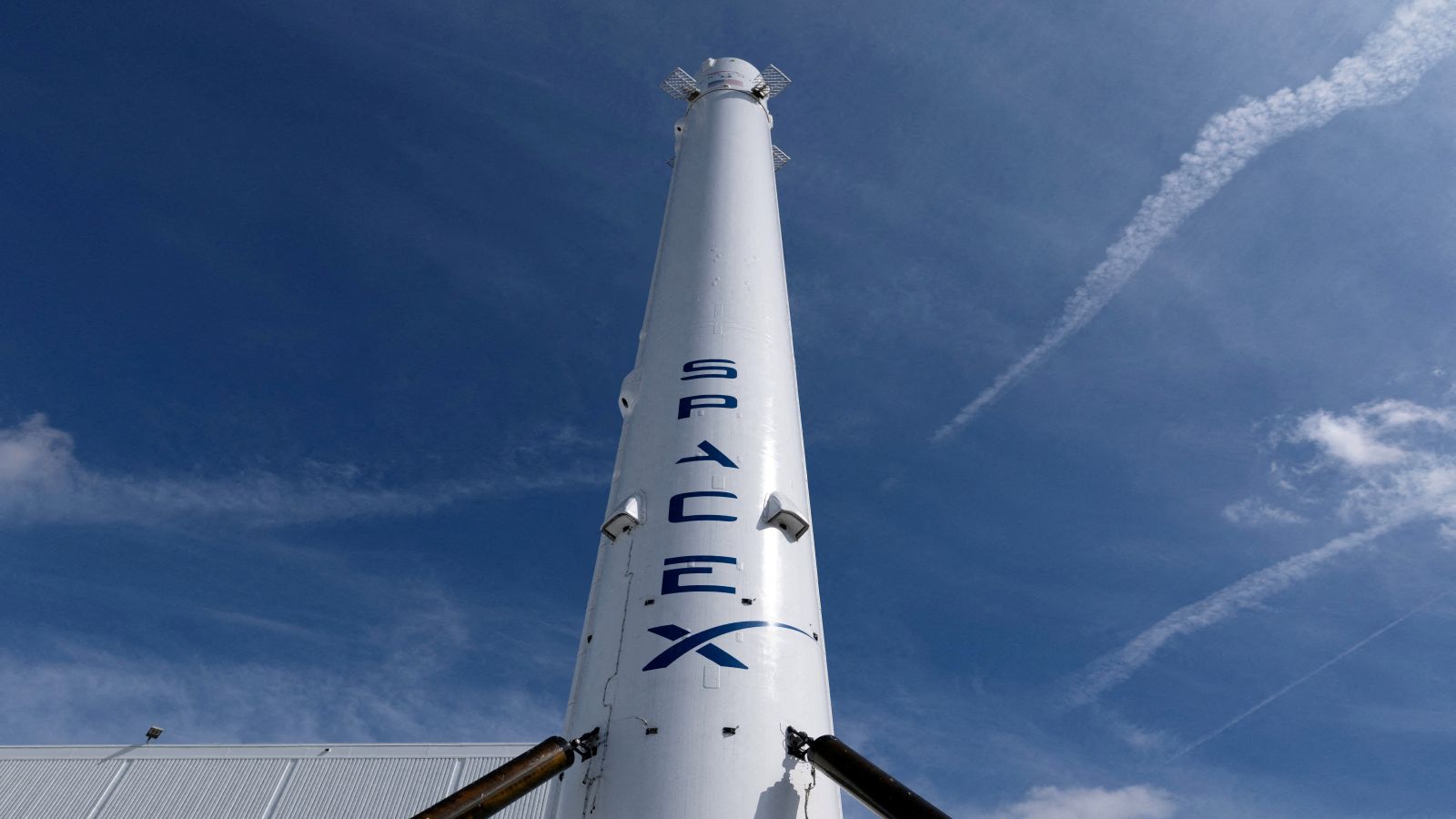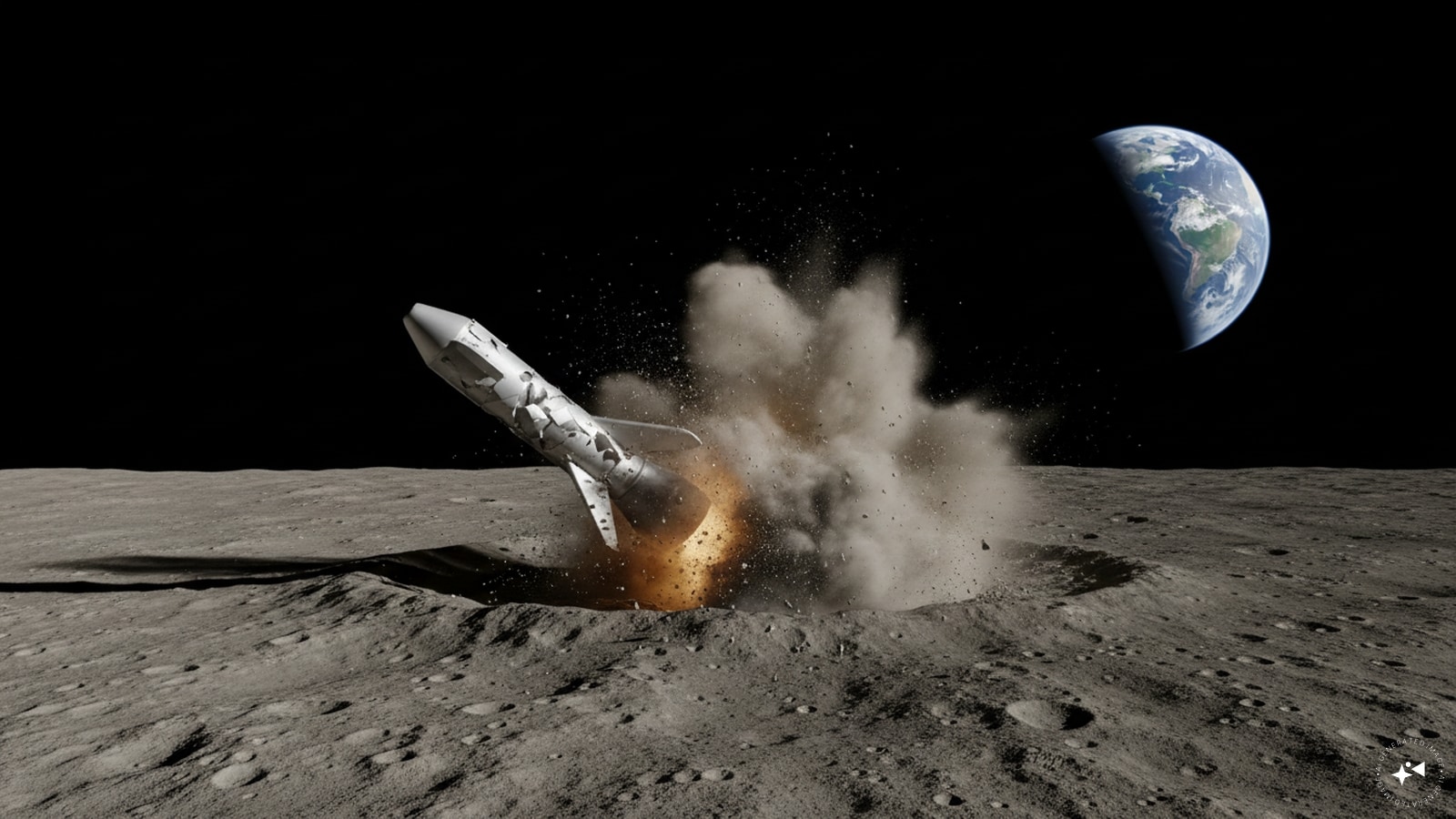
An abandoned SpaceX rocket stage is hitting the Moon. Right now.
If you are tracking the details, the spent Falcon 9 upper stage is slamming into the lunar surface at roughly 5,400 miles per hour. It is a massive piece of hardware—measuring about 39 feet long and weighing nearly 4,000 kilograms—smashing near the Einstein Crater on the Moon's western limb.
This isn't a malicious attack or a secret military test. It is the messy reality of modern space exploration.
The rocket originally launched back in January 2025, carrying two commercial lunar landers: Firefly Aerospace's Blue Ghost-1 and Japan's ispace Hakuto-R Resilience. Once the payload separated, the booster finished its primary job. Left with too little fuel to return to Earth or escape into deep space, it drifted into a chaotic, moon-crossing orbit. Months of solar radiation pressure and gravitational nudges did the rest, putting it on a terminal trajectory with our closest celestial neighbor.
Can you actually see it happen from your backyard? Honestly, no.
The impact flash will happen in a fraction of a second. Because it is hitting a sunlit portion of the Moon, that tiny flash will get completely washed out by harsh solar glare. Even astronomers equipped with powerful ground-based telescopes will struggle to catch the raw collision.
Instead, the real science happens afterward. Researchers are hoping the impact kicks up a massive plume of regolith—lunar dust—that will rise several kilometers high. Because the Moon lacks an atmosphere, that dust cloud might linger or behave in ways that give us fresh data on crater formation. NASA's Lunar Reconnaissance Orbiter (LRO) and South Korea's Danuri spacecraft are positioned to fly over the site, mapping the brand-new crater. Predictions suggest the impact will carve out a hole roughly 66 to 98 feet wide.
The Real Issue Is Orbital Accountability
SpaceX officials noted they followed standard disposal protocols for the Falcon 9 second stage. Technically, they aren't breaking any international laws. That is precisely where the system breaks down.
We treat the space between Earth and the Moon like an open highway with no speed limits, no traffic lights, and zero cleanup crews. This event marks only the second known accidental rocket strike on the lunar surface, following a similar incident involving a Chinese booster in 2022.
As private companies and national space agencies ramp up plans for permanent lunar bases, these "accidents" will stop being rare curiosities. They will become a hazard.
Think about it this way. More than fifty years after the Apollo missions, astronaut footprints remain crisp and undisturbed in the lunar dust because there is no wind or weather to erase them. Whatever junk we crash into the Moon stays there forever. If a stray rocket stage punctures a future habitat's water supply or damages a solar array, a simple "oops, orbital mechanics changed" won't cut it.
What Happens When the Trash Piles Up
Right now, tracking these objects relies heavily on independent astronomers using public tracking data, like orbital expert Bill Gray, rather than a centralized global monitoring system. When a multi-ton metal cylinder hurtles toward the Moon at seven times the speed of sound, we shouldn't be finding out about it through amateur stargazers crunching numbers on public forums.
We need better guidelines for spacecraft disposal. Space agencies already possess the technology to direct spent stages into safe solar orbits or burn them up safely in Earth's atmosphere when fuel budgets allow. Doing so requires extra planning and occasionally sacrificing payload capacity, which means commercial entities will resist unless regulators force their hand.
Keep an eye on the astronomy feeds over the next couple of weeks. Sometime soon, NASA's LRO will publish high-resolution photos of a fresh, jagged scar near the Einstein Crater. It will look fascinating in scientific briefs. Just remember that every new crater we carve out by accident brings us one step closer to trashing the neighborhood before we even manage to move in.