The salt air in Zhuhai smells like jet fuel and crushed oysters. Every two years, this coastal city in southern Guangdong becomes the loudest place in Asia, a tarmac stage where the People’s Liberation Army rolls out its newest wings and missiles under the subtropical sun. Usually, the crowd looks up. They crane their necks until their muscles ache, tracking the vapor trails of J-20 stealth fighters slicing through the humidity.
Not this time.
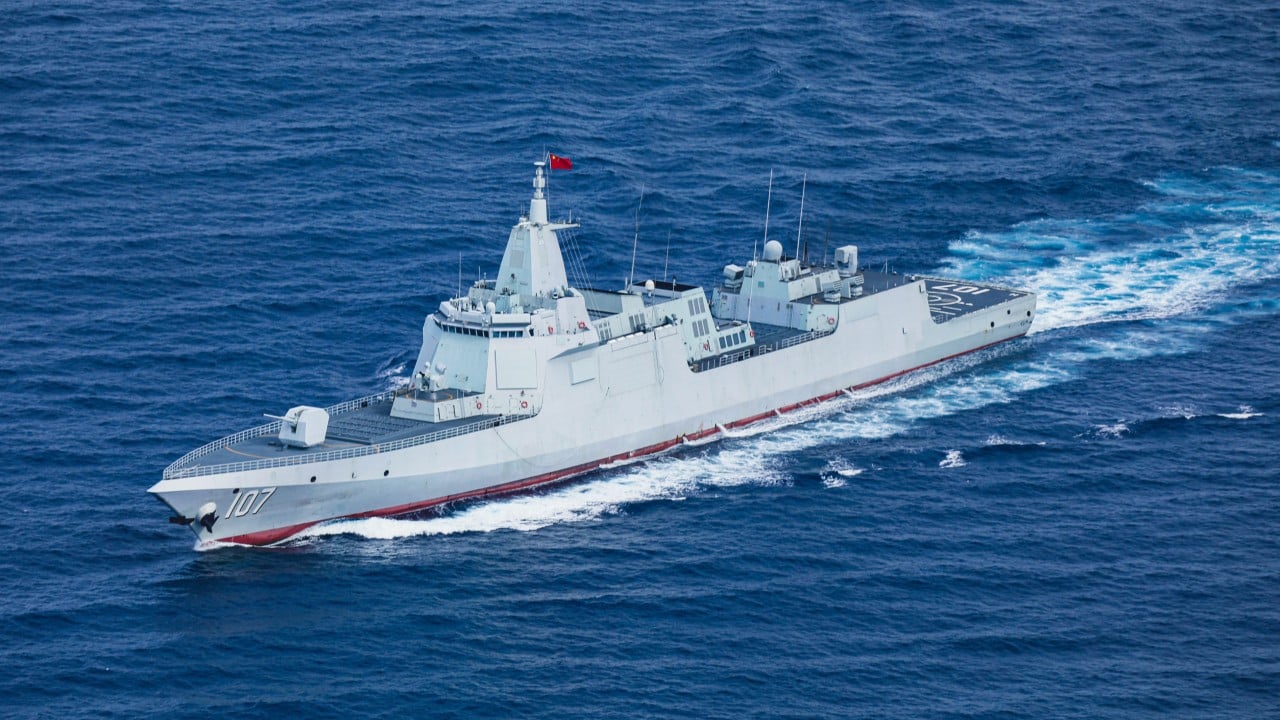
For the first time in the history of the China International Aviation and Aerospace Exhibition—known globally as the Zhuhai Air Show—the sharpest eyes in the room are looking toward the water, or rather, at the shadow a warship casts over an aerospace event. The Type 055 guided-missile destroyer is making its debut.
Wait. A destroyer at an air show?
To understand why a 13,000-ton slab of low-observable gray steel belongs alongside supersonic interceptors, you have to forget everything you think you know about ships. A modern destroyer is no longer a floating artillery battery. It is a floating radar station, a missile silo, and an electronic warfare hub that happens to displace water instead of air. Bringing the Type 055 to Zhuhai is not a logistical quirk. It is a quiet declaration that the boundary between the sea and the sky has permanently dissolved.
The Man on the Pier
To make sense of the cold steel, consider a hypothetical observer—let’s call him Captain Chen, a composite of the veteran naval engineers who spent the better part of three decades watching foreign fleets patrol the edges of the Western Pacific.
Thirty years ago, Chen stood on piers in Qingdao and Dalian looking at ships that were, by modern standards, blind and deaf. Back then, Chinese naval vessels relied on point-defense guns and short-range missiles. If an adversary’s aircraft carrier group parked three hundred miles offshore, Chen’s ships could barely see the horizon, let alone project power past it. The ocean felt vast, unforgiving, and owned by someone else.
I remember the first time I stood near a modern phased-array warship in dry dock—not in China, though the sensation is universal wherever heavy naval engineering meets human scale. You expect a ship to look like a boat. Instead, it looks like a windowless brutalist skyscraper laid on its side. There are no protruding masts tangled with spinning radar dishes, no clutter of exposed wiring, no jagged corners to catch an enemy’s radio waves. Just smooth, inward-sloping planes of painted steel that seem to swallow the sunlight.
When Chen looks at the Type 055—classified by NATO as the Renhai-class cruiser because its sheer displacement dwarfs traditional Western destroyers—he isn't looking at a hull. He is looking at the end of thirty years of naval vulnerability.
An Analog Heart in a Digital Hull
Military brochures love to drown readers in acronyms and millimeter measurements. They will tell you the Type 055 is 180 meters long, 20 meters wide, and powered by four QC-280 gas turbines generating over 150,000 horsepower. Those numbers are true, and they are also completely sterile. They don't tell you what the ship does to the geometry of a conflict.
Think of a traditional naval fleet as a group of hikers walking through a pitch-black forest with flashlights. Each hiker can only see the trees right in front of them. If someone steps on a twig fifty yards away, nobody knows who heard it first or which direction to run.
Now, picture the Type 055 as a silent, elevated watchtower suddenly switched on above the canopy, equipped with thermal imaging and night vision, whispering coordinates directly into the earpieces of every hiker below.
That is the real function of the ship’s integrated mast and dual-band radar system. By combining S-band radars—which peer across immense distances to spot stealth aircraft and ballistic missiles—with X-band radars that track low-flying, sea-skimming threats with pinpoint accuracy, the Type 055 acts as the central nervous system of a carrier strike group. It doesn't just defend itself. It builds a shared, real-time map of the sky for every fighter jet, submarine, and smaller frigate within hundreds of miles.
And then there are the cells.
Built flush into the deck, forward and aft, are 112 vertical launching system (VLS) cells. Unlike older Western launchers that require specific canisters for specific weapons, these universal "cold-hot" launch tubes are wide and deep enough to fire almost anything in the Chinese arsenal. Surface-to-air missiles to swat down incoming bombers. Anti-submarine rockets. Land-attack cruise missiles. And most notably, the YJ-21—a ship-launched hypersonic anti-ship ballistic missile capable of screaming toward a target at speeds exceeding Mach 6, maneuvering violently in its terminal phase to evade interceptors.
One hundred and twelve cells. In practical terms, a single Type 055 carries more missile firepower than an entire squadron of older destroyers from the 1990s.
Why Zhuhai? Why Now?
Still, the question lingers in the humid air over Guangdong: why showcase a warship at an aerospace expo?
The answer lies in how modern warfare is actually fought—and how nations market their deterrence. Over the last decade, the People’s Liberation Army has obsessed over a concept called "system-of-systems" confrontation. In plain English, individual weapons no longer win wars; networks do. A J-20 stealth fighter is lethal on its own, but it becomes exponentially deadlier when it can turn off its own radar—staying completely invisible to enemy sensors—while receiving targeting data from a Type 055 destroyer cruising two hundred miles away.
By integrating the Type 055 into the Zhuhai narrative, Beijing is pulling back the curtain on that network. Visitors walking the exhibition halls aren't just seeing isolated planes or standalone missiles anymore. They are seeing the connective tissue. They are seeing how a satellite in low-Earth orbit talks to a high-altitude drone, which passes a track to a destroyer at sea, which hands off the final firing solution to a jet screaming through the clouds.
There is also an undeniable commercial and diplomatic undercurrent. Zhuhai is China’s premier storefront for international defense buyers. While Beijing does not currently export the full-sized Type 055—its subsystems are too sensitive, its cost too steep for most budgets—displaying its capabilities validates the entire ecosystem of Chinese radars, engines, and missile seekers available on the global market. When foreign delegations from the Middle East, Southeast Asia, and Africa walk past the models and live displays, the message is unmistakable: the technologies forged for China’s heaviest capital ships are trickling down into exportable frigates, corvettes, and air-defense batteries.
The Invisible Stakes
It is easy to get seduced by the symmetry of engineering. Clean lines, vast radar ranges, hypersonic trajectories—on paper, military technology has the cold elegance of pure mathematics.
Yet whenever I read the specifications of a ship like the Nanchang—the lead vessel of the Type 055 class, commissioned in January 2020—or its sister ships like the Lhasa, Anshan, and Wuxi, I feel a familiar, uneasy weight in my chest. We have seen this movie before in human history, even if the props are new.
In the early twentieth century, the launch of HMS Dreadnought rendered every existing battleship on Earth obsolete overnight. It didn't just add a bigger gun to the ocean; it changed the math of empire, forcing rival powers into a frantic, bankrupting race to build faster, heavier, and deadlier hulls. The engineers of 1906 believed they were building instruments of stability—machines so overwhelmingly powerful that no sane rival would dare challenge them.
They were wrong, of course. Technology never eliminates human miscalculation; it merely compresses the time we have to correct it.
Consider what happens next when two fleets equipped with hypersonic missiles and over-the-horizon sensors encounter each other in contested waters—whether in the South China Sea, the Taiwan Strait, or the broader Pacific. In the old days of naval gunnery, commanders had hours to read the wind, watch the smoke on the horizon, and send signal flags back and forth before a single shell was fired. Even during the Cold War, a subsonic cruise missile gave a ship’s crew several tense minutes to verify a radar blip, check rules of engagement, and decide whether an incoming track was a glitch, a bird, or a declaration of war.
Hypersonic weapons shrink those minutes into seconds.
Inside the Combat Information Center of a Type 055—a dimly lit room bathed in the blue-green glow of multifunction consoles—young sailors in their early twenties sit shoulder-to-shoulder watching thousands of data points stream across glass screens. Artificial intelligence algorithms filter the noise, flagging anomalies, calculating intercept probabilities, and recommending firing solutions faster than the human cortex can process a single sentence.
The ship is brilliant. The sensors are astonishing. And yet, the ultimate burden still rests on tired human eyes trying to distinguish a genuine threat from a phantom echo at three in the morning while the hull rolls in a heavy swell.
The Weight of the Horizon
There is a specific kind of quiet that settles over Zhuhai after the flight demonstrations end for the day. The afterburners cool down. The crowds thin out toward the shuttle buses, clutching glossy brochures and plastic models of fighter jets. Down by the water, the lights of the Hong Kong-Zhuhai-Macao Bridge begin to flicker across the Pearl River Estuary, linking three cities across thirty-four miles of open sea.
For the first batch of eight Type 055 destroyers already in active service—and the second batch currently taking shape in the shipyards of Dalian and Jiangnan—that open sea is the real stage.
Western naval analysts frequently debate how the Type 055 stacks up against the U.S. Navy’s Ticonderoga-class cruisers or the Flight III Arleigh Burke-class destroyers. They count VLS cells (112 on the Type 055 versus 96 on a modern Arleigh Burke), compare radar aperture sizes, and argue over propulsion reliability. Those comparisons miss the deeper truth. The United States built its navy around global expeditionary power—a century-long habit of projecting force across every ocean simultaneously. China built the Type 055 to lock the doors to its own front yard, and then slowly, methodically, extend the driveway out into the deep Pacific.
You don't need to match an adversary hull-for-hull globally if you can concentrate overwhelming sensor coverage and missile density within two thousand miles of your own coastline.
That is why the Type 055 has arrived at an air show. It is a reminder that the sky above the Western Pacific is no longer an open highway for whoever owns the fastest jets. Every mile of airspace is now tethered to the steel hulls patrolling below, stitched together by invisible beams of radio energy that never blink and never sleep.
Out beyond the breakwater in Zhuhai, the evening tide pulls back from the concrete seawall, exposing wet stones and rusting mooring rings. Somewhere past the curve of the horizon, out where the gray water meets the graying sky, a 13,000-ton shadow is already listening.