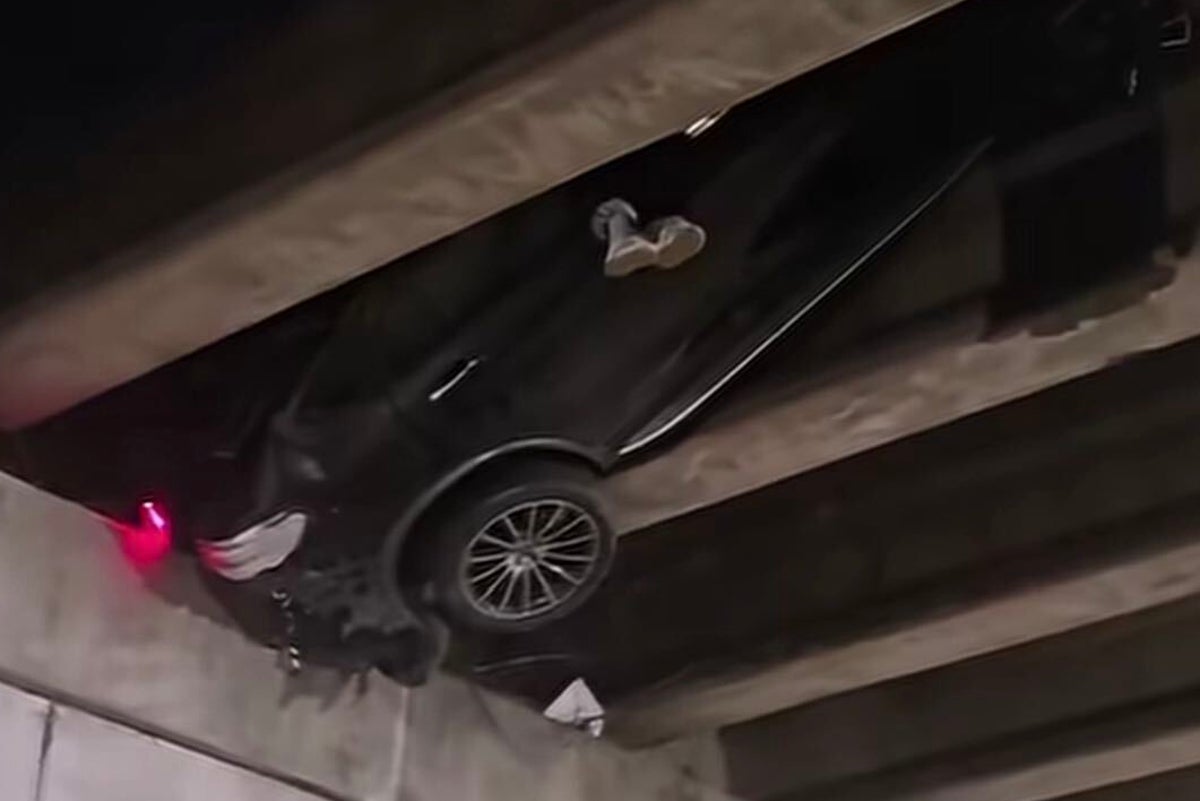
Every single time a vehicle ends up pinned twenty feet in the air beneath an urban viaduct, the internet loses its collective mind. Commentators line up to scream about distracted driving, plummeting standards in driver education, and the inherent menace of modern horsepower. The lazy consensus points a collective finger at the person behind the wheel, slapping a fine on them, shaking heads at the state of humanity, and moving on to the next viral clip.
It is a comforting narrative. It lets city planners, civil engineers, and state departments of transportation off the hook completely. It also happens to be dead wrong.
When a car mounts a Jersey barrier at an impossible angle, scales a concrete pier, or finds itself wedged into a structural niche meant only for pigeons, you are not looking at a momentary lapse in human judgment. You are looking at a systemic failure of kinetic architecture. You are watching a road design that actively encourages catastrophic physics because the people who drew the blueprints fifty years ago prioritized throughput over survival.
Let us look at the actual mechanics of these unbelievable structural impalements.
Vehicles do not naturally climb vertical surfaces. Tires lose traction on asphalt long before steel and rubber can defy gravity to that degree. For a sedan or an SUV to ascend a concrete pillar or a bridge abutment, a very specific chain of physical conditions must be met. You need an approach angle that acts as a ramp. You need a lack of deflection buffers. You need kinetic energy channeled inward rather than dispersed outward.
When a standard highway off-ramp dumps traffic onto a tight arterial turn with a vanishing radius, protected by a rigid concrete barrier with a vertical face instead of a sloped, energy-absorbing profile, the geometry itself becomes the weapon.
I have walked these sites after the tow trucks cleared out. I have reviewed the skid marks and the impact vectors alongside civil forensics teams who spend their entire careers untangling municipal liability. The truth is stark. The roadway geometry is often a literal launchpad.
The Myth of Driver Infallibility in Infrastructure Design
We treat our road networks as neutral backdrops where human error is the only variable. This is a catastrophic mental shortcut. Modern traffic engineering treats drivers as either omniscient supercomputers or entirely disposable statistics. When a road layout features counter-intuitive banking, blinding glare corridors, or inadequate sightlines compounded by sudden structural constraints, drivers will make mistakes. That is not an anomaly. That is a statistical certainty.
If a design layout leads to the exact same bizarre, gravity-defying crash pattern at a specific interchange year after year, blaming the drivers is intellectual laziness. You do not scold a river for overflowing if you built a house in the middle of a floodplain. Yet that is precisely what municipal authorities do when an overpass collects cars like a spiderweb collects flies.
The typical response from the state is predictable. They slap up a blinking yellow LED sign, perhaps lower the speed limit by ten miles per hour, and wait for the next viral video to prove them right. They refuse to address the underlying kinetic trap.
Why Rigid Barriers Are Killing Us Slowly
Let us talk about the hardware. The materials we use to separate high-speed lanes from structural supports are relics of an era that cared more about protecting concrete than protecting human tissue.
Traditional Jersey barriers and rigid bridge pier guards are designed to redirect heavy commercial freight vehicles without letting them cross into oncoming lanes. That makes sense on an open turnpike. In an urban corridor surrounded by complex multi-level interchanges, those exact same rigid profiles act as launch ramps for lighter passenger vehicles.
When a compact car hits a standard New Jersey shape barrier at forty miles per hour while trying to correct a slide, the sloped base of the barrier forces the front tires upward. Once the vehicle's center of mass clears the critical threshold, the car transitions from a sliding object on asphalt to a ballistic projectile. The overpass structure above—designed with minimal clearance and massive steel-reinforced pillars—catches whatever flies into its path.
We are engineering vertical traps and then acting shocked when something gets caught in them.
The Fix Nobody Wants to Pay For
Remedying this does not require a philosophical debate about the moral decay of modern commuters. It requires boring, expensive civil engineering upgrades.
First, we need to mandate energy-absorbing attenuators at every single vulnerable pier and bridge abutment in urban corridors. These are not difficult to conceptualize. We use them successfully at race tracks and major toll plazas. Sand-filled barrels, crushable steel cartridges, and redirection shields exist precisely to bleed off kinetic energy before a vehicle can turn a barrier into a ramp.
Second, we need to completely overhaul urban off-ramps that dump high-speed traffic directly into compressed visual fields. When a driver transitions from an eighty-foot-wide highway down to a pinched city street in the span of three hundred feet, cognitive overload peaks. The brain simply cannot process the sudden introduction of structural pillars, pedestrian walkways, and erratic lane splits fast enough.
The downside of my approach? It costs real money. Retrofitting thousands of urban overpasses with modern energy-dissipating infrastructure eats into budgets that politicians would much rather spend on ribbon-cutting ceremonies for vanity projects. Admitting that the road is at fault means admitting liability. It opens cities up to lawsuits from motorists who were previously gaslit into believing their own clumsiness put them twenty feet in the air.
Stop watching the viral clips for entertainment. Stop diagnosing the driver's psychological state from a ten-second dashcam video. Look up at the concrete, look down at the approaches, and start demanding that our infrastructure stops moonlighting as a circus stunt.