Every few years, a press release hits the science wire with the exact same breathless headline. Scientists cracked open a Cretaceous bone, peered through a microscope, and found intact red blood cells and collagen. The public loses its mind. Creationists pop champagne. Hollywood executives start drafting another Jurassic Park sequel.
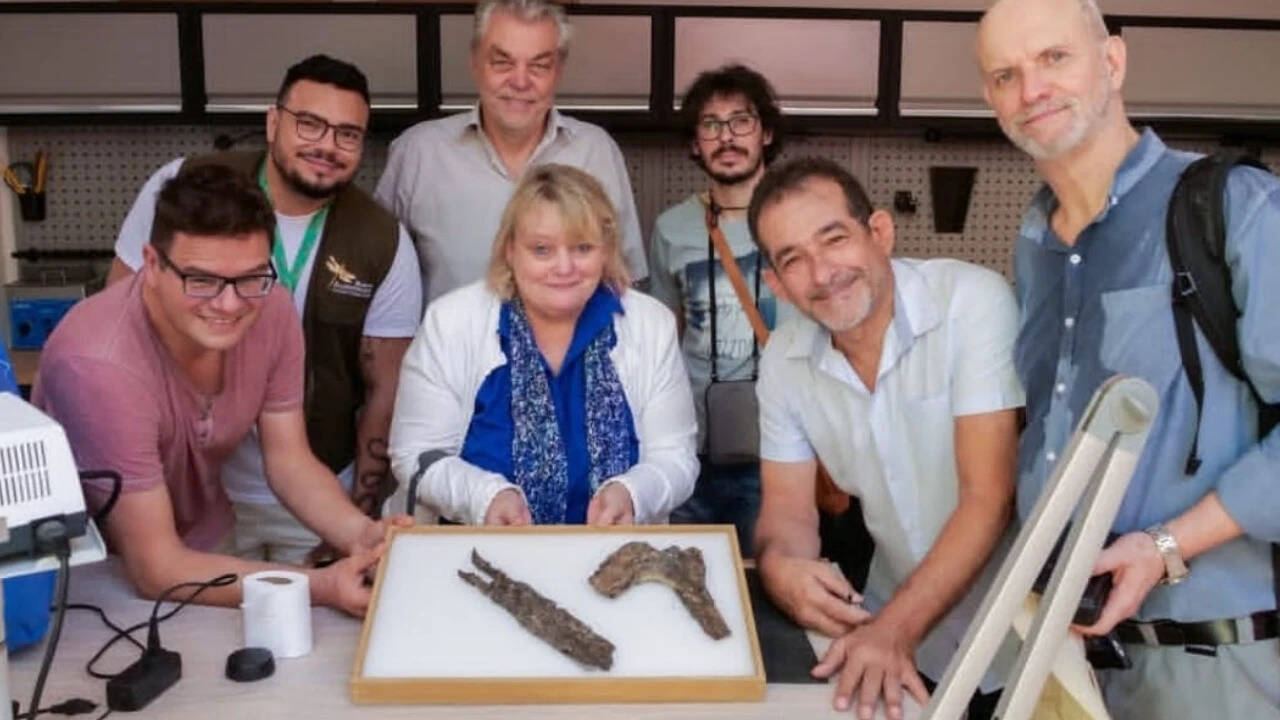
The latest wave comes courtesy of researchers out of Curtin University, adding to a decades-long pile of claims that ancient biological material survives deep time far better than textbooks ever allowed.
Here is the problem. The mainstream science press treats every microscopic red sphere and fibrous strand as a biological miracle, completely glossing over the brutal, unforgiving reality of diagenesis.
You are asking the wrong question when you ask whether dinosaur blood can survive for seventy million years. The real question is far less glamorous, infinitely harder to answer, and keeps analytical chemists awake at night. How do you prove a microscopic blob of iron-rich organic sludge used to be a living cell, and not just ancient bacteria, fungal biofilms, or mineral pseudomorphs mimicking anatomy?
The Lazy Consensus of Paleobiology
The standard narrative goes like this. For decades, paleontologists assumed fossilization meant total mineral replacement. Organic matter rotted away, minerals filled the voids, and all that remained was rock shaped like bone. Then, in 2005, Mary Schweitzer dissolved a Tyrannosaurus rex femur in weak acid and pulled out stretchy, translucent blood vessels and structures resembling red blood cells.
Since then, the field of molecular paleontology has exploded. Teams from London to Perth have reported collagen amino acid sequences, osteocytes, and heme breakdown products in specimens stretching back to the Mesozoic. The lazy consensus among science communicators is that soft tissue preservation is actually common, we just forgot to dissolve the rocks to look for it.
That narrative is dangerously incomplete. It skips straight past the bloodbath happening behind closed doors at analytical chemistry conferences.
I have watched research groups burn hundreds of thousands of dollars in mass spectrometry time chasing phantom peptides, only to realize their "Cretaceous collagen" was actually laboratory contamination from a technician's skin flakes, bovine serum albumin from an adjacent bench, or modern soil microbes that colonized the porous bone ten years before it was dug out of the Montana dirt.
When you pull a fossil out of the ground, you are not holding a sterile time capsule. You are holding a porous sponge that has spent millions of years marinating in groundwater, humic acids, bacterial colonies, and modern atmospheric dust.
What Actually Survives Deep Time
Let us look at the hard thermodynamics of decay. Peptide bonds—the chemical links holding amino acids together to form proteins like collagen—are inherently unstable in the presence of water. Through a process called hydrolysis, water molecules relentlessly snip those bonds apart.
Under standard burial temperatures, kinetic models show that pure, unprotected collagen degrades completely in a fraction of a million years. Not seventy million. Not even two million.
So when a team at Curtin University or North Carolina State reports preserved collagen amino acids or red blood cell structures, they are not claiming the tissue stayed fresh in a biological freezer. They are arguing that an extraordinary chemical intervention froze the clock.
The leading mechanism is iron-mediated crosslinking, often called the Fenton reaction. When red blood cells lyse after death, they dump massive amounts of hemoglobin—and therefore iron—into the surrounding bone matrix. That iron catalyzes the formation of hydroxyl free radicals. These radicals act like microscopic superglue, forcing nearby proteins and lipids to crosslink into dense, insoluble polymers.
In simple terms, the tissue effectively tans itself into a natural plastic.
This is a brilliant biochemical explanation. It explains how the physical shape of a vessel or cell can persist. What it does not do is leave behind intact, pristine DNA or easily readable protein sequences. By the time iron radicals finish wreaking havoc on a collagen molecule, its original chemical signature is heavily altered, oxidized, and fragmented beyond recognition.
The Ghost in the Machine: Biofilms and Pseudomorphs
If you look down a scanning electron microscope at a dissolved dinosaur bone, you will see tiny, biconcave discs or spherical bodies packed inside vascular canals. To the untrained eye, they look identical to erythrocytes—red blood cells.
Thomas Kaye and his colleagues blew a massive hole in this assumption back in 2008. They demonstrated that modern bacterial biofilms—slimy communities of microorganisms that invade the hollow channels of buried bones—naturally form branching tubes and spherical framboids that mimic blood vessels and red blood cells down to the micron scale.
Imagine a scenario where a skyscraper burns down, and decades later, vines grow up through the hollow steel elevator shafts, taking the exact cylindrical shape of the cables that used to run inside them. If you cut a cross-section of those vines a thousand years later, you might mistake the fossilized plant fibers for the original steel cables.
That is the biofilm trap.
Iron oxide minerals like pyrite and goethite also love to crystallize into tiny spheres called framboids inside the exact vascular spaces where blood once flowed. When acid dissolves the surrounding calcium phosphate bone, those iron spheres remain behind, sitting neatly inside hollow tubes. Show a photo of that to a journalist, and the headline writes itself: Dinosaur Blood Found! Show it to a geochemist, and they will ask you for the carbon-14 dating and isotopic fractionation data before they even look at the picture.
Dismantling the Top Myths About Ancient Biomolecules
The public conversation around these discoveries is choked with bad assumptions. Let us clear the wreckage.
Can we clone dinosaurs from preserved red blood cells?
No. Full stop. First, mature mammalian red blood cells do not even have nuclei, though birds and reptiles (including non-avian dinosaurs) do retain nucleated erythrocytes. Second, DNA is vastly more fragile than collagen. Even under the best permafrost conditions on Earth, DNA fragments into unreadable static in roughly one to two million years. Finding crosslinked iron-rich organic residue from the Cretaceous gets you zero percent closer to cloning a Triceratops.
Does finding collagen amino acids prove the Earth is young?
This is a favorite talking point among young-Earth creationists, and it relies on a deliberate misreading of chemical kinetics. Decay rates calculated for unprotected proteins in a test tube do not apply to proteins locked inside dense hydroxyapatite bone crystal lattices and crosslinked by iron free radicals. Geopolymers can survive for hundreds of millions of years—just look at coal and kerogen, which are altered biological molecules from the Carboniferous period. Survival of altered organic matter proves geochemical stabilization, not a six-thousand-year-old planet.
Are amino acid detections proof of original dinosaur proteins?
Not necessarily. Finding individual amino acids like glycine, alanine, or proline inside a fossil is relatively easy. The problem is that bacteria, fungi, and modern laboratory dust are loaded with the exact same twenty amino acids. Furthermore, as proteins degrade over millions of years, amino acids undergo racemization—flipping from their biological "left-handed" (L-isomer) configuration to a 50/50 mix of left- and right-handed forms. If a sample from a 75-million-year-old fossil shows exclusively left-handed amino acids, you have not found a miracle. You have found modern contamination.
How Real Analytical Chemists Separate Fact from Fiction
To be fair to the heavy hitters in this space—researchers like Kliti Grice at Curtin University, Evan Saitta, Sergio Bertazzo, and Timothy Cleland—the serious players are no longer relying on pretty microscope pictures. They know morphology is a liar.
If you want to prove an organic molecule is genuinely endogenous—meaning it originated inside the living animal and not from a Mesozoic microbe or a graduate student's thumb—you have to run a gauntlet of destructive, unforgiving tests.
- Time-of-Flight Secondary Ion Mass Spectrometry (ToF-SIMS): Instead of grinding the bone into powder (which mixes surface contaminants with deep interior molecules), researchers shoot a focused ion beam directly at a freshly fractured cross-section. This maps the exact spatial distribution of specific chemical fragments, like heme rings or amino acid side chains, proving they sit exclusively inside the original osteon structures and nowhere in the surrounding rock matrix.
- Compound-Specific Isotope Analysis: Carbon and nitrogen come in heavy and light isotopes. Ancient terrestrial ecosystems had distinct isotopic signatures compared to modern soil bacteria. By measuring the ratio of carbon-13 to carbon-12 inside individual amino acids extracted from the bone, chemists can see if the molecule matches the ancient food web or a modern fungus.
- Diagenetic Alteration Signatures: True ancient proteins do not look clean. They show massive post-translational modifications—deamidation, oxidation, and advanced glycation end-products (AGEs). Ironically, if a mass spectrometer returns a pristine, undamaged collagen sequence from a Cretaceous dinosaur, veteran proteomicists immediately throw it in the trash. Real ancient molecules look like they survived a nuclear blast.
The Uncomfortable Downside of Skepticism
There is a massive catch to demanding this level of chemical proof, and it slows the entire field down.
The stricter your extraction protocols become, the more likely you are to destroy the very evidence you are looking for. Aggressive cleaning with bleach and solvents strips away modern biofilms, sure, but it also obliterates fragile, partially preserved endogenous biomolecules.
Furthermore, mass spectrometry databases are heavily biased toward modern organisms—humans, cows, mice, chickens, and common bacteria. When an algorithm tries to match degraded, chemically scrambled peptide fragments from an extinct archosaur against a database built for modern medicine, it often produces false positives, matching a broken dinosaur fragment to a modern turkey or ostrich protein simply because birds are the closest living relatives in the reference library.
We are trying to read a burned book using a dictionary written seventy million years after the author died.
Stop Chasing Headlines and Fix the Protocol
If paleobiology wants to mature from a headline-generating curiosity into a bulletproof forensic science, researchers and science journalists alike need to change their playbook immediately.
- Ban morphology-only papers. Publishing high-resolution photos of "blood cells" without accompanying spatial mass spectrometry and isotopic verification is scientific malpractice. Shape proves nothing in diagenesis.
- Mandate blind sediment controls. Every single fossil extraction must be run alongside an identical extraction of the surrounding rock matrix collected five centimeters away from the bone. If the same amino acids or lipid biomarkers show up in the mudstone as in the femur, the data is dead on arrival.
- Publish the contamination failures. Journals only reward positive hits. Until labs start publishing their negative controls and contamination baselines, young researchers will keep mistaking laboratory background noise for Mesozoic biology.
The discovery of altered organic residues in deep time is genuinely fascinating geochemistry. It reveals how iron, minerals, and time conspire to lock molecular ghosts inside stone.
Stop calling it fresh blood, and start treating it like the complex, half-erased chemical crime scene it actually is.