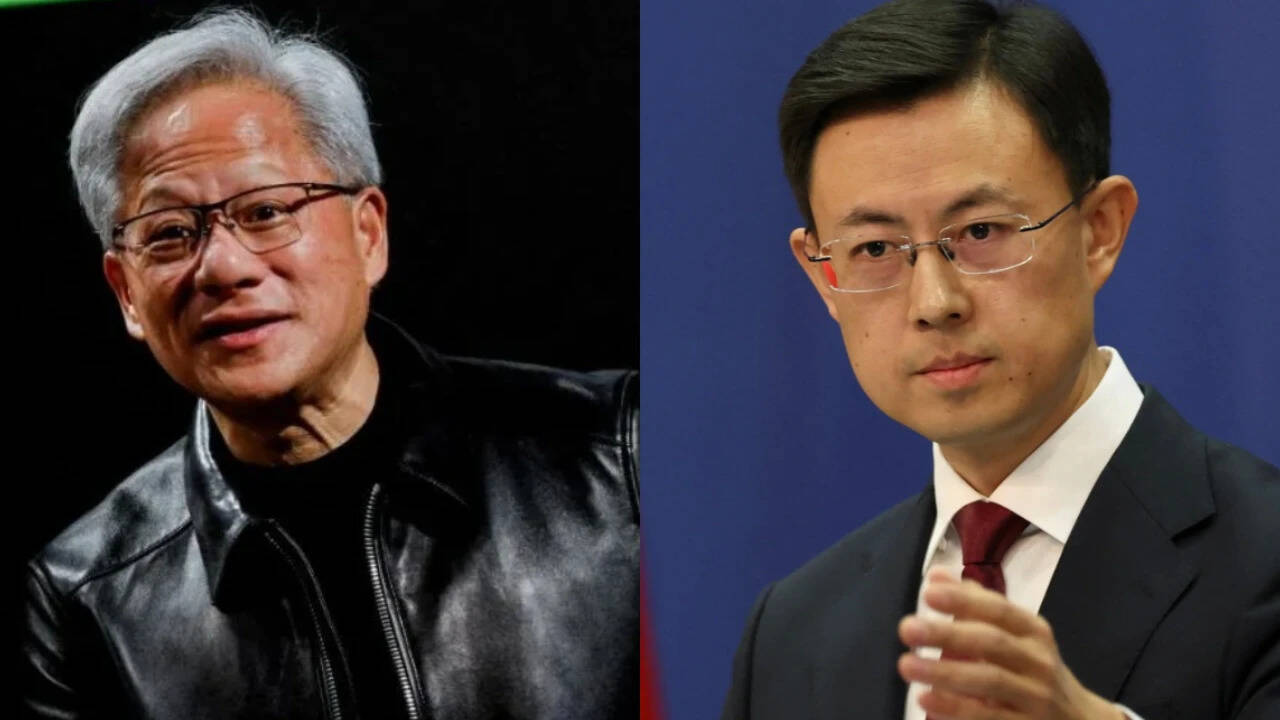
Mainstream tech journalism loves a soap opera. Whenever a tech founder crosses the multi-trillion-dollar threshold, the media industrial complex immediately begins hunting for the cracks in the armor. Right now, the lazy consensus wants you to believe that Nvidia CEO Jensen Huang is drowning in a cocktail of artificial intelligence monopolies, personal boardroom gossip, and geopolitical espionage.
It makes for great clickbait. It also completely misses the actual war being fought in Silicon Valley.
If you are an investor, a founder, or an enterprise buyer trying to figure out what is happening at Nvidia, focusing on tabloid-level scrutiny is a massive distraction. The real story is not that Jensen Huang is under fire for alleged corporate intrigue or regulatory side-eye. The real story is that the traditional rules of corporate governance, export controls, and hardware monopolies are breaking down in real time—and Huang is the only executive ruthless enough to exploit the rubble.
Let’s dismantle the three pillars of this manufactured scandal and look at the cold, hard mechanics of what is actually happening beneath the leather jacket.
The "Espionage" Myth and the Reality of Global Supply Chains
Every few months, a new headline screams about industrial espionage, chip smuggling, or rogue actors bypassing US export controls to get their hands on Nvidia’s H100 and Blackwell architectures. Critics point fingers at Santa Clara, asking why Jensen Huang isn't policing every single server rack from Shenzhen to Dubai.
This framing relies on a fundamental misunderstanding of how global semiconductor distribution works.
Nvidia does not sell individual GPUs out of the back of a van. They design silicon, hand the blueprints to Taiwan Semiconductor Manufacturing Company (TSMC) to fabricate, and sell the resulting chips and reference boards to Original Equipment Manufacturers (OEMs) like Dell, Supermicro, Quanta, and Foxconn. Those OEMs build the servers and sell them to cloud providers, enterprises, and sovereign wealth funds around the world.
Asking Nvidia to track every single GPU after it leaves an OEM factory is like asking Michelin to track every driver who speeds on the Autobahn.
I have spent over a decade advising hardware startups and enterprise infrastructure buyers, and I have watched compliance teams burn millions of dollars trying to build "end-to-end" hardware tracking systems. They fail every single time. Once a server rack enters the secondary market—or gets leased via bare-metal cloud instances through shell companies in Singapore or the Middle East—physical custody becomes irrelevant. Compute is a liquid asset now. You don't need to smuggle a physical chip across a border when you can rent its FLOPS over a fiber-optic cable from anywhere on Earth.
Why Washington’s Export Controls Are Theater
The scrutiny around Nvidia and geopolitical espionage exists because politicians need a scapegoat for policies that ignore basic physics and economics. When the US Department of Commerce updates its export restrictions, Nvidia’s engineering teams immediately design compliant, bandwidth-capped variants (like the H20) to keep their legal revenue streams open.
Critics call this "circumventing the spirit of the law."
Competent executives call it "fiduciary duty." If Huang simply abandoned the second-largest technology market on the planet without trying to build compliant hardware, he would be sued into oblivion by institutional shareholders like Vanguard and BlackRock. More importantly, handing that entire market over to domestic Chinese competitors like Huawei’s Ascend division would accelerate their R&D funding by billions of dollars. Keeping foreign developers hooked on Nvidia’s CUDA software ecosystem—even on degraded hardware—is a feature, not a bug, of American soft power.
The "Affair" and the Cult of the Flat Organization
When the geopolitical angle gets too technical for general audiences, the narrative pivots to culture and personal drama. Rumors of favoritism, blurred personal boundaries, and executive-level friction at Nvidia have circulated in Silicon Valley whisper networks for years. Whenever an executive abruptly departs or a reorganization happens without warning, outside observers immediately look for a personal scandal.
They are looking in the wrong place. The chaos isn't personal; it is structural.
Jensen Huang famously operates Nvidia with a radically flat organizational chart. While most Fortune 500 CEOs have seven to ten direct reports, Huang has maintained upwards of forty to sixty direct reports. He does not do traditional one-on-one meetings. He does not want sanitized PowerPoint decks filtered through three layers of middle management.
Here is what that actually looks like inside the building:
- Public accountability: If a project is failing, you don't get a gentle coaching session behind closed doors. You get dissected in front of your peers so everyone else learns from your mistake.
- Zero political insulation: Without vice presidents acting as buffers, engineers and product leads have direct access to the CEO—and direct exposure to his wrath.
- Information symmetry: Everyone in the room hears the exact same strategic directives at the exact same time, eliminating the telephone game that kills legacy tech giants like Intel.
To an outsider raised on polite, HR-approved corporate culture, this environment looks toxic, erratic, and rife with personal drama. When high-profile executives leave or clash, gossip columns invent salacious backstories because they cannot comprehend a workplace where ego is systematically starved of oxygen.
Admittedly, this management style has a brutal downside. It creates a single point of failure. If Huang steps off a curb tomorrow, there is no traditional hierarchy ready to absorb the shock. Succession planning at Nvidia is practically non-existent because the entire company is wired directly into one man’s central nervous system. That is a massive risk for shareholders—and it is a far more legitimate critique than any tabloid rumor.
The AI Monopoly Question: Are You Asking the Wrong Problem?
The third leg of the scrutiny stool is antitrust. Regulators in the US, Europe, and Asia are circling Nvidia, convinced that an 80% to 90% market share in AI training silicon constitutes an illegal monopoly.
If you are a tech buyer or investor, asking "Will regulators break up Nvidia?" is the wrong question. Even if the Department of Justice forced Nvidia to spin off its networking division (Mellanox) tomorrow, it wouldn't dent their dominance by a single percentage point.
Nvidia’s moat is not their silicon. Their moat is CUDA—the proprietary parallel computing platform and programming model they released in 2006.
For nearly twenty years, while competitors were chasing mobile chips and low-power CPUs, Huang forced Nvidia to pour billions of dollars into software libraries, compilers, and developer tools so that researchers could use graphics cards to run complex physics and math simulations. Every major AI framework—PyTorch, TensorFlow, JAX—was built on top of CUDA.
The Switching Cost Trap
Imagine a scenario where a rival chipmaker—let's say AMD or a hyperscaler's internal ASIC team—builds a processor that is 20% faster and 30% cheaper than Nvidia’s flagship GPU. On paper, every data center should switch immediately.
In practice, they don't. Why?
- Codebase rewrite costs: Moving a massive distributed training cluster off CUDA requires rewriting low-level kernels, debugging silent numerical inaccuracies, and retraining engineering teams.
- Utilization rates: Raw hardware speed (measured in TFLOPS) means nothing if your software stack leaves the chip sitting idle 40% of the time waiting for memory transfers. Nvidia’s NVLink interconnects and NCCL communication libraries ensure clusters run at peak utilization.
- Time-to-market: In the AI arms race, a three-month delay in model training can bankrupt a startup or wipe tens of billions off a hyperscaler’s market cap. Nobody gets fired for buying Nvidia; you get fired for saving 15% on hardware and missing your product launch by two quarters.
Regulators cannot "break up" developer preference. You cannot pass a law forcing PhDs at Stanford and engineers at OpenAI to stop liking a software tool that works out of the box.
What You Should Actually Do With This Information
Stop reading the gossip columns and start adjusting how you operate in an Nvidia-dominated world. Whether you are deploying capital or deploying code, the current scrutiny creates massive opportunities for people who ignore the noise.
1. For Enterprise Tech Buyers: Stop Chasing Hardware Discounts
If you are negotiating with cloud providers or OEMs, stop obsessing over the hourly rate of raw GPU compute. Focus entirely on token-per-dollar efficiency and cluster uptime. Buying cheaper, non-Nvidia silicon for inference workloads is a smart play only if your models are static and well-supported by open-source compilers like Triton. For frontier training, pay the "Nvidia tax" and use the time you saved to actually ship your product.
2. For Investors: Watch the Networking, Not the Chips
Everyone watches GPU shipment numbers. That is lagging data. The real metric of Nvidia’s health is the attach rate of their Spectrum-X Ethernet and InfiniBand networking hardware. As AI clusters scale from 10,000 GPUs to 100,000+ GPUs, the bottleneck shifts entirely from the processor to the cables connecting them. If hyperscalers successfully replace Nvidia’s networking gear with Broadcom or Arista switches, the moat is finally starting to erode. Until then, ignore the regulatory headlines.
3. For Founders: Build Abstraction Layers, Not Chip Killers
If you are building in the AI infrastructure space, do not bet your company on a specific hardware vendor winning the silicon wars. Build software that abstracts the underlying hardware away completely. Give enterprises the ability to route workloads dynamically across Nvidia, AMD, Google TPUs, and AWS Trainium without touching their application code. The real money isn't in beating Jensen Huang; it’s in selling the insurance policy to companies terrified of being locked into his ecosystem.
The scrutiny surrounding Jensen Huang isn't a sign that Nvidia is collapsing. It is the inevitable friction generated when one company out-executes an entire industry for two decades straight. The media will keep chasing shadows, regulators will keep holding hearings, and competitors will keep complaining about fairness.
Meanwhile, Huang will just keep shipping the next architecture.