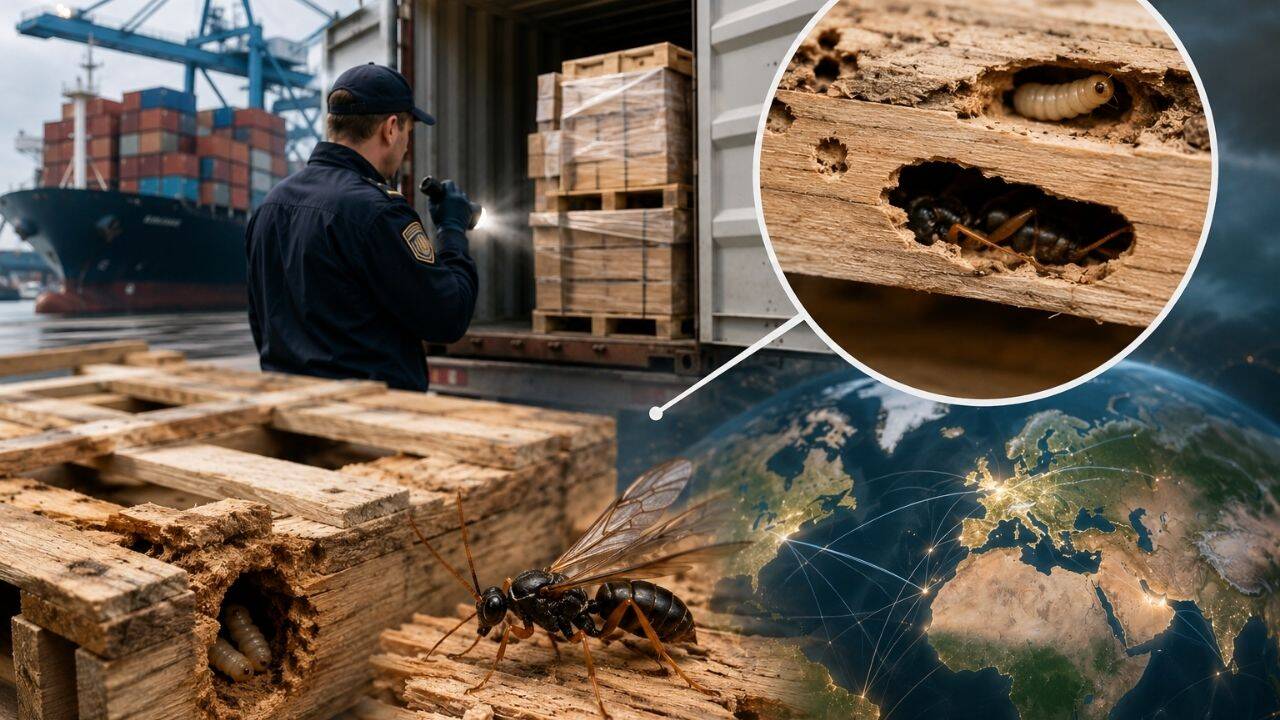
The industry loves a neat scapegoat. For decades, the biosecurity establishment has pointed an accusing finger at wooden pallets, crates, and dunnage, blaming international trade's structural skeleton for every woodwasp and invasive beetle that crosses a border. The standard narrative treats wood packaging as a floating biological weapon, pointing to numbers like 2,562 woodwasp interceptions between 1952 and 2020 as proof of an ongoing invasion.
It is a comforting narrative. It gives regulators something tangible to stamp, inspect, and fine. It also happens to be a massive distraction from reality.
I have spent years watching supply chain operators throw millions of dollars at obsessive wood packaging compliance while their actual risk vectors bleed out in plain sight. They treat heat treatment stamps like holy relics while ignoring the structural failures of global quarantine management.
Let us dismantle the lazy consensus.
The Interception Fallacy
Look closely at those historical interception numbers. Two thousand five hundred and sixty-two woodwasp interceptions over nearly seven decades sounds terrifying to anyone who does not understand how probabilities work in global logistics. Millions of metric tons of cargo move across oceans daily. Against that staggering volume, a couple of thousand interceptions across sixty-eight years represents a statistical rounding error.
More importantly, an interception is not an establishment. Finding an organism in a shipping crate proves that a transport mechanism exists. It does not prove that the mechanism is driving ecological collapse. Regulators conflate the presence of a pest with the probability of its colonization.
Imagine a scenario where a port inspector finds a single Sirex woodwasp larvae tucked deep inside a pine pallet originating from central Europe. Panic ensues. The shipment is delayed, treated, or turned away. Everyone pats themselves on the back for saving the local forest.
Except they missed the point entirely.
That woodwasp has zero chance of locating a stressed, susceptible host tree of the exact right species within a three-mile radius of a concrete-paved container yard surrounded by asphalt. The biological barriers to establishment are brutal. Nature weeds out ninety-nine percent of accidental travelers long before human intervention ever occurs. By hyper-focusing on the wood packaging pathway, we are guarding the front door while leaving the garage door wide open.
What International Standards Got Wrong
The entire international framework governing wood packaging—most notably ISPM 15—is built on a bureaucratic compromise. It mandates either heat treatment to a core temperature of 56 degrees Celsius for thirty minutes or methyl bromide fumigation.
On paper, this looks rigorous. In practice, it is a game of compliance theater.
I have walked through timber processing yards where the certification stamp is treated like a commodity. The stamp is applied, the paper trail is clean, and the cargo moves. But inspection integrity varies wildly by jurisdiction. A stamp from a facility with lax oversight is worth less than the ink used to print it.
Worse yet, treating the wood packaging ignores the cargo itself. Live plants with soil, imported horticultural products, and consumer goods packed in untreated corrugated cardboard harbor far higher risks of hitchhiking pests than a kiln-dried piece of pine. Yet, because wood packaging has a convenient acronym and an easy-to-audit stamp, it absorbs the lion's share of regulatory anxiety.
We have optimized for auditability rather than biology. Regulators love ISPM 15 because a stamp is easy to check. You either see the wheat stamp or you do not. Biology does not care about your stamps. Biology cares about host availability, climate matching, and vector density.
The Real Cost of Misdirected Panic
When companies pour resources into redundant packaging protocols, real economic damage follows. Extra handling, proprietary plastic alternatives that create environmental nightmares of their own, and punishing port delays add up quickly.
I have seen mid-sized manufacturing firms blow hundreds of thousands of dollars annually on redundant crate certifications and bespoke packaging materials, all to satisfy risk-averse legal teams who cannot tell the difference between a bark beetle and a carpenter bee. That capital could have gone toward supply chain resilience, inventory buffering, or actual operational upgrades. Instead, it vanishes into compliance bureaucracy.
The honest truth about contrarian risk management is that it makes people uncomfortable. Admitting that we cannot sterilize the entire planet makes managers nervous. They want a guarantee. They want a zero-tolerance policy for nature.
Nature does not negotiate. Pests move with trade. They have moved with trade since the first Phoenician merchant loaded timber onto a galley. Trying to achieve absolute zero risk in a globalized economy is a fool's errand that bankrupts businesses while offering a false sense of security.
Shifting From Compliance To Ecology
If we want to stop wasting capital on wood packaging panic, we need a complete operational reset.
Stop treating every intercepted organism as an existential crisis. Shift the focus from border-line inspections to landscape-level resilience. An ecosystem with diverse, healthy tree species resists pest pressure naturally. An over-managed, monoculture urban forest collapses the moment a single woodwasp looks at it crosswise.
We need to redirect resources away from stamping pallets and toward early detection systems in high-risk forests. Catching an introduction five years after it happens—when the population has already exploded—is a failure of intelligence, not a failure of border control.
The next time a logistics consultant tells you that your wooden crates are an ecological time bomb, ask to see their data on actual forest vulnerability rather than historical interception counts.
Burn the compliance manual. Look at the trees.