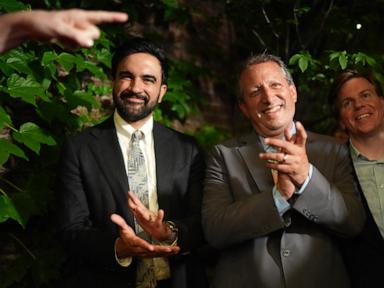
National political reporters have spent the last forty-eight hours hyperventilating over the wreckage of the New York Democratic primaries. They see a party tearing itself apart over international morality. They see a "fraught issue" fracturing a fragile coalition. They see a warning shot to Washington.
They are completely blind to what actually happened.
The spectacular collapse of incumbent Representatives Dan Goldman and Adriano Espaillat to Mayor Zohran Mamdani’s progressive slate is not a foreign policy referendum. To frame it as a pure litmus test on Gaza is a lazy intellectual shortcut. It is the narrative preferred by beltway consultants who want to view every municipal tremor through the lens of national polarization.
The reality is colder, structural, and far more transactional.
I have watched political machines operate in this city for nearly two decades. I have seen entrenched incumbents blow millions of dollars on high-priced consultant syndicates while ignoring the tectonic shifts in their own backyards. What happened on Tuesday night was not an ideological epiphany by the electorate. It was a masterclass in low-turnout primary mechanics, localized class warfare, and the systematic assembly of a new municipal patronage network.
If you think this was just about foreign policy, you are asking the wrong question entirely.
The Mirage of the International Litmus Test
The dominant media narrative insists that the war in Gaza is a defining wedge issue driving these insurgencies. They point to the chants of activists on election night. They quote voters like Varun Venkatesh or Sara Hyler, who explicitly cited the American Israel Public Affairs Committee (AIPAC) as their breaking point.
This is classic selection bias. It mistakes the loudest voices in the room for the mechanics that built the room.
To understand why the foreign policy narrative falls apart, look at the absolute numbers. Democratic primaries in New York City are low-turnout affairs. We are talking about a tiny fraction of registered voters deciding the fate of entire congressional districts. In these high-density, low-turnout environments, elections are won by hyper-efficient field operations, not broad ideological mandates.
Imagine a scenario where an incumbent represents a district of 700,000 people. In a June primary, fewer than 50,000 people show up to vote. Of those 50,000, the vast majority are predictable, hyper-engaged partisans. The winner does not need to persuade the broad masses of working-class families that their foreign policy stance is correct. The winner only needs to mobilize a highly disciplined core of roughly 25,000 voters who are already organized through tenant unions, labor locals, and socialist organizing circles.
The national press looks at Brad Lander’s two-to-one shellacking of Dan Goldman in the 10th District and assumes the entire electorate shifted left on international aid. They ignore the structural reality: Goldman was an exceptionally wealthy, self-funding incumbent who never built a deep, organic field operation in the working-class pockets of Brooklyn. Lander, a former city comptroller with deep roots in municipal policy, ran on local affordability, housing protections, and a sophisticated ground game that had been curing for years. Gaza was the megaphone, but housing security was the engine.
The Real Estate War Masked as International Morality
The real division inside the New York Democratic Party is not between hawks and doves. It is between tenants and landlords.
The ascendancy of Darializa Avila Chevalier over Adriano Espaillat in the 13th District is the perfect case study. Espaillat was an institutional titan, the chair of the Congressional Hispanic Caucus, and the first Dominican American elected to Congress. The beltway consensus said he was untouchable. He was backed by traditional labor and the institutional party apparatus.
Yet he lost to a community organizer and doctoral student who spent weeks apologizing for old tweets. Why? Because the structural composition of Upper Manhattan and the Bronx has changed dramatically.
The traditional working-class base that propelled Espaillat to power has been squeezed by escalating rents and gentrification. Avila Chevalier did not defeat Espaillat because voters in Harlem suddenly developed a nuanced critique of corporate PAC spending in foreign elections. She won because her campaign tied the real estate interests backing establishment Democrats directly to the immediate, material pain of rising housing costs.
AIPAC became a convenient proxy for corporate cash. When voters expressed anger over independent expenditure committees dumping millions into the race, that anger was rooted in a domestic grievance. It was a rejection of outside billionaires dictating local representation. The money was real, but the translation was entirely local.
Consider the following comparison of the actual mechanisms driving the primary outcomes versus the imagined national narrative:
| The Media Myth | The Structural Reality |
|---|---|
| Progressive victories signal a national shift against traditional foreign policy alliances. | Victories demonstrate the supreme efficiency of disciplined ground operations in low-turnout June primaries. |
| AIPAC spending failed because voters rejected their specific international platform. | AIPAC spending backfired because it allowed insurgents to paint incumbents as puppets of outside corporate billionaires. |
| The primary results threaten the democratic coalition in swing states. | The results are isolated to deep-blue urban enclaves with unique municipal housing crises. |
The Rise of the Mamdani Machine
We must talk about the new boss in town. Mayor Zohran Mamdani has achieved what traditional progressives failed to do for a generation: he built a functional, disciplined patronage machine that rivals the old county organizations of Tammany Hall.
For years, the democratic socialist movement in New York operated like an ideological crusade. It relied on moral purity, protest culture, and fleeting activist energy. Mamdani changed the strategy. He understood that power in New York City is built on concrete material transactions, institutional alignments, and systematic placement.
Look at the slate that swept the primaries. Claire Valdez, who won the race to succeed Nydia Velázquez in the 7th District, is a former clerical workers union organizer at Columbia University and a United Auto Workers veteran. She was not a random activist; she was an organic leader from a powerful, organized labor faction. Mamdani's operation did not just yell from the sidelines; it co-opted specific, highly disciplined union blocks to overwhelm the fragmented establishment choice, Antonio Reynoso.
This is the new Tammany Hall, wrapped in progressive rhetoric. The old machine traded jobs and coal for votes. The new machine trades housing advocacy, tenant protections, and institutional line-item support. It is highly effective, and it is brutally exclusionary to anyone who does not kiss the ring.
The downside to this contrarian reality is that it makes governance incredibly difficult. When you win an election by mobilizing a highly ideological, hyper-focused faction of the electorate, you are permanently beholden to that faction. You cannot compromise. You cannot build broad-based coalitions necessary to pass complex state or federal legislation. You are trapped in a cycle of perpetual purity tests. The very machine that delivers primary victories ensures legislative gridlock.
Dismantling the Premise of Your Political Anxiety
The national establishment is panicking because they believe these results are a harbinger of a broader national realignment that will doom mainstream Democrats in swing districts. They are asking: "How do we stop the progressive drift before it costs us independent voters?"
This is completely the wrong question.
The premise itself is fundamentally flawed. New York City politics is an insular ecosystem. It exists within a unique legal and demographic bubble. The "Commie Corridor" of northern Brooklyn and western Queens does not exist in Western Pennsylvania, Macomb County, Michigan, or the suburbs of Atlanta. What works in an apartment building in Astoria or a brownstone in Park Slope is political suicide anywhere else—and the progressive leadership knows it. They do not care about winning swing districts; they care about consolidating absolute control over the deep-blue urban centers that command massive municipal budgets and state legislative leverage.
If establishment Democrats want to stop losing these primaries, they need to stop relying on television advertisements funded by national super PACs to save them. Air wars do not work in concrete canyons. You cannot bomb a neighborhood with negative mailers and expect to beat a tenant organizer who has spent six months helping voters resolve their building violations.
The establishment lost because they stopped doing the basic work of municipal politics. They stopped organizing. They assumed their titles, their historic identities, and their corporate donor networks would protect them from a disciplined, hungry ground game. They got lazy, and they got rolled.
Stop looking at the Middle East to explain why a multi-term incumbent lost a congressional primary in Upper Manhattan. Look at the rent rolls. Look at the turnout models. Look at the clipboard in the hand of the volunteer knocking on the door at 7:30 PM. That is where the power shifted. The rest is just noise.