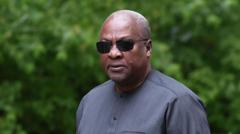
The media theater surrounding Ghana's Human Sexual Rights and Family Values Bill has devolved into a predictable, lazy consensus. Mainstream commentary views the situation through a single, narrow lens: a binary battle between Western liberal human rights values and conservative African sovereignty. When the Ghanaian parliament passed the revived legislation in May 2026, international headlines immediately fixated on the executive desk, parsing whether President John Dramani Mahama would sign it or succumb to external pressures.
This framing is completely wrong. It miscalculates the actual mechanics of political survival, national sovereignty, and economic vulnerability in West Africa.
The standard narrative insists that this bill is merely a domestic culture war or a case of regional prejudice. Having analyzed legislative overreach and macroeconomic policy across emerging markets for two decades, I see this as a textbook diversion strategy. The global outrage machine is missing the real structural disaster. The true crisis in Ghana is not an ideological debate over identity; it is the calculated deployment of populist legislation to mask systemic state incapacity and a pending fiscal collapse.
The Mirage of Constitutional Scrutiny
Western observers cheer whenever an executive delays signing a bill under the guise of constitutional review or judicial scrutiny. They treat the legal process as an independent safeguard. It is not. It is a stalling mechanism designed to balance two conflicting, irreconcilable ledger sheets: domestic voter appeasement and foreign debt maintenance.
Let us look at the mechanics. Same-sex conduct was already illegal under Ghana's colonial-era criminal code. The new bill, however, goes significantly further by criminalizing the mere act of identifying as LGBTQ+ and imposing severe prison sentences on allies, advocates, and civil society organizations.
[Domestic Political Demand] ---> High-Volume Populist Legislation
                                           |
                                  (Executive Dilemma)
                                           |
[Foreign Capital Dependency] <--- Strategic Judicial Stalling
The political elite do not necessarily care about the administrative execution of this law. I have seen governments across the continent push through un-implementable laws simply to capture the news cycle. The legislative process is treated as a low-cost, high-yield tool for domestic mobilization.
By framing the delay as a matter of waiting for constitutional clarity or proper state presentation, the executive branch avoids a direct collision with international donors while maintaining its nationalist credentials at home. It is a masterclass in risk deferral.
The $3.8 Billion Sovereign Trap
The lazy consensus completely ignores the mathematical absurdity of the state's position. The Ghanaian Finance Ministry previously warned that enacting this type of sweeping legislation would jeopardize $3.8 billion in World Bank financing and derail a critical $3 billion International Monetary Fund (IMF) stabilization package.
When a state relies on foreign capital to keep its currency functioning and its debt serviced, culture wars become expensive liabilities.
- The IMF Red Line: Western multilateral donors rarely pull funding explicitly over social policy, but they use structural benchmarks to squeeze non-compliant regimes.
- The Capital Flight Reality: Private international investors do not care about local cultural values; they care about stability. A country that alienates major multilateral lenders experiences immediate capital flight and a rapid depreciation of its local currency.
- The Sovereign Risk Premium: Passing laws that trigger institutional funding cuts automatically drives up the yield on sovereign bonds, making future borrowing unsustainable.
Imagine a scenario where a corporation purposely alienates its primary credit facility to satisfy a vocal group of minority shareholders. It is corporate suicide. On a nation-state scale, it is structural negligence. The government cannot pay civil servants or stabilize the cedi with ideological purity. The moment the foreign credit lines dry up, the domestic political base will turn on the regime, regardless of what social legislation was passed.
Why the Colonial Import Argument Fails
Proponents of the bill frequently claim they are defending indigenous culture against foreign, Western imports. This is a historical and logical fallacy that the international press routinely fails to correct.
The irony is glaring: the original statutes criminalizing same-sex intimacy in West Africa were themselves introduced by European colonial administrations in the 19th century. Pre-colonial African societies possessed complex, varied understandings of gender and sexuality, often documented in local languages and traditions long before European missionaries arrived.
By using the machinery of the post-colonial state to expand penal codes inherited from the British Empire, local politicians are not purging Western influence. They are codifying it. They are utilizing a Western governance framework to enforce a Victorian moral order, all while wrapping the entire exercise in the flag of anti-colonial resistance. It is an exceptional sleight of hand.
The Real Structural Cost to Local Business
The conversational focus remains obsessively fixed on human rights conferences and diplomatic statements. The tangible, ground-level economic destruction of the bill is ignored.
The true vulnerability lies in the administrative burden the legislation places on regular local commerce. By criminalizing the failure to report targeted individuals, the bill effectively turns every landlord, small business owner, and employer into an unpaid agent of state surveillance.
If a commercial property owner rents an office space to a civil society group or a human rights organization that is later deemed to be "promoting" prohibited identities, that landlord faces immediate criminal liability. This creates massive operational uncertainty. Small and medium-sized enterprises cannot afford to audit the private lives or advocacy leanings of their clients, employees, or tenants.
The resulting atmosphere does not protect family values; it destroys commercial trust. It drives economic activity into the informal shadow economy, reduces tax compliance, and discourages local entrepreneurship.
Dismantling the Deflection Strategy
Why is this happening now? Because the state needs an enemy. When inflation erodes purchasing power, when public infrastructure underperforms, and when debt restructuring terms demand domestic austerity, a government cannot run an election campaign on its economic performance.
Targeting a vulnerable minority is the oldest deflection strategy in politics. It consolidates the religious establishment, unites opposing political factions, and provides a highly visible, emotional issue to dominate public discourse.
The international community plays right into this trap. Every time a Western embassy issues a heavy-handed, moralizing statement, it validates the local populist narrative that the nation is under siege from external forces. This allows proponents of the bill to position themselves as defenders of national dignity, effectively silencing domestic critics who are concerned about the actual economic collapse.
Stop looking at the signature on the document. Look at the balance sheet. The real crisis in Ghana is a state using legislative theater to hide its fiscal fragility from its own citizens.