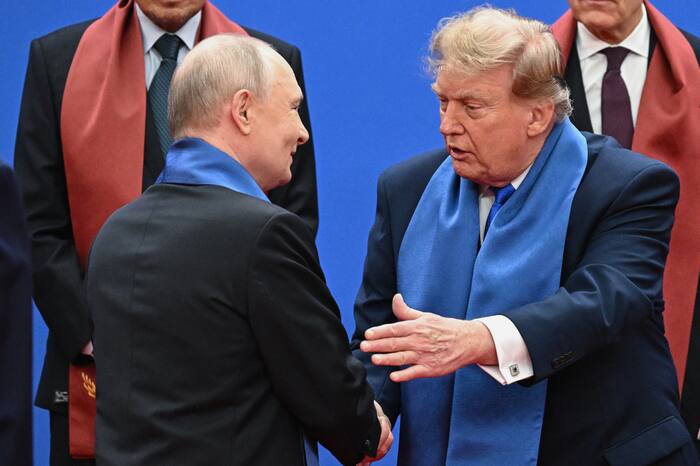
Sequential summitry between the United States, China, and Russia operates on a strict game-theoretic mechanism: bilateral pre-negotiations establish the bargaining baseline and lock in asymmetric concessions before a trilateral session can dilute leverage. When President Xi Jinping and President Donald Trump initiate direct bilateral talks prior to a scheduled trilateral summit involving President Vladimir Putin, the structural objective is to define the agenda boundaries, isolate non-negotiable security parameters, and prevent a two-against-one diplomatic encirclement.
Standard geopolitical reporting treats sequential summits as linear calendar events rather than interlocking bargaining games. According to standard diplomatic reporting frameworks—such as the headline reference noting that Presidents Xi and Trump begin talks ahead of a later trilateral with Putin—the public narrative typically focuses on immediate bilateral friction points while framing the subsequent three-party meeting as a culminating photo opportunity or broad consensus-building forum. In operational reality, the bilateral phase functions as a pre-commitment mechanism. By engaging directly before Putin enters the room, Washington and Beijing each attempt to shift the Nash equilibrium of the upcoming trilateral session, altering the payoff matrix for all three capitals before multilateral rules of engagement take effect.
The Game-Theoretic Mechanics of Bilateral Pre-Positioning
In international relations theory, specifically within two-level game frameworks and sequential bargaining models, the order of negotiations dictates the distribution of surplus value. A trilateral summit involving three nuclear-armed powers with divergent economic and security interests introduces severe coordination problems and the constant risk of coalition formation.
1. Preventing Adverse Coalition Formation
In any three-player game where no single actor holds absolute hegemony across all domains—military, economic, and technological—the primary fear of each participant is the formation of a blocking coalition by the other two.
- The U.S. Calculus: Washington enters the bilateral phase with Beijing seeking to decouple Chinese economic and diplomatic support from Russian strategic objectives. By addressing bilateral trade, tariff structures, and technology transfer controls directly with Xi, the U.S. administration attempts to raise the opportunity cost for Beijing of aligning too closely with Moscow during the subsequent trilateral session.
- The Chinese Calculus: Beijing uses the bilateral opening to establish itself as the indispensable intermediary. By engaging Trump first, Xi demonstrates to Moscow that China maintains independent channels with Washington, thereby maximizing Beijing's leverage over Putin before the trilateral begins. Simultaneously, China signals to Washington that bilateral economic stability is contingent upon U.S. restraint regarding core Chinese territorial and security interests.
- The Russian Calculus (Ex-Ante): Although absent from the initial bilateral room, Putin’s strategic posture shapes every concession offered or withheld. Moscow monitors the bilateral readout for signs of a Washington-Beijing accommodation that could isolate Russia on European security architecture, energy sanctions, or arms control frameworks.
2. Agenda Control and Issue Linkage
Agenda setting determines which variables are endogenous to the negotiation and which remain exogenous. In bilateral talks preceding a trilateral, both Washington and Beijing work to ring-fence specific disputes so they cannot be used as bargaining chips by the third party.
Issue linkage occurs when one actor ties progress in a domain where it holds an advantage to concessions in a domain where it faces a deficit. During the Xi-Trump bilateral phase, economic access, tariff schedules, and semiconductor supply chains serve as primary linkage instruments. If Washington and Beijing establish a provisional framework on bilateral trade deficits or industrial policy prior to Putin's arrival, they effectively remove those economic levers from the trilateral table. Putin cannot exploit U.S.-China trade friction to extract security concessions in Eastern Europe or the Arctic if those trade parameters have already been stabilized in the preceding bilateral round.
Deconstructing the Three Pillars of the Bilateral-to-Trilateral Transition
To analyze how a bilateral opening translates into trilateral outcomes, observers must track three distinct operational variables rather than relying on public communiqués.
Pillar One: Strategic Stability and Arms Control Architecture
The expiration or erosion of Cold War-era bilateral arms control treaties between Washington and Moscow has created a structural vacuum. The United States has consistently argued that any successor framework to agreements like New START must incorporate China’s expanding nuclear arsenal, while Beijing has historically resisted trilateral limits given the disparity in warhead counts between China and the two Cold War superpowers.
In the bilateral phase, Trump and Xi confront this asymmetry directly. The operational mechanism here is threshold definition:
- Washington seeks commitments on strategic transparency, missile launch notifications, and constraints on fissile material production.
- Beijing demands reciprocal constraints on U.S. missile defense deployments in the Indo-Pacific and space-based reconnaissance assets.
- If the bilateral session yields even a narrow procedural agreement—such as establishing a bilateral strategic stability working group—it fundamentally alters the trilateral session with Putin. Moscow can no longer use Chinese non-participation as a unilateral veto against discussing nuclear risk reduction, nor can Washington easily weaponize the bilateral U.S.-Russia treaty framework without accounting for Chinese force modernization.
Pillar Two: Global Trade Flows, Sanctions, and Financial Plumbing
Economic statecraft forms the second operational pillar. The United States maintains structural dominance over global dollar clearing systems and high-end semiconductor fabrication equipment, while China commands global manufacturing capacity and critical mineral processing. Russia, operating under extensive Western sanctions, relies heavily on non-dollar settlement mechanisms and bilateral trade corridors with China.
During the bilateral talks, the core negotiation centers on secondary sanctions enforcement and market access:
- Tariff Calibration: The U.S. utilizes tariff threats and export control lists to extract purchasing commitments, intellectual property protections, and restrictions on dual-use technology transfers to third parties.
- Supply Chain Resilience: China seeks the relaxation of entity-list restrictions on major technology firms and predictable access to U.S. consumer markets to offset domestic structural headwinds, including real estate sector deleveraging and demographic contraction.
- The Russian Spillover: Any bilateral understanding between Washington and Beijing regarding financial compliance or dual-use export controls directly constrains Moscow’s procurement networks before Putin enters the trilateral room. Conversely, if the Xi-Trump talks deadlock over tariffs, Beijing enters the trilateral with a strong incentive to deepen alternative financial and energy clearing mechanisms with Moscow.
Pillar Three: Regional Security Buffers and Sphere-of-Influence Friction
Geopolitical friction concentrates along maritime and continental fault lines: the Taiwan Strait, the South China Sea, the Korean Peninsula, and Eastern Europe. Each capital defines its core security perimeter in terms that directly conflict with the forward presence or alliance structures of the others.
In sequential summitry, bilateral pre-talks test the credibility of deterrence signals:
- Indo-Pacific Signaling: Trump and Xi use direct leader-to-leader communication to establish crisis-management guardrails, ensuring that tactical military encounters in the Western Pacific do not escalate unintentionally while diplomatic tracks are active.
- Eurasian Linkage: Washington evaluates the extent to which Beijing is willing to exert diplomatic or economic pressure on Moscow to freeze or settle active European conflicts. Beijing, recognizing that a protracted conflict in Europe ties down U.S. military bandwidth and defense industrial capacity, weighs the strategic benefit of U.S. distraction against the economic cost of ruptured European trade relationships.
The Cost Function of Diplomatic Sequencing
Executing a high-stakes bilateral meeting immediately prior to a trilateral summit carries quantifiable diplomatic risks and operational bottlenecks. The decision to sequence talks in this manner is governed by an implicit cost function balancing domestic political signaling against alliance cohesion.
1. Allied Anxiety and Extended Deterrence Erosion
When a U.S. president engages in direct, high-level bilateral talks with Xi Jinping and subsequently enters a trilateral forum with Vladimir Putin, treaty allies in both Europe and the Indo-Pacific experience acute abandonment anxiety. Nations such as Japan, South Korea, the Philippines, and NATO front-line states monitor sequential great-power diplomacy for signs of a "grand bargain"—an arrangement in which Washington trades away regional security commitments or softens sanctions regimes in exchange for bilateral economic gains or strategic stability agreements.
To mitigate this cost, U.S. negotiators must conduct intensive pre-summit consultations with allied capitals and enforce strict transparency protocols. Failure to manage allied perceptions triggers hedging behavior, where regional partners accelerate independent military buildups or pursue their own bilateral accommodations with Beijing and Moscow.
2. The Commitment Problem in Personalist Diplomacy
Summitry driven directly by heads of state—particularly leaders who favor centralized decision-making and transactional bargaining—faces a structural commitment problem. While leader-to-leader meetings can cut through bureaucratic inertia rapidly, agreements reached without deep institutional buy-in suffer from implementation decay.
- Bureaucratic Drag: Trade ministries, defense establishments, and intelligence agencies in Washington, Beijing, and Moscow possess distinct institutional incentives. A verbal understanding between Trump and Xi regarding export control enforcement or agricultural purchases can be stalled by regulatory rulemaking, licensing delays, or technical compliance reviews.
- Asymmetric Time Horizons: Democratic administrations operate on two- and four-year electoral cycles, creating pressure for immediate, visible deliverables such as trade volume targets or hostage releases. Authoritarian systems operate on multi-decade strategic horizons, allowing Xi and Putin to trade short-term tactical concessions—such as temporary commodity purchases or rhetorical de-escalation—for permanent structural gains, such as the weakening of alliance cohesion or the normalization of territorial status quos.
3. Information Asymmetry and Misinterpretation
Sequential talks generate rapid shifts in diplomatic signaling. If the Xi-Trump bilateral concludes with ambiguous public readouts, Moscow enters the trilateral operating under incomplete information. In game theory, incomplete information increases the probability of miscalculation. Putin may overcompensate by adopting an uncompromising opening posture in the trilateral to test whether Washington and Beijing have reached a covert understanding at Russia’s expense. Conversely, if the bilateral visibly fractures, Putin gains immediate tactical leverage, positioning Russia as the swing vote capable of tipping the trilateral balance toward Beijing.
Structural Limitations of the Bilateral-to-Trilateral Model
Analysts and policymakers frequently overestimate what sequential summitry can achieve because they conflate diplomatic process with structural resolution. Three hard constraints limit the efficacy of this format:
- Incompatibility of Core Regimes: No amount of summit sequencing can reconcile fundamental ideological and structural divergences between liberal democratic market systems and state-capitalist authoritarian regimes. Talks can manage friction, establish rules of the road, and prevent accidental kinetic escalation, but they cannot eliminate the underlying competition for technological and normative primacy.
- Domestic Economic Constraints: Leaders arrive at the negotiating table bound by domestic political economy. U.S. negotiators cannot unilaterally dismantle industrial policy protections supported by domestic manufacturing coalitions, just as Chinese negotiators cannot abandon state-directed industrial subsidies that underpin domestic employment and technological self-reliance.
- Third-Party Spoilers: Great-power summits do not occur in a vacuum. Actions by regional actors—such as North Korean missile tests, Middle Eastern supply chain disruptions, or domestic political shocks within allied nations—can instantly invalidate the carefully calibrated assumptions established during the bilateral phase before the trilateral session even convenes.
Operational Indicators to Monitor During the Transition
To assess whether the Xi-Trump bilateral has successfully structured the subsequent trilateral with Putin, observers must look past diplomatic pleasantries and track four concrete empirical indicators between the two sessions:
- Composition of Working-Level Delegations: Track which cabinet officials and technical experts remain behind after the bilateral to draft joint statements versus those departing early. The presence of senior treasury, commerce, and defense officials in the transitional working groups indicates substantive framework drafting rather than purely symbolic engagement.
- Specificity of Readout Language: Distinguish between aspirational verbs ("discussed," "exchanged views," "expressed willingness") and operational commitments ("agreed to establish," "committed to lifting," "scheduled technical talks within thirty days"). Only the latter alters the baseline for the trilateral.
- Currency and Commodity Market Reactions: Financial markets price in diplomatic outcomes faster than official statements confirm them. Movement in the offshore renminbi (CNH), U.S. Treasury yields, defense sector equities, and energy futures during the window between the bilateral and trilateral sessions reveals institutional investor assessments of tariff and sanctions trajectories.
- Pre-Trilateral Signaling from Moscow: Monitor statements from the Russian Ministry of Foreign Affairs and Kremlin spokespersons immediately following the Xi-Trump bilateral readout. Defensive or sharply critical commentary regarding "exclusive bilateral arrangements" confirms that Washington and Beijing succeeded in narrowing Moscow’s trilateral maneuvering room; enthusiastic endorsement of "multipolar cooperation" indicates the bilateral failed to bridge core U.S.-China divides.
Strategic Execution Protocol for the Trilateral Phase
For the United States to convert an initial bilateral engagement with China into durable strategic leverage during a subsequent trilateral summit with Russia, the negotiating team must execute a disciplined three-step operational sequence:
First, lock in a written, verifiable bilateral protocol on crisis communications and non-proliferation guardrails with Beijing before Putin enters the room, ensuring that basic strategic stability is treated as a settled baseline rather than a trilateral bargaining chip. Second, maintain strict separation between bilateral economic track concessions and trilateral security demands, refusing to trade away multilateral sanctions enforcement or allied defense commitments for short-term bilateral trade deficit reductions. Third, utilize the trilateral forum explicitly to test the limits of the Sino-Russian partnership by introducing targeted proposals—such as fissile material cutoffs, space debris mitigation treaties, or Arctic navigation rules—that force Beijing and Moscow to reveal their divergent institutional priorities in real time.