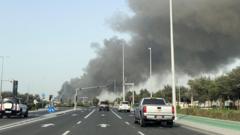
The escalation of direct kinetic exchanges between the United States, Israel, and Iran has transitioned from a shadow war governed by plausible deniability into a structured cycle of overt retaliation. This shift is not merely a diplomatic breakdown; it is a fundamental recalibration of regional deterrence. The current conflict architecture is defined by three distinct operational variables: the degradation of Iranian proxy autonomy, the technical performance of multi-layered integrated air defense systems (IADS), and the signaling utility of precision deep-strike capabilities. Understanding the trajectory of this conflict requires moving past surface-level headlines to analyze the underlying cost-imposition strategies and the attrition of red lines.
The Triad of Deterrence Erosion
The traditional Iranian defense posture relied on "Forward Defense"—the use of non-state actors in Lebanon, Yemen, and Iraq to create a buffer zone. Recent US and Israeli strikes have targeted the command-and-control (C2) nodes of these proxies while simultaneously hitting sovereign Iranian territory. This dual-track approach breaks the insulation Iran previously enjoyed.
- Proxy Decoupling: When the US strikes IRGC-linked facilities in Syria or Iraq, it forces Tehran to choose between abandoned assets and direct intervention. The current intensity suggests that the proxy "shield" has become a "conductor" for direct conflict.
- Technological Overmatch: The interception rates of Iranian ballistic missiles and loitering munitions provide a data-rich environment for Western intelligence. Every failed Iranian strike serves as a diagnostic test for the Arrow-3, David’s Sling, and Iron Dome systems. The efficacy of these systems alters the "Cost-per-Kill" (CpK) ratio, forcing Iran to expend higher volumes of cheaper munitions to achieve a single kinetic success.
- The Intelligence Gap: The precision of Israeli strikes on sensitive Iranian sites indicates a high level of penetration within the Iranian security apparatus. This creates a psychological bottleneck where Iranian leadership must weigh the risk of a retaliatory strike against the high probability of that strike being intercepted or anticipated.
The Cost Function of Multi-Front Engagement
Military operations in this theater are governed by an economic logic of attrition. Israel’s defense strategy is high-capital, high-tech, while the Iranian offensive strategy is low-capital, high-volume.
Interception Economics
The financial burden of defense is significantly higher than the cost of offense. An Iranian Shahed-136 drone costs approximately $20,000 to $50,000 to produce. In contrast, an Israeli Tamir interceptor (Iron Dome) costs around $50,000, and a Standard Missile-3 (SM-3) used by US Aegis-equipped destroyers can cost over $9 million.
This creates a Sustained Attrition Inequality. For Israel and the US, the goal is not just to intercept, but to do so in a way that does not deplete interceptor inventories faster than Iran can produce launch platforms. If Iran can force the US and Israel to exhaust their stockpile of high-end interceptors against low-end threats, they create a "window of vulnerability" for their more sophisticated hypersonic or medium-range ballistic missiles.
The Logistics of Precision
The second day of retaliations highlighted a shift toward targeting high-value infrastructure over personnel. By focusing on production facilities for solid-fuel propellants or radar arrays, Israel is aiming to degrade Iran's long-term "regenerative capacity." Personnel can be replaced; specialized industrial machinery and cryogenic cooling systems for missile production cannot be easily bypassed under current sanctions regimes. This is a move from tactical retaliation to strategic neutralization.
Kinetic Signaling and the Escalation Ladder
Every missile launch and airstrike is a form of communication. The "Day Two" strikes are distinct because they moved beyond the "tit-for-tat" paradigm into "escalatory dominance."
- Vertical Escalation: Increasing the intensity or the destructive power of the strikes (e.g., moving from drone strikes to ballistic missiles).
- Horizontal Escalation: Expanding the geographic scope of the conflict (e.g., hitting sites in Isfahan vs. hitting proxies in the Bekaa Valley).
The current US-Israeli logic appears to be focused on Compellence. The objective is to make the cost of Iranian retaliation so prohibitively high that Tehran is compelled to return to the status quo of the shadow war. However, this assumes that the Iranian leadership operates on a purely rational-actor model. If the Iranian regime perceives the strikes as an existential threat to the leadership itself, the cost-benefit analysis shifts toward "Desperation Strikes," where the goal is no longer victory, but maximum regional disruption.
The Technical Reality of Iranian Air Defense
The performance of Iranian domestic air defense, specifically the Bavar-373 and the S-300 systems, remains a critical unknown. The ability of Israeli F-35I "Adir" jets to operate within Iranian airspace suggests a significant gap in electronic warfare (EW) and stealth-detection capabilities.
The bottleneck for Iran is not the number of missiles, but the Sensor-to-Shooter Loop. If Israeli and US forces can jam or destroy the "eyes" (radar) of the Iranian defense network, the "muscles" (missile batteries) become useless. The strikes on day two specifically targeted early-warning radars, which effectively blinds the Iranian military to subsequent waves of attack. This creates a "suppression of enemy air defenses" (SEAD) environment that allows for sustained aerial superiority.
Strategic Bottlenecks and Resource Constraints
The US role in this conflict is defined by its ability to provide logistical and intelligence "connective tissue." Without US satellite data and mid-air refueling capabilities, the operational range of Israeli strikes would be severely limited.
- The Refueling Constraint: Long-range strikes on Iran require multiple refueling cycles. This makes the tankers the most vulnerable point in the kill chain.
- The Munitions Depth: Both sides are facing a "deep-magazine" problem. High-intensity conflict consumes munitions at a rate that exceeds peacetime manufacturing capacity. The US must balance its support for Israel with its commitments in Eastern Europe and the Indo-Pacific.
The strategic play is now centered on the Point of Irreversible Escalation. If the US and Israel target Iranian oil refineries or nuclear facilities, they move from "controlled retaliation" to "regime destabilization." This carries the risk of a total closure of the Strait of Hormuz, which would trigger a global energy shock.
The immediate tactical priority is the systematic elimination of Iranian drone launch sites and missile storage facilities to reduce the volume of the next Iranian salvo. By reducing the "volume of fire," the US and Israel can maintain the efficacy of their interceptor stockpiles. The long-term objective is to force a "Strategic Pause" by demonstrating that the Iranian offensive capability has reached a point of diminishing returns. Tehran is now forced to evaluate whether another round of strikes will yield any kinetic result other than the further exposure and destruction of its high-value domestic defense assets.