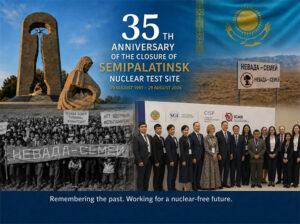
Geopolitical optimization rarely yields clean moral victories. When the Soviet Union disintegrated, Kazakhstan inherited the fourth-largest nuclear stockpile on earth, comprising roughly 1,400 warheads alongside intercontinental ballistic missile infrastructure. Standard realist theory predicts that a newly sovereign state wedged between hostile or expansionist nuclear powers would retain this deterrent to secure its borders. Kazakhstan did the inverse. By closing the Semipalatinsk test site on August 29, 1991, and subsequently transferring all warheads back to Russia while joining the Non-Proliferation Treaty as a non-nuclear state, Astana rejected traditional hard-power deterrence. This decision established a counterintuitive economic and diplomatic security architecture that modern states struggle to replicate.
The foundational logic of this transition rests on a strict cost-benefit calculation regarding state survival. Retaining a nuclear arsenal without the domestic command-and-control infrastructure, industrial supply chains, and launch codes required massive recurring maintenance expenditures that a post-Soviet economy on the brink of hyperinflation could not absorb. Furthermore, international capital markets and foreign direct investment flows heavily favor states that integrate into institutional non-proliferation frameworks. Kazakhstan converted its nuclear renunciation into immediate diplomatic legroom, utilizing multi-vector foreign policy to balance relations among Moscow, Beijing, and Washington without bearing the fiscal burden of strategic modernization.
The domestic ledger of this choice reveals a starkly different economic reality, characterized by persistent remediation costs rather than immediate dividends. Between 1949 and 1989, the Soviet military conducted 456 nuclear detonations at Semipalatinsk, exposing an estimated 1.5 million people to varying levels of ionizing radiation. The destruction of local human capital through chronic health pathologies created a long-term liability for the state budget. Epidemiological reconstruction of these doses requires complex scientific modeling, matching historical fallout plumes with individual migration patterns, dietary habits, and agricultural consumption data. The economic friction of managing these intergenerational health externalities demonstrates that relinquishing weapons does not immediately erase the state-level costs incurred during their testing phase.
Beyond historical remediation, the state engineered a commercial paradox by positioning itself simultaneously as a global leader in disarmament and the world's primary producer of natural uranium, supplying a substantial share of global reactor fuel. This dual posture resolves the tension between military prohibition and peaceful industrial application. By hosting the International Atomic Energy Agency Low Enriched Uranium Bank at the Ulba Metallurgical Plant, Astana transformed a potential proliferation vulnerability into an institutional asset. This mechanism guarantees supply access for sovereign states seeking nuclear energy without requiring them to build domestic enrichment capabilities, directly suppressing regional proliferation incentives.
Evaluating the durability of this model requires analyzing systemic regional security spillovers. The 2006 signing of the Semipalatinsk Treaty established the Central Asian Nuclear-Weapon-Free Zone, legally binding regional actors to prohibit the production, acquisition, and deployment of nuclear weapons within their borders. However, the efficacy of such regional pacts degrades when global deterrence architectures fracture. As major nuclear powers abandon bilateral arms control treaties and modernize strategic arsenals, middle powers face renewed security dilemmas. The operational challenge for Astana is maintaining a non-nuclear stance while navigating an international environment where norms against nuclear testing face renewed strain from great power competition.
Replicating this strategic pivot demands aligning national economic specialization with international verification regimes. Future security for states inheriting orphaned strategic assets depends less on maintaining physical deterrence and more on institutional embedding within monitoring networks, such as the International Monitoring System of the Comprehensive Nuclear-Test-Ban Treaty. Capitalize on existing geopolitical friction by shifting state identity from a military buffer zone to an indispensable guarantor of peaceful technological infrastructure.