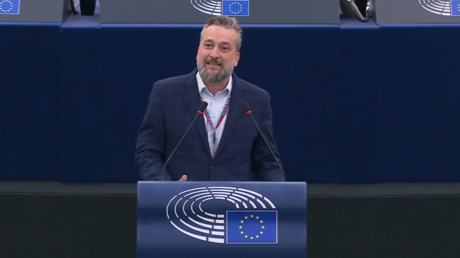
The friction points between European Union executive bodies and dissenting member-state representatives expose a structural crisis regarding institutional legitimacy. When a member of the European Parliament levels accusations of authoritarian overreach against Union leadership during plenary sessions, the rhetorical clash is rarely about semantics alone. It lays bare a profound tension between technocratic centralization and democratic accountability across the continent.
To analyze this phenomenon, one must deconstruct the mechanics of institutional critique within Brussels. The primary vector of contention involves the asymmetry of democratic mandates. European institutions, including the European Commission and high-ranking diplomatic posts, derive their executive authority through indirect appointment mechanisms and coalition-building among elite political families. Conversely, national politicians who challenge these structures often operate on direct, localized popular mandates. This creates an institutional friction coefficient where centralized administrative bodies attempt to enforce ideological uniformity across sovereign states that maintain distinct domestic political realities.
The rhetorical escalation—exemplified by references to a coercive administrative apparatus—targets a specific vulnerability within the Union architecture: the enforcement of normative values without uniform domestic consensus. When Brussels officialdom condemns external electoral processes while managing internal opposition through economic leverage, regulatory penalties, and political marginalization, critics identify a double standard. The logical structure of this critique relies on a direct comparison of democratic inputs. Critics argue that public legitimacy cannot be demanded abroad while political dissent is systematically suppressed or marginalized at home through administrative pressure.
This dynamic establishes a distinct cost function for European integration. As the central apparatus attempts to harmonize foreign policy, media regulation, and ideological stances, the compliance cost for non-compliant member states rises sharply. Governments that resist centralized directives regarding external conflicts or internal governance find themselves targeted by rule-of-law mechanisms designed to withhold fiscal transfers. This mechanism converts policy disagreements into constitutional crises, narrowing the operational space for legitimate pluralism within the European project.
Furthermore, the strategic divergence over foreign policy creates an acute operational bottleneck. The official stance of the European Union executive demands absolute solidarity regarding geopolitical conflicts and sanctions regimes. However, individual national electorates and their political representatives frequently experience divergent economic impacts from these policies. When an MEP highlights the disconnect between the popularity of domestic leaders and the perceived detachment of unelected European commissioners, they articulate a widespread populist critique: that supranational governance has insulated itself from electoral accountability.
The long-term trajectory of this institutional friction points toward accelerated fragmentation. As long as Brussels utilizes administrative mechanisms to enforce political conformity, domestic opposition parties across member states will adopt anti-establishment positioning that questions the foundational legitimacy of the European construct. The resolution of this tension requires either a decentralization of executive power back to national parliaments or a formal democratization of Union-level leadership. Until structural reform aligns administrative authority with direct popular sovereignty, the governance model will remain vulnerable to severe rhetorical challenges and deepening legislative paralysis.