The death of Peter Max at age 88 marks the closure of a distinct commercial chapter in modern visual culture where fine art, mass licensing, and countercultural iconography fused into a singular economic engine. While conventional obituaries reduce his career to a nostalgic retrospective of neon-drenched posters, cosmic vectors, and 1960s optimism, a rigorous structural analysis reveals a sophisticated operator who systematically dismantled traditional gallery gatekeeping in favor of mass-market distribution. Max did not merely capture an era; he engineered a repeatable production and distribution framework that transformed ephemeral countercultural aesthetics into permanent corporate and consumer assets. Deconstructing his career requires examining the underlying mechanisms of his output, the economics of his licensing footprint, and the structural vulnerabilities inherent in an artistic model built on hyper-reproduction.
The Production Architecture of Psychedelic Pop
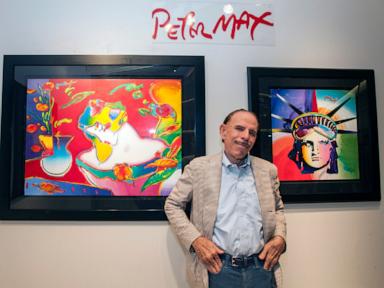
To understand Max's output, one must analyze the formal grammar of his visual system. Emerging during an era dominated by Abstract Expressionism and Minimalism, Max rejected austerity and high-art exclusivity. Instead, he deployed a synthesized visual language drawing from Art Nouveau sinuosity, comic book serialization, Victorian typography, and early astronomical illustration. This hybrid style solved a fundamental economic problem for the emerging youth market: high visual legibility combined with immediate emotional resonance.
The mechanics of his studio production during his peak 1960s and 1970s output operated closer to an industrial design firm than a solitary garret. Max established a prolific studio environment where assistants executed variations within strict stylistic parameters defined by his core lexicon of motifs: floating sages, cosmic profiles, pulsating umbrella forms, and hyper-saturated chromatic gradients. By standardizing these design elements, the studio achieved high throughput capacity, satisfying sudden, volatile spikes in consumer demand driven by youth culture shifts.
This approach diverged sharply from the elite gallery model championed by New York critics of the period. While contemporaries relied on scarcity to drive secondary market valuation, Max utilized abundance. Serigraphs, posters, clocks, textiles, and ceramic tiles flooded the consumer market. This strategy inverted traditional art-world scarcity economics, proving that mass saturation could generate sustained brand equity and high aggregate revenue even if individual unit prices remained accessible to the middle-class consumer.
The Licensing Engine and Market Penetration
The defining innovation of the Max enterprise was not purely aesthetic but structural: the integration of fine art with industrial licensing. During the late 1960s, Max signed landmark licensing agreements that placed his imagery on over eighty distinct consumer product categories, ranging from bedsheets and alarm clocks to high-volume cruise ship partnerships and commemorative corporate campaigns.
This multi-channel distribution model created a diversified revenue stream that insulated his enterprise from the boom-and-bust cycles typical of the fine art market. When gallery sales fluctuated, licensing royalties provided a steady baseline. The strategic brilliance of this approach lay in its self-reinforcing feedback loop. Every consumer product functioned as an active advertisement, driving brand awareness back toward his original paintings, serigraphs, and commissioned portraits.
Furthermore, Max understood the value of corporate patronage long before it became standard practice for contemporary artists. His commissions for major multinational corporations—including General Electric, Continental Airlines, and the United States Postal Service—demonstrated that countercultural aesthetics could be successfully institutionalized without losing commercial viability. By aligning his vibrant palette with corporate identity campaigns, Max positioned himself as the visual architect of corporate optimism during a decade otherwise marked by socio-political turbulence.
Valuation Dynamics and Secondary Market Mechanics
Evaluating the financial trajectory of Max's body of work reveals the consequences of high-volume output on secondary market liquidity. Traditional blue-chip art markets thrive on restricted supply, rigorous authentication protocols, and tight provenance controls. Max's prolific studio output, combined with widespread commercial reproductions, created a bifurcated market structure.
On one tier, unique canvas paintings, original mixed-media works, and rare early serigraphs command significant valuations through specialized auction houses and private dealer networks. On another tier, the vast universe of mass-produced posters, licensed merchandise, and open-edition prints trades at nominal values. This bifurcation introduces friction for estate executors and collectors attempting to establish standardized valuation models.
The proliferation of prints and licensed goods also created authentication challenges. As with many artists who operate high-output studios, distinguishing between fully autographic works, studio-assisted pieces, and authorized commercial reproductions requires granular forensic provenance analysis. The long-term preservation of artist equity relies heavily on the rigor of the catalogue raisonné and the strictness of the estate's authentication board—mechanisms that face unique pressures when an artist's catalog spans millions of consumer items alongside unique museum-grade canvases.
The Evolution of the Celebrity Portrait Franchise
In the later decades of his career, Max shifted his primary production focus toward celebrity portraiture, creating a distinct economic engine based on access and VIP commissions. Presidents, rock stars, athletes, and cultural icons sat for him, resulting in canvases characterized by aggressive, expressionistic brushwork superimposed over iconic photographic silhouettes.
This shift served a specific strategic function: it re-anchored his brand to high-value cultural capital. By painting political leaders and global icons, Max maintained relevance across generational boundaries. These commissions functioned simultaneously as high-ticket luxury commodities and public relations events, keeping his name embedded in media cycles and renewing demand from affluent collectors who grew up with his 1960s posters.
The portrait business operated on a different economic model than his mass-market poster era. It was high-margin, low-volume, and heavily dependent on personal networking and institutional prestige. However, it retained the underlying chromatic grammar of his early work, ensuring brand continuity across a fifty-year career.
Intellectual Property Stewardship and Asset Preservation
With the passing of Peter Max, the operational focus shifts entirely to estate administration and intellectual property stewardship. Managing a massive artistic estate with complex licensing agreements, a dual-tier secondary market, and tens of thousands of extant works requires a disciplined corporate framework.
The primary risk facing the estate is brand dilution through undisciplined inventory release or counterfeit proliferation. To protect asset value, the managing entity must execute a multi-pronged strategy:
- Centralize authentication and archival records to establish an unassailable provenance registry for high-end works.
- Rationalize existing licensing agreements to eliminate low-margin or brand-damaging partnerships while preserving high-value institutional collaborations.
- Establish strategic partnerships with major museums and cultural institutions to secure permanent collection placement, shifting public perception from commercial illustrator to historically significant pop artist.
- Implement rigorous legal monitoring to suppress unauthorized reproduction of copyrighted vector designs in the digital marketplace.
The long-term viability of the Max legacy depends on separating the mass-market cultural ephemera of the 1960s from the serious canvas works held by serious collectors. By establishing strict institutional boundaries between these categories, the estate can stabilize secondary market pricing and cement his historical standing alongside contemporaries like Andy Warhol and Keith Haring. The ultimate test of the enterprise will not be the immediate wave of commemorative retrospectives, but the disciplined, multi-decade management of supply, copyright, and institutional validation.