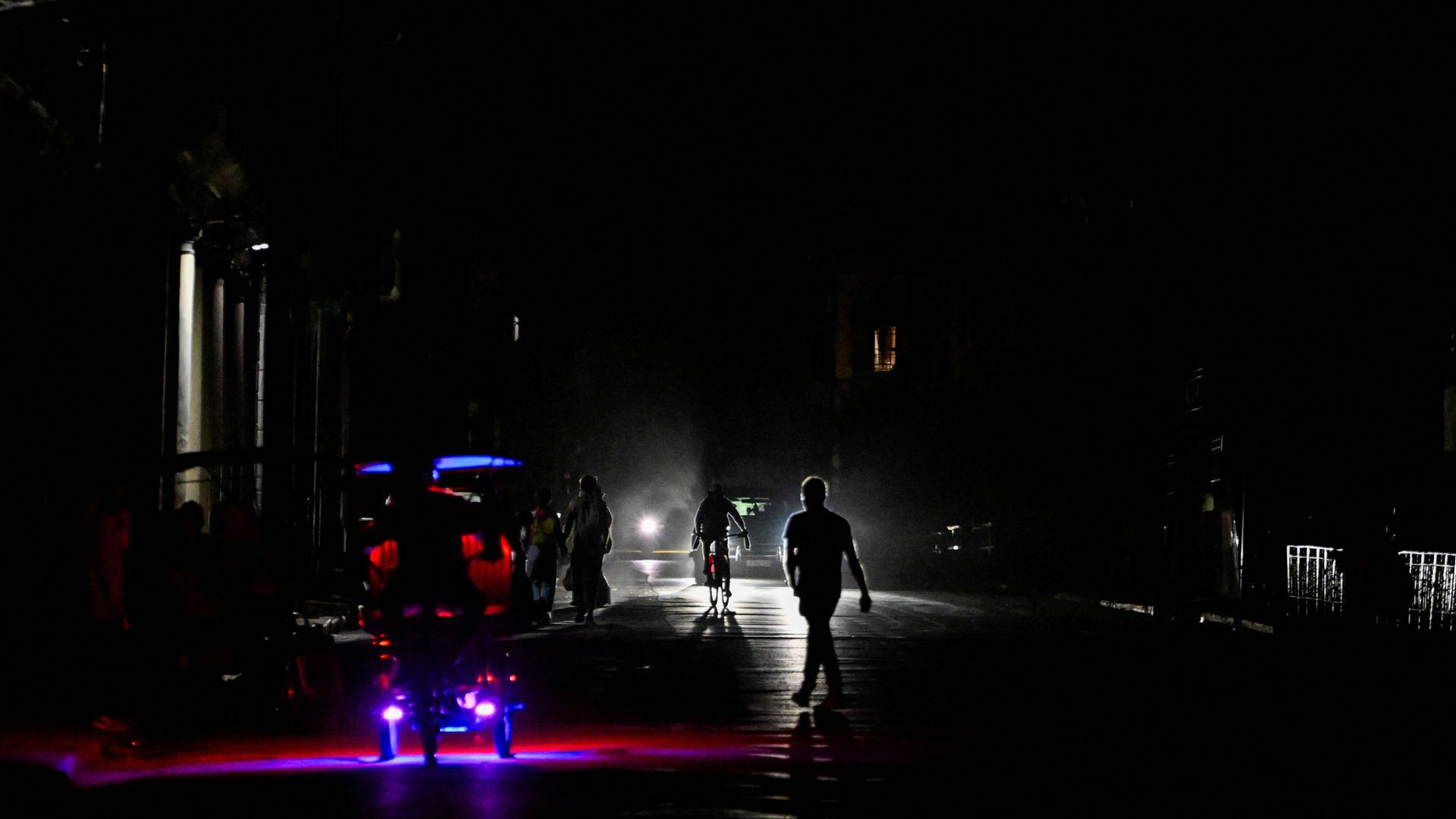
The total failure of the Cuban national electrical grid (SEN - Sistema Eléctrico Nacional) is not a series of isolated technical accidents but the terminal stage of a decades-long capital depreciation cycle. When a national grid undergoes three total collapses within a single month, the primary constraint is no longer fuel liquidity or weather events; it is the loss of "dynamic stability"—the system's ability to absorb minor fluctuations without cascading into a zero-state. Cuba’s energy crisis serves as a case study in how centralized infrastructure reaches a point of non-linear decay, where the cost of maintenance exceeds the total economic output of the utility.
The Triad of Grid Vulnerability
To understand why the Cuban grid fails repeatedly, we must categorize the crisis into three distinct operational pillars: Generation Deficit, Transmission Fragility, and Input Volatility.
1. Generation Deficit and the Thermal Aging Curve
The backbone of the Cuban power system relies on eight large-scale thermoelectric plants (TEPs), such as the Antonio Guiteras and Felton facilities. The average age of these units exceeds 40 years, placing them well beyond their designed lifecycle of 25–30 years.
- Thermodynamic Inefficiency: Aging boilers and turbines suffer from thermal fatigue, leading to frequent "forced outages" (salidas imprevistas).
- Maintenance Backlog: Due to a lack of foreign currency, critical components—specifically high-pressure seals, turbine blades, and control systems—are patched rather than replaced. This creates a "fragile uptime" where the plant operates at reduced capacity (derated) to prevent a catastrophic blowout.
- Desalination Failure: Thermoelectric plants require ultrapure water for steam generation. Failures in water treatment subsystems often lead to internal corrosion, necessitating immediate shutdowns to prevent permanent engine loss.
2. Transmission Fragility and Frequency Instability
A power grid must maintain a precise frequency (60Hz in Cuba). When demand exceeds supply, the frequency drops. If it drops below a critical threshold, protective relays automatically disconnect sections of the grid to prevent damage to generators.
In a healthy system, this is managed through "spinning reserves"—extra capacity that can be throttled up instantly. Cuba has zero spinning reserves. When a major plant like Antonio Guiteras trips, the sudden loss of hundreds of megawatts creates a frequency sink. The remaining smaller plants cannot compensate for the inertia loss, leading to a "black start" requirement across the entire island.
3. Input Volatility and the Crude Oil Mismatch
Cuba’s reliance on domestic heavy crude oil is a double-edged sword. While it reduces reliance on certain imports, Cuban crude is high in sulfur and metals.
- Corrosive Feedstock: Burning high-sulfur oil accelerates the degradation of boiler tubes, requiring more frequent cleaning and maintenance cycles than units burning light sweet crude or natural gas.
- The Logistics Bottleneck: Dependence on floating power plants (Turkish Karadeniz Powerships) provides a temporary buffer, but these units require stable fuel deliveries and hard currency payments. When tankers are delayed or credit lines are frozen, these "plug-and-play" solutions become idle assets.
The Mechanics of a Total Grid Collapse
A total blackout (un apagón total) is the result of a "cascading failure." This occurs through a specific sequence of physical events:
- Trigger Event: A high-capacity transmission line fails or a major generator trips due to a mechanical fault.
- Overload Redistribution: The load formerly carried by the failed unit shifts to the remaining units.
- The Frequency Death Spiral: Remaining units, already operating at near-maximum capacity, cannot handle the surge. Rotational speed in the turbines slows, frequency drops, and automated safety systems disconnect the generators to prevent the physical destruction of the turbines.
- Islanded Mode Failure: Attempts to isolate provinces into independent "micro-grids" or "islands" often fail because these smaller regions lack the internal generation-to-load balance necessary to stay synchronized.
The Economic Feedback Loop of Darkness
The energy crisis is a self-reinforcing economic drain. The "Cost of Unserved Energy" (CUE) in Cuba is currently immeasurable because it has moved beyond industrial downtime into the destruction of basic supply chains.
- Industrial Paralysis: Manufacturing and food processing stop entirely during blackouts. Since these industries generate the exports needed to buy fuel, the blackout directly reduces the state's ability to prevent the next blackout.
- The Cold Chain Collapse: Without refrigeration, the domestic food supply rots. This necessitates increased emergency food imports, further diverting capital away from grid modernization.
- Operational Complexity of Black Starts: Restarting a dead grid is a high-risk technical maneuver. It requires "starting power" from small diesel generators to slowly synchronize larger plants. Each failed attempt to restart the grid (of which there were several in the recent month) causes thermal stress on the equipment, shortening the remaining life of the units.
Distributed Generation as a Failed Stopgap
In the mid-2000s, Cuba pioneered a "Energy Revolution" based on distributed generation (thousands of small diesel and fuel-oil engines across the country). While this was intended to provide resilience, it has become a liability.
- Fuel Distribution Logistics: Moving fuel by truck to thousands of small sites is significantly less efficient than piping it to a few large plants.
- Maintenance Dispersion: It is harder to maintain 2,000 small engines than five large ones. The lack of spare parts for these decentralized units has led to a high "graveyard" rate for small generators.
The Infrastructure Dead-End
The current strategy of "emergency repairs" is a tactical response to a structural problem. There is no mathematical path to grid stability using the current fleet of thermoelectric plants. Even if fuel were unlimited, the physical infrastructure is too degraded to provide a consistent base load.
To restore functionality, the system requires a complete transition to a different energy mix, likely involving high-penetration renewables coupled with massive battery storage or a complete replacement of the thermal fleet with modern combined-cycle gas turbines. However, the capital expenditure required for this—estimated in the billions of USD—is currently unavailable due to the country's credit rating and external economic pressures.
Strategic Forecast for Energy Security
The data suggests that Cuba is entering a period of "managed decay," where the national grid will cease to exist as a unified entity. The likely evolution follows three phases:
- Fragmentation: The SEN will de-facto split into regional micro-grids. Tourism hubs and high-value zones will be prioritized with dedicated floating generation, while rural areas face indefinite "load shedding" (rotating blackouts).
- Privatized Insulation: Small businesses and wealthy households will move entirely toward off-grid solar and lithium-ion storage, creating a tiered society of "energy haves and have-nots."
- Asset Cannibalization: Maintenance crews will be forced to strip parts from non-functioning plants to keep the "least-broken" units online, accelerating the total decommissioning of the peripheral grid.
The immediate strategic priority for any entity operating within this environment is the abandonment of grid-dependence. Infrastructure resilience in Cuba is now synonymous with total energy autonomy; any strategy relying on the "restoration" of the centralized SEN is based on a fundamental misunderstanding of the physical state of the assets. The grid is not just broken; it is entering a state of entropic exhaustion from which there is no low-cost recovery. Expect the frequency of "total system failures" to increase as the thermal stress of restart cycles creates new fractures in the remaining core units.