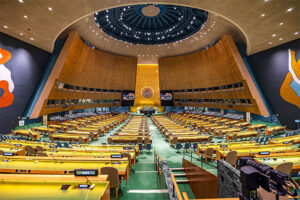
International governance operates under conditions of severe resource constraints, where agenda space functions as a scarce economic commodity. When high-level diplomatic forums allocate attention toward hypothetical future systemic risks, they invariably extract capital, administrative bandwidth, and policy prioritization from current structural failures. The diplomatic positioning surrounding the United Nations General Assembly highlights a recurring systemic misallocation: the elevation of speculative existential risks over measurable, ongoing human rights regressions.
Evaluating this dynamic requires moving past rhetorical posturing to analyze the actual mechanics of international policy formation. Agenda dominance by speculative tech narratives and autonomous weapons frameworks crowds out legislative execution for existing treaty obligations, specifically regarding gender equality and institutional protections for women. Understanding this displacement requires examining how governance frameworks process threat perception, resource allocation, and priority ranking at the multilateral level.
The Economics of Multilateral Agenda Allocation
Diplomatic bandwidth is finite. The General Assembly maintains a strict temporal ceiling, limiting the number of substantive resolutions, committee hearings, and ministerial interventions it can accommodate during a session. When member states introduce novel, highly technical, or speculative paradigms—such as the alignment dynamics of artificial superintelligence or the preemptive regulation of lethal autonomous weapon systems—they occupy institutional mindshare that would otherwise target codified legal frameworks.
This competition for attention creates a zero-sum trade-off. Every hour spent debating the theoretical limits of machine consciousness or the remote future of algorithmic governance is an hour diverted from enforcing the Convention on the Elimination of All Forms of Discrimination Against Women or monitoring state-sponsored rollbacks of reproductive autonomy.
To model this dynamic, consider the attention economy of international diplomacy through an opportunity cost framework:
- Fixed Institutional Capacity: The total number of working groups, drafting committees, and high-level plenaries remains bounded by operational realities.
- Variable Salience: High-drama, frontier-technology narratives attract immediate media amplification and executive-level sponsorship from powerful state actors.
- Decay of Routine Enforcement: Mundane, bureaucratic enforcement mechanisms for existing human rights treaties suffer from neglect because they lack the novelty value required to capture leadership focus.
Consequently, shifting the center of gravity toward speculative existential risks acts as a structural tax on existing human rights infrastructure. The more resources directed toward hypothetical threats, the weaker the monitoring apparatus protecting marginalized populations becomes.
The Asymmetry of Threat Perception
The dominance of futuristic threats in diplomatic discourse stems from a fundamental bias in risk assessment: the preference for novel, catastrophic hypotheticals over continuous, quantifiable harms.
Artificial intelligence governance and autonomous military hardware present clean, technologically deterministic narratives. They appeal to technocratic elites who prefer engineering-style solutions to complex social and political friction. By framing global instability as a technical coordination problem solvable through algorithmic alignment or international arms control treaties for robotics, states can sidestep the intractable political confrontations required to address institutionalized discrimination, gender-based violence, and systemic disenfranchisement.
Human rights violations, conversely, lack the seductive novelty of frontier technology. They are messy, deeply embedded in local legal traditions, and frequently implicate powerful domestic political constituencies within member states. It is politically convenient for governments with regressive domestic human rights records to pivot the international conversation toward futuristic tech safety. Participating in global panels on superintelligence costs a repressive regime nothing in terms of immediate internal reform, whereas committing political capital to women’s rights initiatives demands structural concessions
Strategic Misallocation at UNGA 81 The Displacement of Human Capital Risk by Technocratic Distraction
news, technology
{}
International summit agendas are economic markets of attention. When the United Nations General Assembly convenes its high-level debates, state actors and multilateral organizations allocate finite diplomatic capital, media saturation, and legislative priority across a competing vector of global crises. The curation of this agenda dictates institutional resource allocation for the subsequent fiscal year.
During the eighty-first session, the dominant thematic architecture tilted aggressively toward speculative technological governance. Ministerial panels, plenary addresses, and specialized working groups disproportionately weighted artificial general intelligence safety and autonomous lethal weapons systems. This concentration of discourse crowded out the operational mechanics of human rights enforcement, specifically institutional protections for women in conflict zones and transition economies. Treating this imbalance as a mere oversight misdiagnoses the structural incentive systems driving international diplomacy. The prioritization of speculative existential risk over immediate structural protection represents a calculated displacement of political capital toward domains yielding higher reputational returns with lower localized diplomatic friction.
The mechanics of diplomatic agenda-setting operate on a return-on-investment framework where the currency is global visibility. Addressing structural disenfranchisement, gender-based violence as a weapon of war, and systemic exclusion from economic participation requires long-horizon legal enforcement, financial commitments, and direct confrontation with sovereign governance models. By contrast, debating speculative frontiers like superintelligence and autonomous weaponry offers a frictionless alternative. These topics allow state delegates to project forward-looking regulatory leadership without imposing enforceable obligations or destabilizing bilateral trade relations.
This dynamic creates a severe resource misallocation across three distinct dimensions.
First, normative attention is diverted from quantifiable harms with active casualty rates to probabilistic, unquantifiable future contingencies. While autonomous weapons and algorithmic alignment present legitimate long-term governance challenges, their current policy footprint remains largely theoretical compared to the systemic dismantling of legal protections for women in active conflict theaters. The valuation model applied by multilateral committees systematically discounts immediate human capital degradation in favor of high-tech futurism.
Second, the structural exclusion of women from peacebuilding frameworks degrades the quality of institutional outcomes. Empirical data from post-conflict reconstruction cycles consistently demonstrates that peace accords involving diverse demographic representation exhibit lower rates of recidivism and higher economic stability indexes. When international bodies marginalize these vectors to accommodate technocratic panels, they compromise the tactical efficacy of every subsequent intervention.
Third, the institutional apparatus required to police technological domains borrows capital and administrative bandwidth from human rights monitoring bodies. Human rights watchdogs operate under constrained operational budgets. When diplomatic capital shifts toward establishing new regulatory bureaucracies for emerging technologies, legacy protective frameworks experience budget contractions and staffing deficits.
To correct this strategic blind spot, multilateral governance bodies must restructure their evaluative criteria. Agenda prioritization ought to be governed by a severity-multiplied-by-immediacy coefficient rather than media saturation metrics. Until international forums penalize the substitution of tangible human security for speculative technological anxiety, structural rights abuses will continue to subsidize the rhetorical ambitions of global elites.


