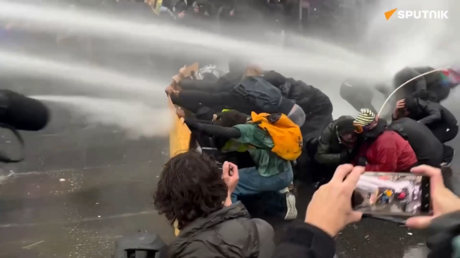
The return of young protesters to Italian streets is not an episodic flare-up of student dissatisfaction; it is the predictable kinetic output of a multi-decade macroeconomic insolvency. When a state systematically subordinates labor market liquidity, educational return on investment, and intergenerational fiscal equity to preserve legacy entitlements, street mobilization becomes the rational market clearing mechanism for political grievance. Standard media narratives treat these demonstrations as isolated cultural reactions to specific legislative triggers—such as university funding adjustments, labor decree modifications, or geopolitical alignments. That framing misdiagnoses the symptom as the disease. To understand the recurrence and escalating intensity of Italian youth protests, analysts must map the underlying structural bottlenecks: depressed wage elasticity, rigid dual-tier labor segmentation, demographic dependency ratios, and the collapse of institutional representation channels.
The Architecture of Intergenerational Fiscal Extraction
Every advanced economy operates on an implicit intergenerational contract where current workers fund current retirees with the expectation of reciprocal support and capital accumulation. In Italy, this contract has fractured due to compounding demographic asymmetry and sovereign debt servicing constraints. Also making news in related news: Why Blaming Level Crossing Crashes on Bad Drivers Is a Deadly Lie.
Italy maintains one of the highest median ages in the European Union alongside a public debt-to-GDP ratio consistently hovering near 140 percent. These two variables create an inescapable fiscal vise. Government expenditure is structurally locked into non-discretionary categories: pension obligations and debt interest payments. Because pension outlays consume roughly 15 to 16 percent of Italy’s GDP—substantially above the OECD average—the fiscal bandwidth remaining for productive capital expenditure, research and development, and primary-to-tertiary education is severely compressed.
This creates a direct resource transfer mechanism from low-asset, high-potential demographic cohorts to high-asset, fixed-income demographic cohorts. For an Italian citizen under the age of thirty, the state functions less as an incubator of upward mobility and more as a tax-collection apparatus servicing historical liabilities. When university budgets face real-term stagnation or tuition structures fail to offset declining instructional quality, students are reacting to a degraded value proposition. They are paying into a fiscal system that offers diminishing marginal returns on human capital development. Further details on this are detailed by USA Today.
The Three Bottlenecks of the Italian Labor Entry Pipeline
Youth mobilization is heavily correlated with the friction encountered during the transition from academic credentialing to stable economic production. In Italy, this transition is obstructed by three distinct structural mechanisms.
Dual-Tier Labor Market Segmentation
Successive labor market reforms over the past three decades—ranging from the Treu Package to the Biagi Law and the Jobs Act—attempted to reduce unemployment by introducing contractual flexibility at the margins rather than reforming core protections. The unintended consequence was a bifurcated labor market. Older cohorts retained open-ended contracts (contratto a tempo indeterminato) fortified by strong dismissal protections and seniority-based wage progression. Conversely, new entrants were funneled into precarious, fixed-term arrangements, unpaid or underpaid internships (stage), and quasi-subordinate freelance contracts (Partita IVA). This segmentation shifts the entire burden of macroeconomic volatility onto the youngest workers. During economic contractions, firms adjust headcount by simply declining to renew temporary youth contracts, insulating legacy staff while generating acute income instability for anyone under thirty-five.Real Wage Stagnation and Credential Inflation
Italy is the only major OECD economy where real wages have declined over the past thirty years. Entry-level compensation for university graduates frequently fails to clear the cost of living in primary urban economic centers such as Milan, Rome, or Bologna. Simultaneously, the domestic corporate structure—heavily weighted toward micro, small, and medium-sized enterprises (SMEs) operating in traditional, low-margin sectors—exhibits low absorption capacity for advanced STEM and management talent. This mismatch produces credential inflation: young workers accumulate higher degrees to compete for jobs that neither require advanced specialization nor pay a skill premium. The resulting frustration is not merely financial; it is a collapse of expected social status.The Housing Cost-to-Income Divergence
In university cities and major employment hubs, residential rental markets have decoupled from local wage realities. The expansion of short-term tourist rentals, combined with rigid urban zoning laws and insufficient purpose-built student housing, has driven urban rent-to-income ratios past critical thresholds. When a student or junior professional must allocate 50 to 65 percent of net income solely to securing basic shelter, disposable income vanishes, household formation is delayed indefinitely, and geographic mobility within the country becomes economically unviable. Street protests organized around tent encampments outside universities are a direct physical manifestation of this spatial exclusion.
Why Institutional Channels Fail to Absorb Grievance
In a functional representative democracy, acute economic grievance among a distinct demographic cohort is captured by political parties, trade unions, or civic associations, translated into legislative platforms, and resolved through electoral competition. In Italy, these institutional shock absorbers have failed, leaving extra-parliamentary mobilization as the primary remaining option.
Demographic Electoral Marginalization
Political parties are rational vote-maximizing entities. In an aging electorate where voters over the age of fifty-five vastly outnumber voters under thirty-five, party platforms naturally optimize for the median older voter. Policies that protect pension indexation, resist property taxation, or preserve incumbent occupational licenses yield immediate electoral dividends. Conversely, policies designed to liberalize labor entry, reform university governance, or subsidize youth housing require upfront fiscal outlays whose political returns materialize over a ten-to-fifteen-year horizon—far beyond the standard Italian electoral cycle of less than two years. Consequently, youth-centric policy demands are systematically discounted across the political spectrum.
Trade Union Representation Gaps
Historically, Italy’s major labor confederations (CGIL, CISL, UIL) acted as the primary organizing vehicles for working-class discontent. However, their membership bases have aged substantially, with retirees frequently accounting for roughly half of total union enrollment. Because union bargaining strategies prioritize the defense of existing industrial contracts and pension entitlements, precarious youth workers and students remain structurally underrepresented in formal tripartite negotiations with the state and employer associations. Without institutional bargaining power at the negotiating table, young cohorts lack leverage unless they disrupt public order.
The Mechanics of Modern Protest Mobilization
Lacking institutional backing, contemporary Italian youth movements rely on decentralized network dynamics that alter both their tactical execution and their strategic vulnerability.
- Trigger Events vs. Structural Fuel: Specific legislative actions—such as adjustments to school-to-work alternation programs (PCTO), security decrees restricting public assembly, or foreign policy alignments—act as synchronization mechanisms. They provide a shared focal point that allows dispersed grievances to coalesce into coordinated physical gatherings across multiple cities simultaneously.
- Asymmetric Disruption Tactics: Because student collectives and precarious worker networks cannot execute traditional industrial strikes that halt manufacturing output, they deploy high-visibility, low-cost disruption tactics. Occupying university lecture halls, blocking transit nodes, and staging symbolic encampments maximize media amplification relative to the number of active participants.
- The Absence of Hierarchical Command: Decentralized organizing via encrypted messaging platforms allows rapid mobilization without identifiable leadership structures. While this insulates the movement against targeted state co-optation or preemptive legal neutralization, it creates a severe strategic handicap: the inability to negotiate binding concessions.
Operational Limitations and Strategic Vulnerabilities
Analyzing these protests through a rigorous operational lens exposes critical flaws that limit their capacity to force systemic legislative change. Mobilization is not equivalent to political power.
First, episodic energy decay plagues student-led movements. Because participation is tied to academic calendars and transient life stages, organizational memory resets every three to four years. A cohort that masters street logistics and media framing graduates or emigrates, forcing the next cohort to rebuild operational capacity from zero. State institutions, possessing permanent bureaucratic continuity, simply outwait the protest cycle.
Second, coalition fragmentation prevents the formation of a unified negotiating front. Youth demonstrations routinely bundle incompatible ideological demands—combining housing affordability, anti-austerity economics, climate transition mandates, and international geopolitical grievances into a single protest platform. While this broad tent maximizes initial crowd size, it dilutes policy specificity. Lawmakers cannot negotiate with a movement that lacks a prioritized, actionable legislative term sheet.
Third, the exit valve of emigration continuously drains the domestic movement of its most capable organizers. Unlike previous generations of Italian youth who had to fight domestically to alter their economic trajectory, contemporary young Italians operate within the European Union’s single labor market. High-agency individuals facing domestic wage stagnation increasingly choose geographic exit over political voice. Over the past decade, hundreds of thousands of young Italians—disproportionately holding tertiary degrees—have relocated to northern Europe and North America. This brain drain relieves acute pressure on the domestic political system by exporting the exact demographic cohort most capable of leading sustained institutional reform.
Strategic Imperatives for Institutional and Corporate Actors
For policymakers, university administrators, and corporate leaders operating within Italy, treating youth street protests as a transient public order issue is a strategic error. The underlying demographic and fiscal drivers guarantee recurring volatility. Stabilizing the operating environment requires targeted structural interventions rather than rhetorical concessions.
1. Re-engineer the Entry-Level Compensation Floor
Corporate leadership in high-value sectors cannot rely on national collective bargaining agreements (CCNL) to attract and retain junior talent. Organizations must unilaterally abolish unpaid or sub-subsistence internships, establish transparent multi-year wage progression bands tied to measurable skill acquisition, and localize compensation packages to reflect urban housing realities. Firms that absorb this margin compression upfront will capture an asymmetric advantage in talent retention while competitors suffer high attrition and reputational damage.
2. Decouple Student Housing from Speculative Tourism Markets
Municipal governments and university administrations must treat student housing supply as critical economic infrastructure. This requires accelerating public-private partnerships to convert underutilized state-owned real estate into high-density student residences, paired with strict zoning caps on short-term rental conversions in university districts. Increasing supply elasticity is the only durable mechanism to compress urban rent-to-income ratios without distorting broader residential property markets.
3. Transition from Precarious Margins to Unified Progressive Contracts
Legislative reform must eliminate the regulatory arbitrage that incentivizes firms to cycle through temporary youth contracts. Replacing fragmented entry-level contract types with a single open-ended contract featuring gradually increasing employment protections over a three-to-five-year tenure aligns employer risk management with worker stability. This removes the structural cliff that currently triggers mass youth layoffs during minor economic downturns.
Until Italy alters the fundamental fiscal math governing intergenerational resource allocation and labor market entry, street mobilization will remain a permanent feature of its domestic landscape. Observers should track three leading indicators to forecast the next escalation cycle: urban rent-to-entry-wage ratios in Milan and Bologna, net youth emigration statistics published by ISTAT, and real per-student state university funding. When all three metrics deteriorate simultaneously, institutional containment fails and street disruption becomes inevitable.