Antoni Gaudí’s design for the Basílica i Temple Expiatori de la Sagrada Família operates not as a mere aesthetic monument, but as a highly optimized structural computer engineered decades before the advent of digital processing. Standard architectural critique treats the cathedral as a work of religious mysticism or organic surrealism. This view misinterprets the core methodology. Gaudí utilized empirical physics, geometric optimization, and biomimetic structural engineering to solve the fundamental problem of Gothic architecture: the handling of lateral thrust without the use of external flying buttresses.
By analyzing the monument through a framework of load distribution, material science, and geometric logic, we can isolate five distinct engineering systems that define the structure's hidden mechanics.
1. The Catenary Optimization Framework
Traditional Gothic cathedrals rely on pointed arches and heavy flying buttresses to redirect the outward lateral forces generated by massive stone vaults down to the ground. This system requires significant external bracing, which limits interior light and demands massive structural footprints. Gaudí eliminated the need for these external supports by applying a strict catenary and parabolic optimization framework.
A catenary is the natural curve assumed by a perfectly flexible cord suspended between two points under the influence of gravity. When inverted, this curve forms a pure compression arch. Because the shape mirrors the line of thrust perfectly, the internal stresses are entirely compressive, eliminating destructive tensile forces that stone cannot withstand.
[Pure Hanging Chain (Tension)] ---> [Inverted Arch (Pure Compression)]
                                      └──> Result: Zero Lateral Thrust / No Buttresses Needed
To calculate these forms, Gaudí constructed complex stereostatic models using weighted strings and small sacks of birdshot scaled to the weight of the proposed masonry. By suspended these networks upside down, he could observe the exact trajectory of gravity-induced tension. Photographing these models and inverting the images yielded the precise geometry required for pure compression columns and vaults.
The primary limitation of this method is its rigidity regarding live loads, such as seismic activity or wind forces. While the catenary arch handles static dead loads flawlessly, fluctuating lateral wind loads introduce bending moments that the stone must absorb via its sheer mass and internal friction.
2. Arborescent Column Distribution and Materials Grading
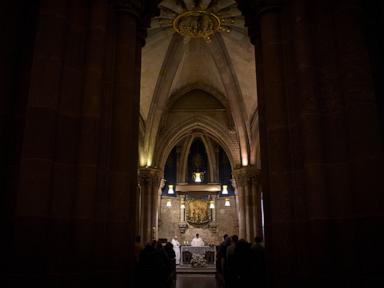
The interior of the Sagrada Familia functions as an explicit tree-like structural matrix. Instead of vertical pillars meeting horizontal beams or traditional rib vaults at right angles, Gaudí’s columns branch out as they ascend, meeting the ceiling vaults at angled trajectories that align directly with the resultant lines of force.
This arborescent system achieves two mechanical objectives:
- It reduces the structural span of the ceiling vaults, allowing the upper canopy to be lighter and more fractured.
- It collects loads from multiple points in the roof and channels them smoothly down into singular, consolidated piers.
The material composition of these columns is not uniform; it is strictly graded based on the calculated weight distribution profile. The structural core utilizes four distinct stone types chosen for their specific compressive strengths ($N/mm^2$):
| Stone Type | Compressive Strength | Structural Location |
|---|---|---|
| Red Porphyry | Exceptionally High | The four central pillars supporting the main crossing and Christ transept |
| Basalt | High | The primary perimeter columns supporting the central nave |
| Montjuïc Sandstone | Medium-High | Outer aisles, decorative elements, and lower-stress vertical shafts |
| Granite | High | Secondary supporting vaults and specific high-wear junctions |
As the columns ascend, their cross-sections transform geometrically to distribute stress evenly. A column starts at the base as a star-shaped polygon with a high number of vertices (e.g., a double-generating 12-pointed star) and, through a series of alternating helical turns, transitions into a circle at the point of branching. This geometric modulation prevents stress concentrations at sharp corners and optimizes the moment of inertia along the length of the shaft.
3. Hyperboloid and Paraboloid Light Manipulation
The vaults of the Sagrada Familia discard traditional spherical or flat geometry in favor of ruled surfaces, specifically hyperboloids, paraboloids, and helicoids. These quadric surfaces are mathematically defined by straight lines moving through space, allowing them to be constructed using straight timber formwork despite their complex, undulating appearance.
The integration of hyperboloids in the ceiling vaults solves a dual structural-lighting bottleneck. A traditional stone vault acts as a solid barrier to light, requiring windows to be placed exclusively on vertical exterior walls. A hyperboloid, however, features an open neck or throat at its center.
Hyperboloid Geometry:
        /      \   <-- Wider outer flare collects external light
       |   ||   |  <-- Narrow throat concentrates stress / focuses light beam
        \      /   <-- Inner flare distributes light across interior surface
This structural void serves a critical purpose:
- Mass Reduction: The removal of stone from the center of the vault reduces the overall dead load acting on the supporting columns.
- Light Directing: The flared geometry acts as a natural acoustic and optical diffuser. Sunbeams entering through the upper clerestory windows strike the hyperbolic curves, which bounce and scatter the light deeply into the nave, minimizing harsh shadows and eliminating the need for massive chandelier arrays at lower levels.
4. Double-Helix Structural Pier Mechanics
The towers of the Nativity and Passion façades do not employ internal solid scaffolding or traditional stone stacking. Instead, they are engineered as hollow, perforated structural tubes that rely on a double-helix geometry to resist high-velocity wind loads coming off the Mediterranean Sea.
The exterior walls of these towers feature long, angled stone louvers (jalousies) inclined at precise angles. This design choice functions as an aerodynamic escape valve. Rather than presenting a solid flat barrier to wind forces—which would create massive overturning moments at the base—the louvers allow air to pass through the outer shell of the tower, deflecting it upward and inward into the central void. This action equalizes pressure differences between the windward and leeward sides of the structure.
Internally, the helical staircases winding up the perimeter of these hollow tubes act as structural stiffeners. They function similarly to the internal ribbing of a modern industrial chimney or the structural bands of a rocket fuselage, preventing the thin stone walls from buckling under compressive stress or twisting under torsional wind loads.
5. The Fractured Tile Mosaic (Trencadís) Elasticity Shell
On the pinnacles and upper exterior surfaces of the basilica, Gaudí implemented trencadís, a technique utilizing broken shards of ceramic tiles, glass, and porcelain set in lime mortar. While frequently discussed as an artistic choice driven by Catalan Modernism, the system serves a vital protective and thermodynamic function for the underlying stone and concrete elements.
The high-altitude pinnacles are exposed to extreme thermal cycling, experiencing intense solar radiation during the day and rapid cooling at night. Solid stone or large uniform ceramic sheets would crack under the resulting thermal expansion and contraction due to the accumulation of internal tensile stress.
The trencadís system introduces an intentionally fractured, multi-jointed surface layer:
- Stress Dissipation: The thousands of micro-joints between the broken tile fragments absorb localized thermal expansion without transferring significant stress to the structural concrete core underneath.
- Impermeable Barrier: The glazed ceramic and glass shards are highly resistant to water penetration, preventing acidic rainwater from entering the structural masonry and corroding internal metal reinforcements or causing freeze-thaw spalling.
- Reflective Coefficient: The highly reflective glaze of the tiles bounces a significant percentage of solar radiation away from the building's peak, reducing the overall thermal load transferred to the interior spaces during peak summer months.
Modern Computational Validation and Strategic Execution
When contemporary structural engineers began the process of completing the unfinished central towers—including the 172.5-meter Tower of Jesus Christ—they subjected Gaudí's original plaster models to finite element analysis (FEA). The digital simulations revealed that the tension-compression vectors calculated by Gaudí’s analog hanging chain models matched modern structural optimization algorithms to within single-digit percentage margins.
To execute the remaining construction within the required safety and time parameters, the project shifted from traditional on-site masonry to a post-tensioned stone panel system. Huge blocks of Montjuïc sandstone and granite are CNC-machined to millimeter tolerances, assembled into composite panels on-site at a logistical facility outside Barcelona, and laced internally with high-strength stainless steel tendons. These bars are tensioned to compress the stone blocks together before the panel is hoisted into place on the towers.
This deployment of post-tensioned stone represents a direct evolution of Gaudí's logic. By artificially introducing compressive stress to the stone modules before they experience wind or gravity loads, the structural engineering team eliminates the possibility of tensile failure entirely. The towers function as monolithic, pre-stressed columns capable of resisting dynamic lateral forces without increasing the thickness—and consequently the dead weight—of the perimeter walls.
For modern architectural and engineering operations, the execution of the Sagrada Familia offers a definitive playbook: do not treat historical materials as obsolete, but use geometric form and pre-stressing mechanics to force ancient mediums to perform at modern industrial thresholds.