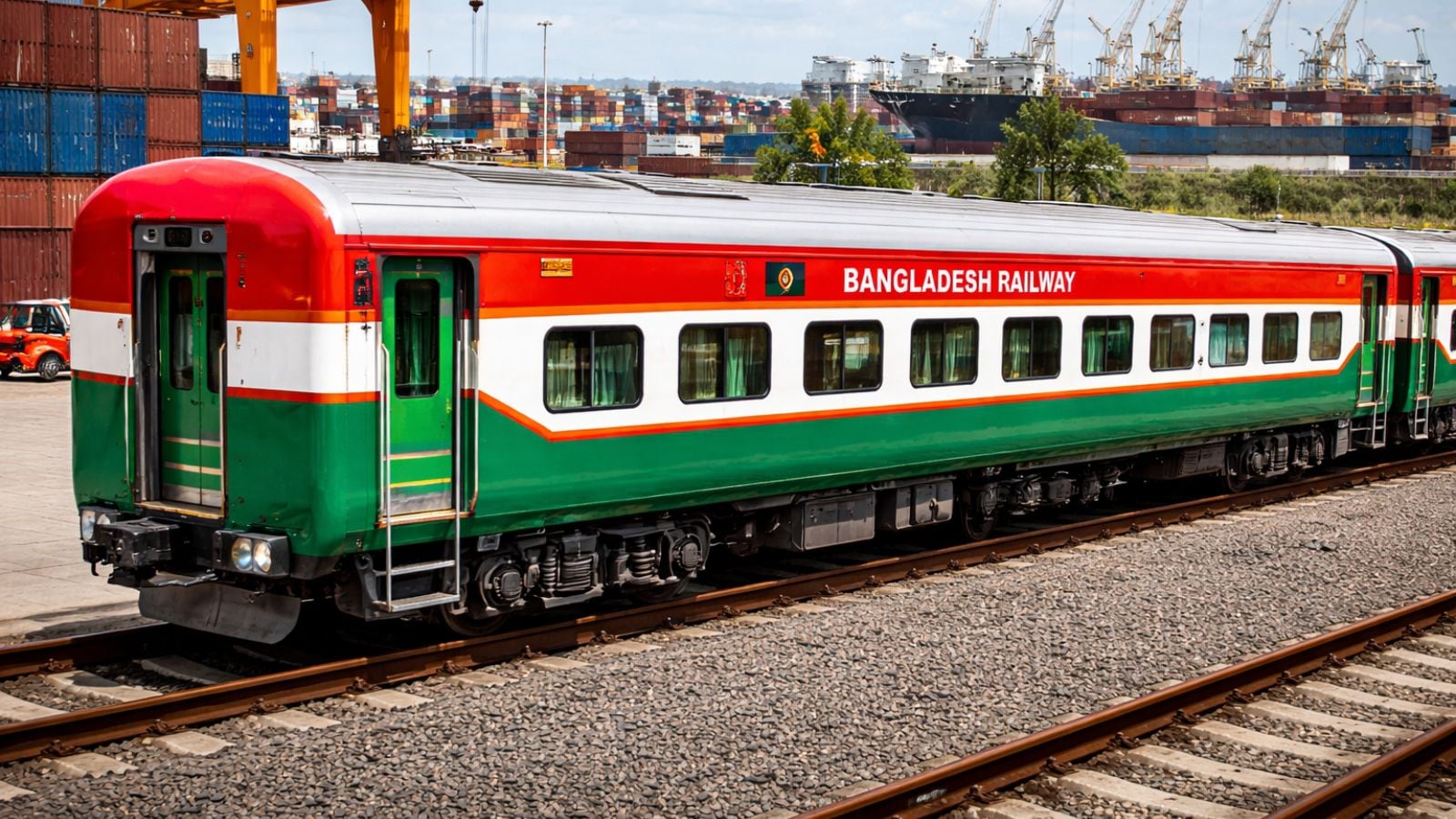
The acquisition of 200 broad-gauge passenger coaches by Bangladesh Railway (BR) from India represents more than a simple procurement exercise; it is a critical intervention in the rolling stock lifecycle management of a national rail network facing a catastrophic equipment deficit. Currently, over 50% of the passenger coaches in the BR inventory have exceeded their economic life of 35 years. This procurement, funded through a 20-billion-taka credit line, serves as a stop-gap measure to prevent a total collapse of service frequency while the state attempts to transition from meter-gauge legacy systems to a unified broad-gauge standard.
The Rolling Stock Deficit Function
The efficiency of a railway network is a function of track capacity, signaling sophistication, and rolling stock availability. In the Bangladeshi context, the third variable is the primary bottleneck. The decision to import 200 broad-gauge coaches is driven by three distinct systemic pressures:
- The Retirement-Replacement Gap: The rate at which aging stainless steel and vacuum-brake era coaches are being decommissioned exceeds the rate of local refurbishment and new procurement. Without this influx, the net fleet size would shrink annually, leading to a "death spiral" where fewer coaches are forced into longer duty cycles, accelerating their mechanical failure.
- Standardization Requirements: Bangladesh is geographically divided by track gauges. The eastern zone is predominantly meter-gauge (1000 mm), while the western zone is broad-gauge (1676 mm). The strategic pivot of the National Railway Master Plan is to convert the entire network to broad or dual-gauge to facilitate regional connectivity with India and the Trans-Asian Railway. These 200 coaches are specifically targeted at the western zone’s capacity expansion.
- Speed and Safety Thresholds: Modern coaches equipped with Linke Hofmann Busch (LHB) technology—the likely standard for this Indian export—offer higher speed potential (160 km/h design speed) and superior crashworthiness compared to the older Integral Coach Factory (ICF) designs currently prevalent in the BR fleet.
Technical Specification and Mechanical Integration
The utility of these 200 coaches depends on their alignment with existing maintenance infrastructure. Modern broad-gauge coaches utilize pneumatic braking systems and modular interiors, which require a specialized maintenance ecosystem. The procurement logic assumes a decrease in the Mean Time To Repair (MTTR) because these units use standardized components that are readily available in the regional supply chain.
The technical superiority of these coaches is anchored in their Anti-Telescopic Design. In the event of a collision, traditional coaches tend to "telescope" or climb on top of one another, resulting in high casualty rates. The LHB-platform coaches utilize center buffer couplers and structural reinforcements that absorb kinetic energy, keeping the coaches upright and on the tracks during a derailment. This shift in safety architecture is a prerequisite for increasing track speeds from the current 80–100 km/h average to the projected 120 km/h operational speeds on the newly upgraded broad-gauge corridors.
The Economic Calculus of Sovereign Credit Lines
The financing of this 200-coach deal through a Government of India (GoI) line of credit introduces a specific set of trade-offs. While the interest rates are typically concessional, the procurement is tied to the lending nation’s manufacturing base. This creates a Vendor Lock-in Effect regarding long-term maintenance and spare parts.
- Initial Capital Expenditure (CAPEX): Lowered by the credit line, allowing BR to bypass immediate budget constraints that would otherwise halt procurement.
- Operational Expenditure (OPEX): Expected to decrease in the short term due to the lower maintenance requirements of new assets compared to 40-year-old coaches.
- Supply Chain Dependency: BR must align its workshop capabilities at Saidpur and Parbatipur with Indian technical standards. This includes retooling for stainless steel welding and electronic control systems for air conditioning and lighting.
The failure to establish local manufacturing or assembly for these coaches represents a missed opportunity for technology transfer. While the 200 imported units solve the immediate capacity crisis, they do not address the underlying dependency on foreign OEMs (Original Equipment Manufacturers).
Operational Constraints and the Signaling Bottleneck
Adding 200 coaches to the inventory does not automatically translate to increased passenger throughput. The relationship between rolling stock and throughput is non-linear. The utility of these new assets is constrained by two factors:
I. The Turnaround Time (TAT) Constraint
A coach only generates revenue when it is in motion. If the terminal facilities at Dhaka (Kamalapur) and Chittagong are congested, these new coaches will spend a disproportionate amount of time idling in yards. Without simultaneous investment in station bypass loops and automated yard management, the marginal utility of the 200th coach is significantly lower than that of the first.
II. The Signaling Threshold
The existing signaling on many broad-gauge sections is still based on mechanical or semi-automated systems. Increasing the number of coaches—and by extension, the number of trains—requires a higher density of blocks. If the signaling system cannot handle more "train paths" per hour, the new coaches will simply lead to longer train compositions (20-22 coaches instead of 14-16) rather than more frequent departures. While longer trains increase capacity, they also strain platform lengths and traction power.
Comparative Reliability: LHB vs. ICF Design
The transition from older ICF-style coaches to the modern LHB-style units included in this deal marks a shift in the Physics of the Ride.
- Weight Dynamics: LHB coaches are made of stainless steel, which is lighter than the carbon steel used in ICF coaches. This reduces the axle load on the tracks, lowering track maintenance costs.
- Braking Systems: The transition from vacuum brakes to disc brakes allows for a significantly shorter braking distance. This is a critical safety factor when operating in the densely populated corridors of Bangladesh, where unauthorized track crossings are frequent.
- Ride Quality: LHB coaches utilize a more sophisticated suspension system (primary and secondary), which minimizes vertical and lateral oscillations. For the passenger, this translates to a "stabler" ride at high speeds, which is essential for competing with the expanding luxury bus market.
The Geopolitical and Regional Logistics Context
This procurement is a sub-component of the broader "Connectivity Gambit" in South Asia. By adopting Indian-standard broad-gauge coaches, Bangladesh Railway ensures seamless interoperability for cross-border services like the Maitree and Mitali Express.
Standardization reduces the friction at the border. If both nations use identical rolling stock and gauge, the need for "transshipment"—the physical movement of goods or passengers from one train to another—is eliminated. This creates a regional rail corridor that could eventually link the landlocked Northeast of India to the Chittagong and Mongla ports. The 200 coaches are the "software" that allows this "hardware" (the tracks) to function as a unified economic engine.
Risk Assessment: Procurement Without Integration
The primary risk to this strategy is Institutional Inertia. Historically, Bangladesh Railway has struggled with "cannibalization," where new coaches are stripped for parts to keep older units running because the procurement of genuine spares is delayed by bureaucratic friction.
Another risk is the Traction Mismatch. These 200 coaches require high-horsepower broad-gauge locomotives to pull them effectively, especially if the plan is to run longer 20-coach rakes. If the locomotive procurement does not keep pace with the coach import, BR will find itself with a surplus of passenger capacity that it cannot physically move.
The success of the 200-coach import must be measured against the Availability Ratio. If, within three years, the availability ratio of these coaches falls below 90%, the procurement should be deemed a failure of maintenance strategy rather than a failure of the asset itself.
Strategic Execution Path
To maximize the Return on Investment (ROI) for these 200 broad-gauge coaches, the administration must move beyond simple procurement and focus on the following operational imperatives:
- Immediate Decommissioning of "Zombie" Assets: Use the arrival of the 200 new coaches to aggressively retire coaches that are 40+ years old. Keeping obsolete stock in the system clogs yards and consumes disproportionate maintenance hours for marginal gains.
- Digital Maintenance Tracking: Implement a barcode-based inventory and maintenance system for these specific units. Tracking the wear-and-tear of these coaches in real-time will allow for predictive maintenance, avoiding the "break-fix" cycle that plagues the current fleet.
- Traction Synchronization: Accelerate the procurement of broad-gauge locomotives with at least 3000 HP to ensure the new coaches can be utilized in high-capacity, high-speed rakes.
- Loop Line Extension: Prioritize the lengthening of platforms and loop lines at secondary stations to accommodate the longer rakes enabled by the new broad-gauge stock, preventing "bottlenecking" where long trains are held at outer signals because they cannot fit in the station.
The 200-coach import is a tactical victory in a strategic war against infrastructure decay. Its value lies not in the metal itself, but in whether it triggers a total modernization of the operational philosophy of the western zone. Failure to align maintenance, traction, and signaling with this new rolling stock will result in these coaches becoming high-tech relics in an low-tech system.