Torrential monsoonal precipitation events in high-relief mountainous topography do not operate as random acts of meteorological caprice. Instead, they function as predictable failure points within an unstable geological and infrastructural matrix. When severe weather systems batter the fragile ecologies of high-altitude ranges, the resulting casualties and infrastructural collapses expose systemic vulnerabilities in land-use planning, slope stabilization, and early-warning dissemination. Analyzing these compounding crises requires moving past descriptive reporting to examine the structural mechanics of mass-wasting events, riverine surges, and logistical isolation.
The Geomechanical Equation of Slope Failure
Landslides and debris flows are governed by the ratio of shear stress to shear strength along potential failure planes within a soil or rock mass. Persistent, high-intensity rainfall alters this equation through two distinct physical mechanisms: pore-water pressure elevation and soil matrix saturation.
As water infiltrates colluvial and residual mantle layers, it increases the pore-water pressure. This effectively reduces the effective normal stress holding soil particles together, diminishing frictional resistance along the slip surface. Concurrently, weight increases as dry or partially saturated voids fill with water, augmenting the gravitational driving force downward along the slope.
When rainfall intensity exceeds the saturated hydraulic conductivity of the upper strata, infiltration capacity is saturated, generating unhindered surface runoff. This runoff scours hillslopes, initiates rill and gully erosion, and removes the buttressing toe support of larger unstable slopes. In regions characterized by heavily weathered bedrock and seismic fracturing, such as the mid-hills and high-altitude zones of the Himalayas, even short-duration high-intensity downpours cross critical thresholds of slope stability. The spatial distribution of these failures clusters heavily along anthropogenic alterations, where unengineered road cuts steepen slope angles and disrupt natural subsurface drainage networks.
Hydrological Overload and Fluvial Dynamics
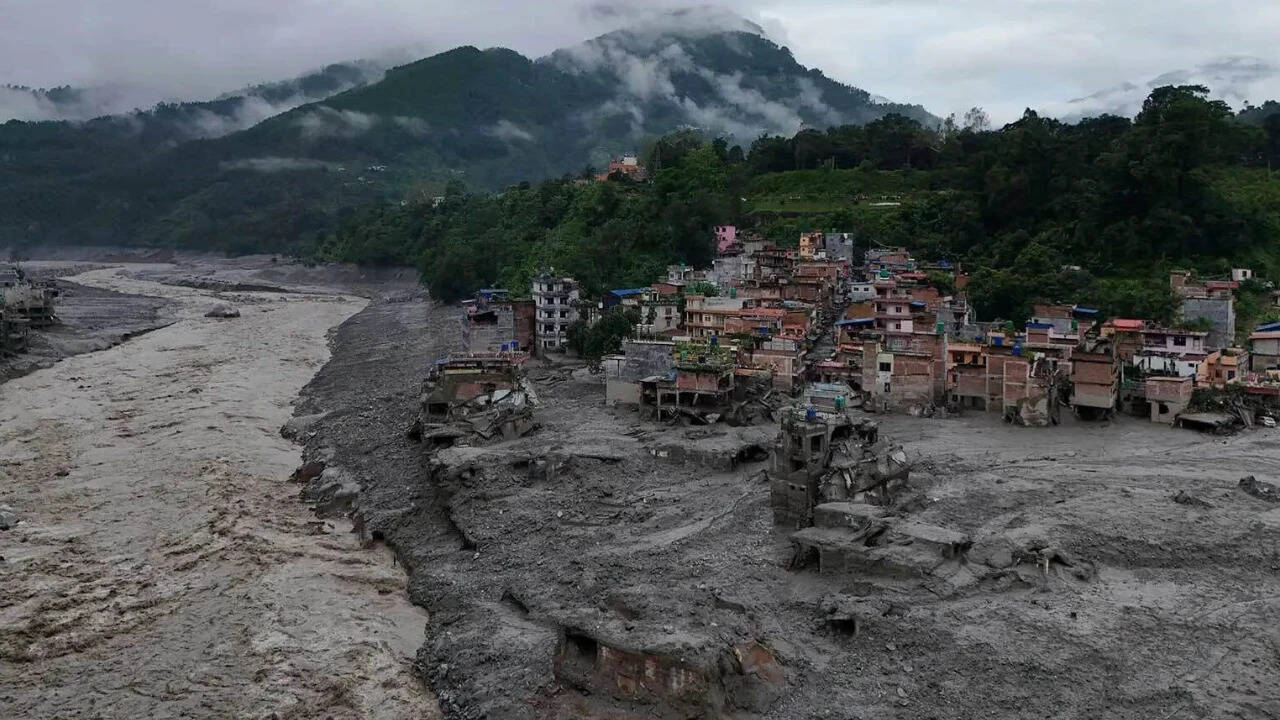
Riverine flooding in narrow mountain valleys follows a rapid hydrograph response characterized by steep rising limbs and high peak discharges. Unlike lowland river systems with broad floodplains that attenuate flood waves through storage, Himalayan river corridors feature restricted cross-sectional areas. When tributary catchments experience simultaneous heavy precipitation, concentrated runoff funnels rapidly into main-stem channels.
This hydraulic concentration produces destructive kinetic energy capable of mobilizing high bedloads of boulders, gravel, and organic debris. The resulting hyper-concentrated flows increase bulk fluid density, amplifying the destructive impact pressure exerted on bank structures, bridge piers, and structural foundations. Furthermore, mass-wasting events that deposit debris directly into river channels generate temporary landslide dams. The subsequent breaching of these natural impoundments triggers catastrophic downstream jökulhlaup-style flood waves, propagating high-velocity surges far beyond the immediate zones of precipitation.
Infrastructural Fragility and Network Vulnerability
Transportation networks in high-relief terrain exhibit high vulnerability due to their linear, constrained topologies. Major arterial highways and strategic trade corridors are typically engineered along river benches or cut directly into the toes of steep mountain slopes. This spatial configuration exposes them to dual hazards: undercutting by lateral river migration and burial by upslope mass wasting.
The systemic failure of bridges, retaining walls, and subgrade foundations creates immediate logistical bottlenecks. When primary corridors are severed at multiple locations, regional distribution networks collapse. Emergency response operations, medical evacuations, and supply chain continuity are severely constrained not simply by the physical blockage of transit points, but by the absence of redundant secondary and tertiary bypass routes. The systemic cost of these disruptions scales non-linearly with the duration of isolation, impacting both immediate humanitarian rescue phases and long-term economic recovery.
Risk Mitigation Through Institutional and Technical Instrumentation
Minimizing life loss during extreme hydro-meteorological events relies on the transition from reactive disaster management to predictive risk mitigation. This operational shift depends on three core technical pillars:
- High-Density Sensor Arrays: Real-time monitoring of rainfall thresholds, soil moisture saturation levels, and river stage heights provides the baseline data necessary to identify impending slope or channel failures before they materialize.
- Automated Early-Warning Cascades: Integrating telemetry data with automated telecommunication routing ensures that warnings reach field responders and downstream populations with minimal latency.
- Zoning and Land-Use Enforcement: Restricting permanent structural development within active alluvial fans, high-risk gully mouths, and unmitigated slip zones eliminates the exposure variable in the disaster risk equation.
Where structural stabilization of entire mountain ranges remains economically and physically unfeasible, resilience engineering must prioritize structural hardening of critical utility nodes, establishment of localized cache networks for isolated communities, and the strict enforcement of seasonal travel restrictions during peak monsoonal anomalies. Comprehensive disaster reduction requires acknowledging that while rainfall intensity is an unalterable meteorological input, vulnerability remains an entirely design-dependent variable.