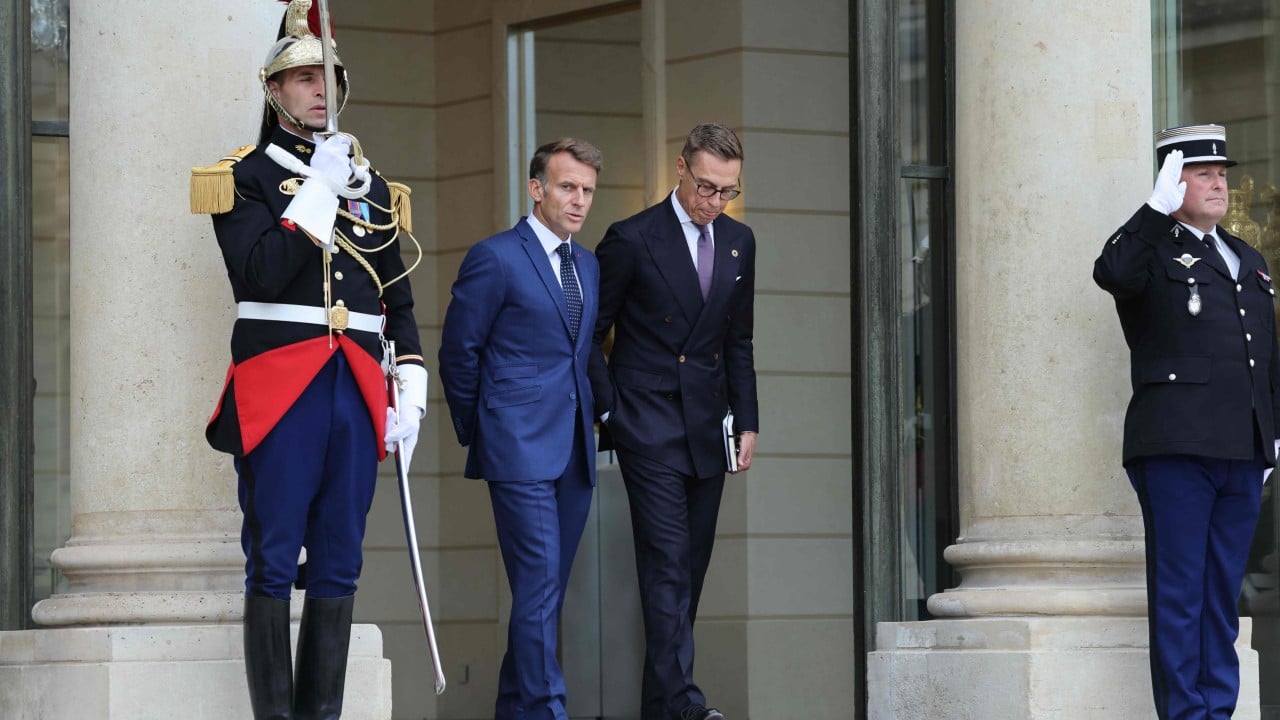
The contemporary European security architecture is experiencing a fundamental structural shift, driven by the erosion of uncritical reliance on traditional security guarantees and the physical expansion of alliance frontiers. When Helsinki officially announced its participation in Paris's forward nuclear deterrence initiative, the move represented far more than a routine diplomatic alignment. It marked a critical juncture in continental defense strategy, testing the operational limits of sovereign nuclear umbrellas outside the formal structures of the North Atlantic Treaty Organization. Deconstructing this shift requires looking past political rhetoric to evaluate the underlying mechanics of deterrence signaling, geographical vulnerability, and escalation control.
The Strategic Calculus of Forward Deterrence
Traditional deterrence theory relies on three distinct variables: capability, credibility, and communication. For decades, the European pillar of deterrence rested almost entirely on the United States extended deterrent, anchored by NATO nuclear-sharing arrangements. However, the shifting political dynamics in Washington and the intensification of conventional conflict on the European continent have exposed a structural vulnerability in this single-source model.
France’s independent nuclear doctrine—formulated around the concept of dissuasion du faible au fort (deterrence of the strong by the weak) and final presidential prerogative—operates on a strictly national basis. By extending this strategic framework through bilateral outreach to frontline states like Finland, Paris is attempting to solve a severe spatial optimization problem. Finland shares a roughly 1,340-kilometer land border with Russia. Integrating a frontline state into a nuclear signaling framework alters the adversary's cost-benefit calculation by shortening the causal chain between conventional provocation and strategic response.
The mechanism operates through strategic ambiguity and political integration rather than immediate physical redeployment. As Finnish leadership has clarified, the policy shift does not necessitate the stationing of nuclear warheads on Finnish soil in peacetime. Instead, the architecture relies on:
- High-level political coordination via newly established bilateral bodies such as the Nuclear Steering Group.
- Doctrinal convergence on escalation management.
- Operational participation in allied exercises that simulate the shadow of nuclear escalation.
The Legislative and Logistical Friction Points
Transitioning from a declaratory policy to an operational framework requires dismantling significant legal and institutional barriers. For Finland, this process began with legislative amendments—specifically the parliamentary adjustments allowing military materiel policy to accommodate the defense requirements of the modern security environment. Yet, legal clearance is merely a baseline requirement; the true friction lies in command-and-control synchronization.
Unlike NATO's Nuclear Planning Group, where non-nuclear allies participate in collective consultations regarding the alliance's overall nuclear posture, the French initiative preserves absolute French sovereignty over employment authority. This creates a distinct asymmetry in the partnership:
- Decision-Making Centralization: The ultimate authority to authorize weapon release remains exclusively in Paris.
- Consultative Integration: Partner nations gain input into crisis signaling, doctrinal alignment, and political framing, but possess no veto over employment.
This asymmetry introduces a credibility challenge. For deterrence to hold, the adversary must believe that the nuclear power treats an attack on the partner state with the same existential gravity as an attack on its own sovereign territory. By formalizing this relationship through structured bilateral mechanisms, France and Finland are artificially constructing that credibility through repeated, highly visible diplomatic and military touchpoints.
The Economic and Opportunity Cost Function
Every strategic alignment involves an implicit allocation of resources and political capital. For France, expanding its deterrent posture increases its diplomatic leverage as the premier security guarantor within the European Union, positioning Paris as the architect of strategic autonomy. However, this posture carries inherent risks. Spreading the political umbrella over an increasing number of non-nuclear states—Finland being the tenth nation to engage with the framework—dilutes the exclusivity of the deterrent and complicates crisis communication channels with nuclear-armed adversaries.
For Finland, the cost function centers on the management of escalation dominance. By tying its national defense directly to a second European nuclear capability, Helsinki diversifies its risk portfolio away from absolute dependence on Washington. Simultaneously, it assumes a heightened profile as a focal point for strategic competition in the Baltic and Arctic regions. The proximity of critical infrastructure, maritime supply lines, and contested airspace means that any deterrence failure carries localized, high-impact consequences.
Operationalizing European Strategic Autonomy
The convergence of French nuclear strategy and Finnish frontline geography exposes the limits of institutional compartmentalization. Traditional models assumed a clean separation between conventional territorial defense, managed via NATO and national armed forces, and strategic nuclear deterrence, managed by superpowers. The current geopolitical reality forces a compression of these domains.
As bilateral working groups translate joint declarations into operational realities, the success of the initiative will be measured not by the volume of political communiqués, but by the resilience of the coordination channels during a crisis. If Europe is to manage regional escalation independently, arrangements must move past declaratory solidarity into hardened, interoperable crisis-response protocols. The immediate strategic imperative for both capitals is to institutionalize these consultative frameworks before shifting threat environments outpace diplomatic adaptation.